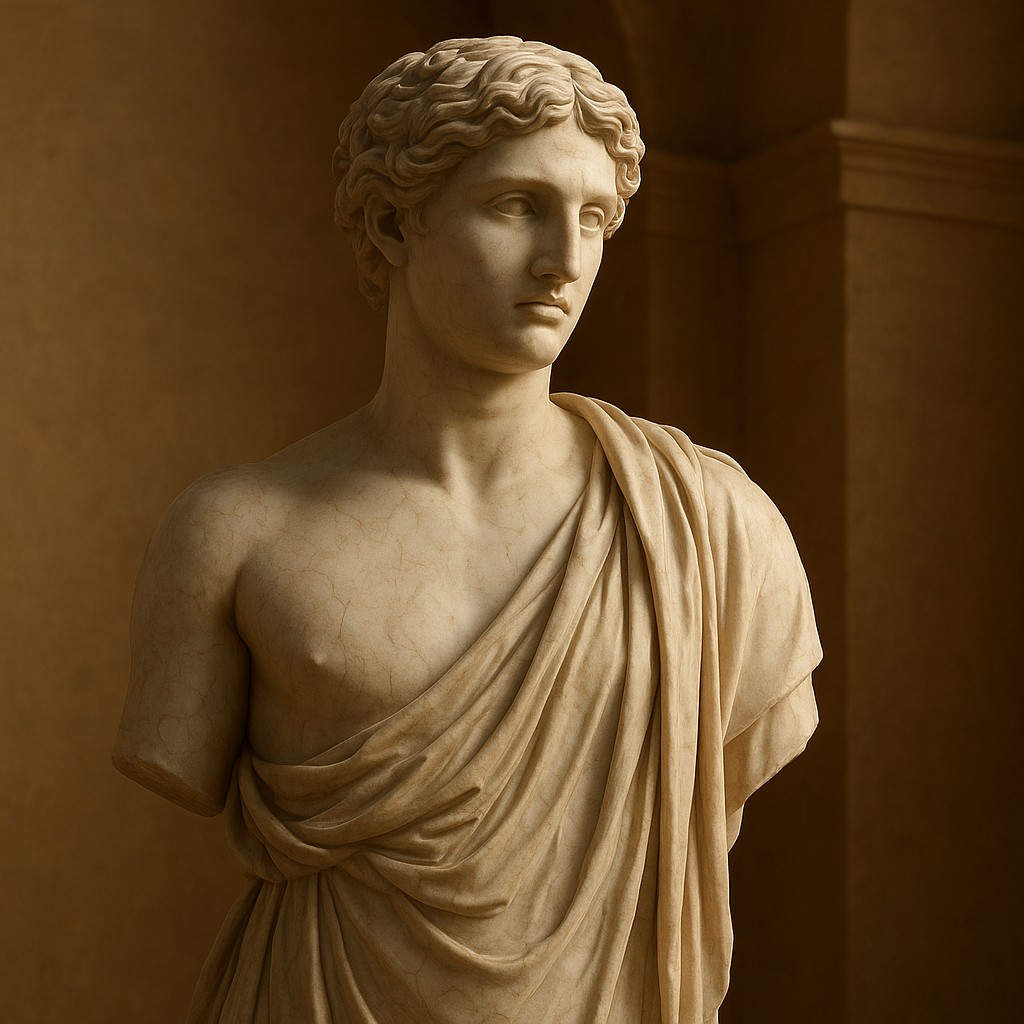
Think of history’s most famous statues: the Venus de Milo with her missing arms, or the Winged Victory of Samothrace, whose head was lost to time. We usually see these missing pieces as tragic casualties of war or neglect. However, they actually tell a much deeper story about physics. When you look at an ancient marble figure that has kept its head, limbs, and delicate details intact for two thousand years, you aren't just looking at a masterpiece of art. You are looking at a feat of structural engineering that has successfully defied the crushing weight of its own material.
While we celebrate the Greeks and Romans for making cold stone look like soft skin, the sculptors themselves were in a constant battle with their medium. Marble is a difficult partner because it has a split personality. It is incredibly strong when you push down on it, but it snaps like a dry twig if you try to stretch or bend it. This weakness meant that every artistic choice, from the tilt of a chin to the thickness of a calf muscle, was a calculated risk. To ensure their work outlasted their civilizations, these artists had to disguise heavy-duty reinforcements as fashion choices or anatomical quirks.
The Fragile Strength of the Stone Giant
To understand why ancient statues look the way they do, we have to look at the chemistry of the rocks. Marble is mostly made of calcite, a crystal that packs together tightly under immense pressure over millions of years. This makes it perfect for "compression," which is the force of weight pushing inward. You can stack marble blocks hundreds of feet high to build the Parthenon because the bottom blocks are stable while supporting everything above them. However, marble is notoriously bad at handling "tension," which happens when forces try to pull a material apart or bend it until it snaps.
In sculpture, tension is the enemy of every outstretched arm and delicate ankle. When a statue stands on two thin legs, the weight of the massive stone torso pushes straight down. But if the statue leans even slightly, that weight turns into a bending force. Because stone cannot stretch, the side of the ankle being pulled apart will develop tiny cracks that eventually lead to a total break. This is the main reason why so many ancient statues are missing hands or noses. These parts act like long levers; the further the weight is from the main support, the more vulnerable it is to the laws of physics.
Disguising the Kickstand and the Strut
If you walk through the Roman galleries of the Louvre or the Met, you might notice a strange trend: many athletic heroes are leaning against random tree stumps or piles of armor. These aren't just decorations meant to tell us about the character's hobbies. They are what engineers call "struts." Because a marble leg is often too brittle to support a 300-pound torso during a minor tremor or a clumsy move by a museum worker, the sculptor added a third point of contact. By connecting the hip to a heavy block disguised as a stump, the artist creates a tripod, spreading the weight and taking the pressure off the ankles.
Beyond these large supports, sculptors used "point-to-point" bracing to protect fragile limbs. You will often see a small, rectangular bridge of stone connecting a statue's wrist to its hip. From a distance, it might look like a mistake or a bit of stone the artist forgot to carve away, but it is actually a vital reinforcement. It stops the arm from vibrating back and forth, which is the most common cause of stone fatigue. By linking the limb to the main body, the sculptor ensures the arm moves in unison with the torso rather than snapping off like a dry branch in the wind.
The Secret Engineering of the Pout and the Thick Neck
The face is the most delicate part of any commemorative work, yet many "pouty-lipped" Roman emperors and thick-necked Greek gods have survived remarkably well. This wasn't just a style choice; it was a way to prevent "shearing," or breaking off. In a stone face, the nose is a high-risk protrusion. A thin, delicate nose has very little surface area connecting it to the face, making it easy to knock off. By carving fuller lips and broader noses, sculptors increased the attachment area, making the features much harder to break.
The neck is another common breaking point. A human head is essentially a heavy stone ball sitting on a thin pedestal. To stop the head from snapping off, ancient sculptors often made the neck thicker than natural or used hairstyles to their advantage. In statues of women from the Flavian period, hair is often piled high in thick coils that blend into the shoulders. This wasn't just a Roman fashion trend; it was a clever way to create a solid column of stone connecting the head to the body. This extra surface area ensures that even if the statue tilts, the neck stays under compression rather than snapping under tension.
Comparing the Survival Odds of Sculptural Features
| Feature |
Structural Risk |
Sculptural Solution |
Why It Works |
| Ankles |
High (Bending/Tension) |
Tree stumps, robes, or vases |
Creates a tripod to share the load. |
| Outstretched Arm |
Critical (Leverage) |
Brace/Strut to the hip |
Stops vibration and reduces weight strain. |
| Neck |
Medium (Shearing) |
Thickened muscles or long hair |
Increases the surface area of the connection. |
| Nose/Chin |
High (Protrusion) |
Compact features, "pouty" lips |
Reduces the length of the lever that can snap. |
| Extended Fingers |
Maximum (Fragility) |
Clenched fists or holding objects |
Bundles thin parts into one solid block. |
The Trade-off Between Realism and Longevity
Every time a sculptor added a support or thickened a limb, they made a trade-off. To make a statue that could survive for 2,000 years, they often had to sacrifice a sense of movement. This is why many marble statues feel "frozen" or stiff compared to bronze ones. Bronze is a metal with high tensile strength, meaning it can bend and stretch without breaking. A bronze statue can stand on one toe with its arms wide because the metal can handle the tension. A marble version of that same pose would collapse under its own weight before the artist finished polishing it.
In fact, many marble statues in museums today are actually "reinforced" copies of lost bronze originals. Roman collectors loved Greek bronze masterpieces, but bronze was expensive and often melted down for weapons during wars. When Roman workshops made marble copies, they had to "translate" the physics. They would take a free-standing bronze athlete and add a tree stump or hip-struts to make the design work in stone. This history of imitation means our understanding of "Classical Art" is shaped by the limits of marble. We see the "pout" and the "stump" and think of them as ancient beauty standards, when they were actually the early versions of a roll cage and a reinforced bumper.
The Mathematics of the Center of Gravity
The final hurdle for any ancient sculptor was the center of gravity. For a statue to stand without being bolted to the floor, its center of mass must stay directly over its base. This sounds simple, but when carving a figure in a "contrapposto" pose - where weight shifts onto one leg - the balance becomes shaky. If the head or an arm reaches too far out, the "moment arm" increases, which can pull the statue over.
Sculptors managed this by slightly distorting human anatomy. They might make one side of the torso slightly heavier or tuck an arm closer to the body to keep the weight centered. They were essentially solving complex 3D physics problems using nothing but their eyes and a chisel. When you stand in front of a heavy marble figure that leans back with casual grace, you are seeing a sculpture balanced so perfectly that the force of gravity passes exactly through the center of its feet. It is a silent, eternal tightrope act.
As you look at the world around you, whether it is a modern skyscraper or an ancient ruin, remember that beauty and durability are rarely accidental. The things we find attractive in ancient art - the strong jawlines, the regal posture, the sturdy presence - are often the survivors' scars from a war against gravity. Every "pout" was a safety measure, and every "stump" was a lifeline. By understanding the mechanics behind these masterpieces, you can appreciate the genius of the ancients not just as artists, but as the first great structural engineers of the human form. Nature tries to pull everything down, but with enough foresight and a few clever supports, we can make stone stand forever.