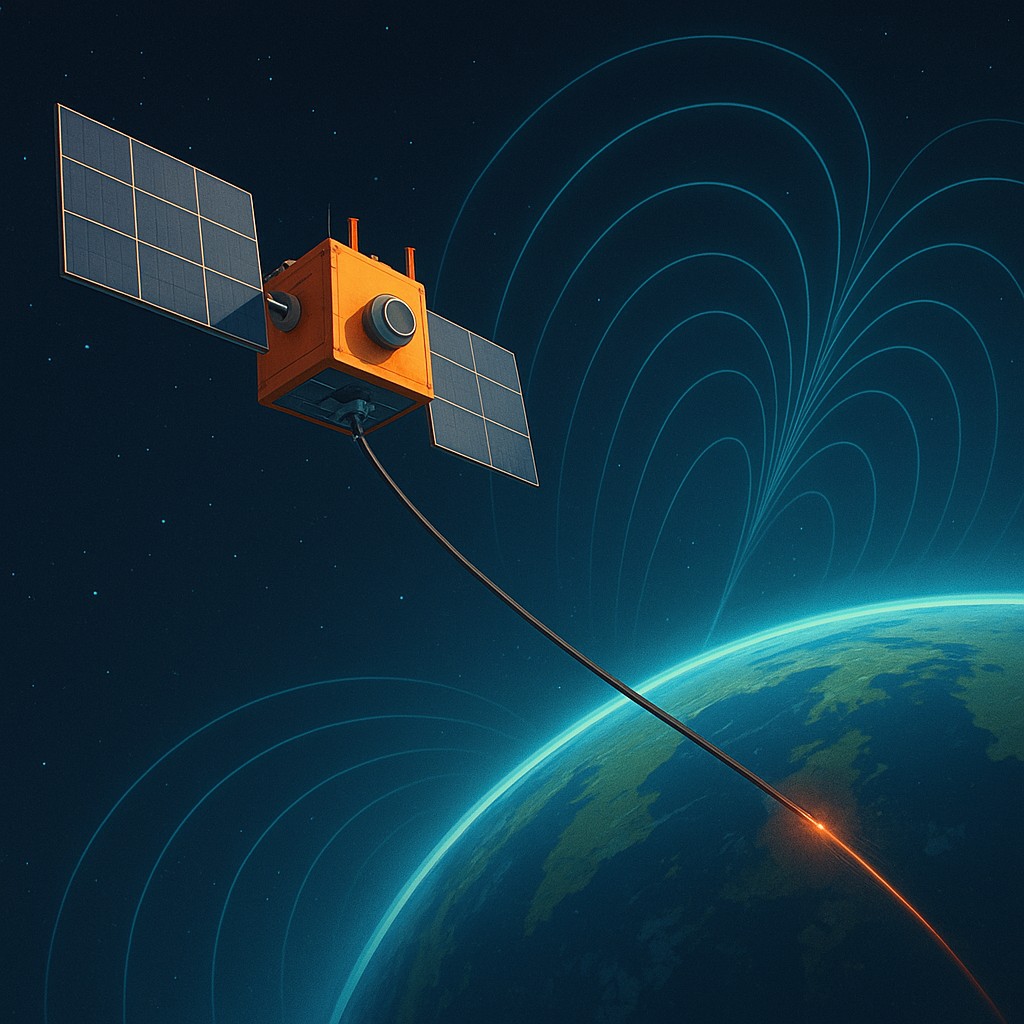
Imagine you are driving a car down a highway at several thousand miles per hour when the engine suddenly dies. You realize you cannot stay in your lane forever, but you have no brakes and no fuel left to steer off the road. In the vast, silent vacuum of Low Earth Orbit (LEO), this is the exact problem facing thousands of satellites. As our orbital highways become crowded with "dead" hardware, the risk of high-speed crashes grows. This threatens to turn the space around our planet into an impassable graveyard of shrapnel. For decades, the only solution was to carry extra fuel for a final "suicide burn" to drop out of orbit, but that fuel adds weight, costs millions, and often runs out before the job is done.
Engineers are now turning to a solution that feels like it was plucked from a classic science fiction novel: electrodynamic tethers. Instead of relying on heavy chemical rockets, these systems use a long, conductive wire to turn the Earth itself into a giant magnetic brake. By interacting with the planet’s magnetic field and the thin layer of charged particles in the upper atmosphere, these tethers generate a force that drags satellites back home to burn up on reentry. It is an elegant, fuel-free way to clean up our cosmic backyard, using the laws of physics as a planetary janitorial service.
The Physics of Orbital Friction
To understand how a simple wire can slow down a spacecraft weighing several tons, we have to look at the invisible forces surrounding our planet. Earth is essentially a giant bar magnet with magnetic lines stretching from pole to pole. Additionally, the upper reaches of our atmosphere, known as the ionosphere, are filled with plasma. This is a thin soup of ionized gas made of atoms that have had their electrons stripped away by solar radiation. When a satellite lets out a conductive tether, typically several kilometers of thin aluminum or copper wire, it creates a bridge moving through this magnetic environment at incredible speeds.
According to Faraday’s Law of Induction, when a conductor moves through a magnetic field, it generates an electric current. As the satellite zips around the Earth at roughly 17,000 miles per hour, the tether cuts across the Earth's magnetic field lines, causing electrons to flow along the wire. This isn't just a side effect; it is the engine of the entire system. By collecting electrons from the surrounding plasma at one end and spitting them back into space at the other, the tether creates a constant loop of electricity. This essentially turns the satellite into a giant, orbiting circuit.
This current is where the magic happens. A basic rule of electromagnetism, known as the Lorentz force, states that a wire carrying a current inside a magnetic field feels a physical push. In the case of a tether, this force pushes against the satellite’s motion. It is a literal "magnetic drag" that acts like a parachute made of invisible physics. Unlike a traditional parachute that needs air pressure to work, this magnetic brake operates in the near-vacuum of space. It steadily saps the satellite of its speed until gravity eventually wins the tug-of-war, pulling the craft down into the thick atmosphere to burn up safely.
Designing a Kilometer-Long Space Anchor
Building a tether that can survive the harsh environment of space while remaining conductive is a major engineering feat. These aren't standard hardware-store wires; they are sophisticated ribbons or braids designed to be incredibly strong yet paper-thin. Most modern designs use "bare tethers" which have no insulation. This allows the wire to collect electrons directly from the space plasma along its entire length, which increases the braking force. This design is much more efficient than older, insulated models that could only interact with the environment at their tips.
One of the biggest hurdles is the mechanism used to let the wire out. Imagine trying to unspool three miles of thread from a moving car without it tangling, snapping, or whipping around. In zero gravity, the tether must be kept under constant tension. Engineers often use "gravity gradient force" to help. Because Earth's gravity is slightly stronger closer to the surface, the end of the tether nearer to the planet feels a stronger pull than the end attached to the satellite. This difference in strength keeps the long wire stretched out vertically, pointing toward the Earth like a long, silver needle.
However, Low Earth Orbit is an obstacle course. Atomic oxygen is highly reactive and can eat away at materials over time. Furthermore, tiny pieces of space junk, some no larger than a grain of sand, can slice through a thin wire like a hot knife through butter. To fight this, many tethers are designed as mesh ribbons or made of several redundant strands. If a tiny meteor hits a mesh tether, it might pop a few holes in the "fabric," but the electricity continues to flow through the remaining paths, ensuring the brake keeps working until the mission is over.
Comparing Traditional and Tether Disposal Systems
The move toward electrodynamic tethers represents a shift away from the "brute force" style of rocket engines. In the past, if you wanted to move in space, you had to bring your own "push" in the form of fuel. This created a difficult choice for satellite owners: the more fuel you carry for the end of the mission, the less weight you have left for cameras or scientific tools. Tethers change the math by using external energy, Earth's rotation and magnetic field, to do the heavy lifting.
| Feature |
Chemical Thrusters |
Electrodynamic Tethers |
| Fuel Requirement |
High (Needs propellant) |
Zero (Uses magnetic fields) |
| System Weight |
Heavy (Tanks, valves, fuel) |
Light (Spool and wire) |
| Complexity |
High (Moving parts, fire) |
Moderate (Unreeling mechanics) |
| Time to De-orbit |
Minutes to Hours |
Weeks to Months |
| Collision Risk |
Low (Small target) |
Higher (Long physical footprint) |
| Cost |
High (Heavy to launch) |
Low (Simple hardware) |
As the table shows, the main trade-off is time versus weight. While a rocket engine can drop a satellite out of orbit in a single afternoon, a tether is a "slow and steady" method that might take several months. For a dead satellite, this delay is fine as long as the system is reliable. The real win is the weight savings. For a "CubeSat" that weighs only a few pounds, carrying a traditional rocket is often impossible. A tether spool, however, can fit into a space the size of a lunchbox. This makes it the only practical way for small satellites to follow international rules for clearing space debris.
Navigating the Magnetic Minefield
Despite being a brilliant idea, electrodynamic tethers create a new set of headaches for space traffic controllers. When you let out a tether that is three or six miles long, you are essentially creating a massive, invisible tripwire in orbit. Even though the wire is very thin, its length makes it much more likely to hit something. In a crowded area like Low Earth Orbit, where thousands of active satellites are zooming around at different heights, a five-kilometer wire is a major hazard.
Managing this risk requires careful coordination. Some modern tethers can be "turned off" by breaking the electrical circuit. If the current stops flowing, the magnetic force disappears, and the tether becomes a limp, passive string. If a potential crash with another satellite is spotted, operators can theoretically change the current to shift the tether's shape or change how fast the satellite is falling, dodging the oncoming traffic.
Furthermore, these long wires can behave wildly. They are prone to "libration," which is just a technical term for swinging back and forth like a pendulum. If the swinging gets too violent, the tether could snap or wrap around the satellite. Engineers use complex math to predict these movements, often using the magnetic field itself to "dampen" the swing, much like a person on a swing set uses their legs to stay in control. It is a delicate dance of electricity and orbital physics that requires constant eyes on the screen.
The Future of the Orbital Dragnet
We are entering a key era for this technology. Groups like JAXA (the Japanese space agency) and private startups like PERSEI Space are testing these systems now. The goal is to move from experiments to "plug-and-play" modules that can be bolted onto any satellite before it launches. In the near future, regulations might require every new satellite to carry an "at-home" kit, like a tether, to make sure it doesn't stay in orbit for centuries after it stops working.
Beyond just cleaning up junk, tether physics offers even more exciting possibilities. If you reverse the process and pump electricity into the tether using solar panels, you can create a force that pushes the satellite up into a higher orbit. This could allow space stations to stay at the right altitude without ever needing to be refueled by expensive cargo ships. In this sense, Earth's magnetic field becomes more than just a brake; it becomes a permanent, invisible highway that can push and pull us through the stars.
Using electrodynamic tethers shows a change in how we think about space. We are learning that the most sustainable way to explore is not by fighting nature with bigger explosions, but by working with the physical fields that are already there. By weaving ourselves into the magnetic fabric of our planet, we can keep the door to the stars open for future generations.
The next time you look at the night sky, imagine those thousands of silent machines circling above. Somewhere among them, a thin, silver thread might be reaching out, grasping the Earth’s magnetic field to find its way home. It is a reminder that even in high-tech space travel, the best solutions often come down to the simple elegance of a wire, a current, and the steady pull of a planet that refuses to let go. This technology is more than a tool; it is a promise to be responsible managers of the final frontier.