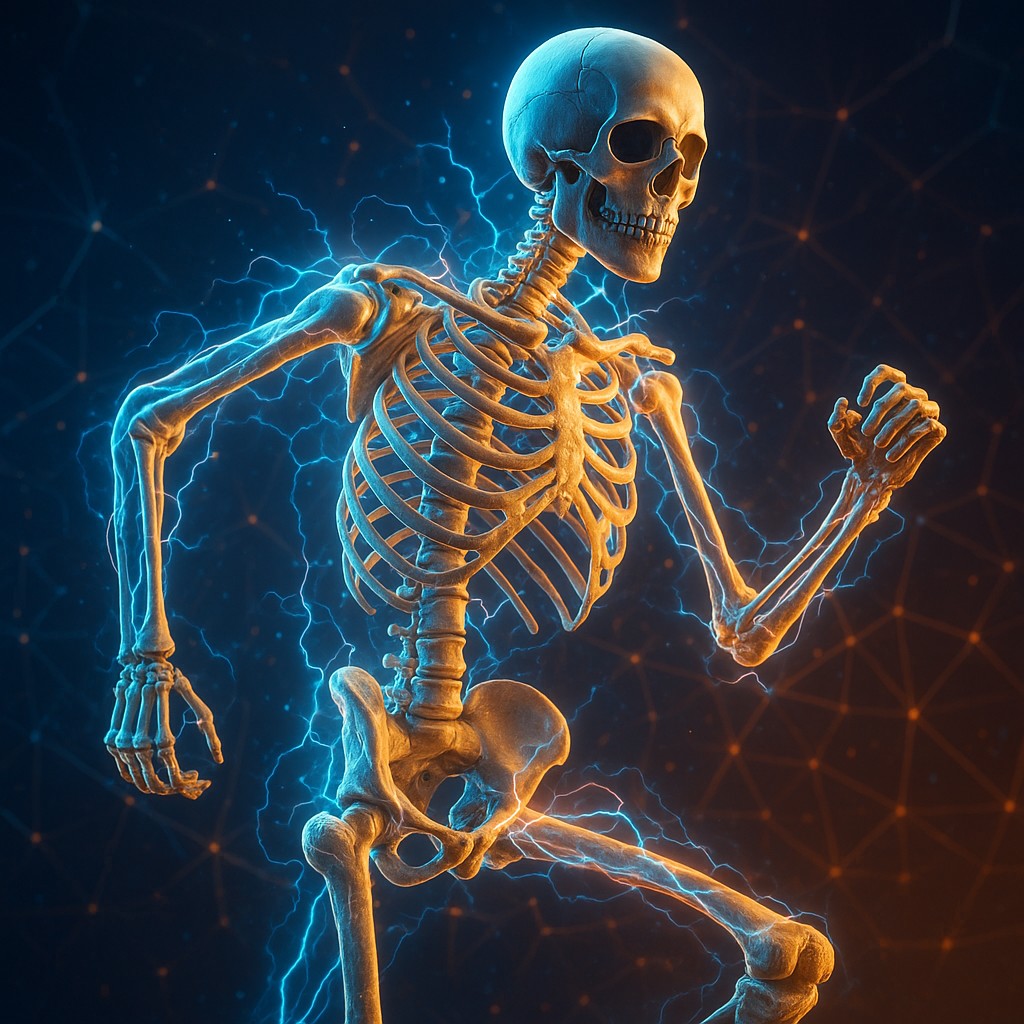
Imagine for a moment that your skeleton is not just a collection of dry, dusty props from a biology classroom, but a high-tech architectural firm that never sleeps. While we often think of bones as "set it and forget it" hardware, they are actually some of the most reactive and "talkative" tissues in the human body. Your femur does not simply sit there holding up your weight; it is constantly listening to the vibration of your footsteps, the tug of your muscles, and even the subtle shifts in how you lean against a desk. In real-time, it adjusts its internal design to ensure you do not collapse under the pressure of daily life.
This internal renovation project is so sophisticated that it operates on a "use it or lose it" principle that would make an efficiency expert weep with joy. Your body is remarkably unsentimental about its resources. If you are not using a specific section of bone to support weight, your body decides that keeping those minerals locked up is a waste of overhead. It then begins to dismantle the structure for parts. On the other hand, if you take up a high-impact hobby like jumping rope or mountain climbing, your bones recognize the new demand and start a microscopic construction boom to reinforce the areas under fire. To understand how solid tissue "knows" it needs to get stronger, we have to look at the intersection of physics and biology.
The Electric Spark in Your Step
At the heart of bone remodeling is a fascinating physical phenomenon called the piezoelectric effect. You might recognize this term from electronics, where certain crystals, like quartz, produce an electrical charge when they are squeezed or stretched. Your bones are essentially biological batteries waiting to be compressed. Bone tissue is a composite material made mostly of collagen fibers and crystals of a mineral called hydroxyapatite. When you take a step, the physical stress distorts these crystals just enough to generate a tiny, measurable electrical current across the tissue.
This isn't electricity like a lightning bolt, but a subtle shift in ions that creates a language of "stress signals." Areas of the bone under high pressure accumulate a specific charge, while ignored areas remain quiet. This electrical chatter is the primary way your body bridges the gap between the big-picture world of "I am carrying heavy groceries" and the microscopic world of "I need more calcium in my wrist." Without this spark, your cells would have no idea where the heavy lifting is happening, leaving your skeleton to grow blindly and inefficiently.
The Specialized Crew of the Remodeling Project
To carry out the orders from these electric signals, the body employs a dedicated trio of cells that act as architects, demolition crews, and site managers.
First are the osteocytes. These are the most common cells in your bone, tucked away in tiny pockets within the hard mineral. They act as biological sensors, detecting fluid flow and electrical changes caused by movement. When an osteocyte feels the "pinch" of pressure, it sends out chemical messengers to recruit the rest of the team, marking exactly where work needs to be done.
Once the signal is sent, the demolition crew, known as osteoclasts, arrives. It might seem odd to start a strengthening project by breaking things down, but you cannot renovate an old house without tearing out the rotten drywall first. The osteoclasts secrete acids that dissolve old bone mineral, releasing calcium back into the blood. Following closely behind are the osteoblasts, or the "builders." These cells lay down new collagen and mineralize it, turning the soft site back into rock-hard bone. This constant cycle of clearing and rebuilding ensures your skeleton remains "fresh" and free of the microscopic cracks that build up over time.
Scaling Growth and Saving Resources
The body’s management of bone density follows a strict logic called the Mechanostat Theory. Think of this as a biological thermostat. Instead of regulating temperature, it regulates structural strength. There is a specific "set point" for physical stress. If the load on a bone stays within a normal range, the builders and the demolition crew stay in balance. However, if the load drops too low, such as during long periods of bed rest or a trip to the zero-gravity environment of space, the body decides the bone is redundant.
This resource management is why astronauts must exercise for hours every day on the International Space Station. Without the constant tug of gravity generating those electric signals, the demolition crew goes into overdrive while the builders take an unauthorized vacation. The result is a rapid loss of bone density. Conversely, when we push ourselves with weight-bearing exercise, we enter the "overload" zone. This triggers the builders to work faster than the demolition crew, leading to a net gain in bone mass. It is a self-regulating system that ensures you are exactly as strong as your lifestyle requires you to be.
| Process Component |
Role in the Body |
Primary Driver |
Long-Term Outcome |
| Piezoelectric Effect |
The Signal |
Compressing crystals |
Turns movement into electricity |
| Osteoclasts |
The Demolition |
Low stress or "clean up" signals |
Breaks down bone to release minerals |
| Osteoblasts |
The Builders |
High stress and electric signals |
Increases bone density and thickness |
| Osteocytes |
The Managers |
Pressure and fluid detection |
Coordinates the remodeling team |
| Mechanotransduction |
The Language |
Movement and physical load |
Translates physics into biology |
The Art of Mechanical Conversation
To communicate with your skeleton, you have to speak its language: impact and resistance. Not all movement is the same to an osteoblast. For example, swimming is a great workout for your heart, but because the water supports your weight, it creates very little "electric noise" in your bones. To keep your skeleton dense, you need activities where gravity is your main opponent. Walking, running, dancing, and lifting weights are like shouting instructions to your bones, while low-impact activities are more like a polite whisper.
It is also important to remember that bone is a "slow" tissue. Unlike muscles, which might feel a "pump" after one workout, bones operate on a much longer timeline. Replacing a section of bone through the remodeling cycle can take several months. This is why consistency matters more than intensity for bone health. A single day of heavy lifting won't change your skeleton, but a year of regular walking tells your body, over and over, that it needs a frame capable of handling that journey.
Correcting the "Static Scaffold" Myth
One common mistake is thinking that bone loss is an inevitable, one-way street as we age. While hormonal changes can shift the balance toward the "demolition" side, the underlying mechanism remains active your entire life. Your bones never lose their ability to sense electricity or respond to pressure. The "static scaffold" myth fails to realize that a seventy-year-old’s bones are chemically and structurally different from what they had at twenty, simply because they have been remodeled thousands of times to suit a different pace of life.
Another myth is that "more calcium" is the only answer to bone strength. While calcium provides the "bricks" for the builders, the builders won't show up to work if there is no signal to build a wall. You can have a backyard full of bricks, but without an architect (osteocytes) and a reason to build (physical stress), the materials will just sit there. Bone health is a partnership between nutrition and physics. You provide the raw materials, and your movement provides the instructions on where to put them.
Embracing Your Inner Architect
When you realize your body is a dynamic, responding system rather than a finished machine, it changes how you view every step you take. You are not just moving through the world; you are literally sculpting your internal architecture with every stroll or climb up the stairs. This biological feedback loop is a testament to the elegance of evolution, ensuring we are not weighed down by heavy, unnecessary bone, yet not left vulnerable by a lack of support.
The next time you feel the resistance of a weight or the impact of your feet on the pavement, don’t just call it "exercise." Think of it as a high-speed data transfer. You are sending a clear, electrical message to your cells that you intend to be strong and resilient. Your body is listening, the signals are firing, and the construction crew is already working on a version of you that is better equipped for tomorrow.