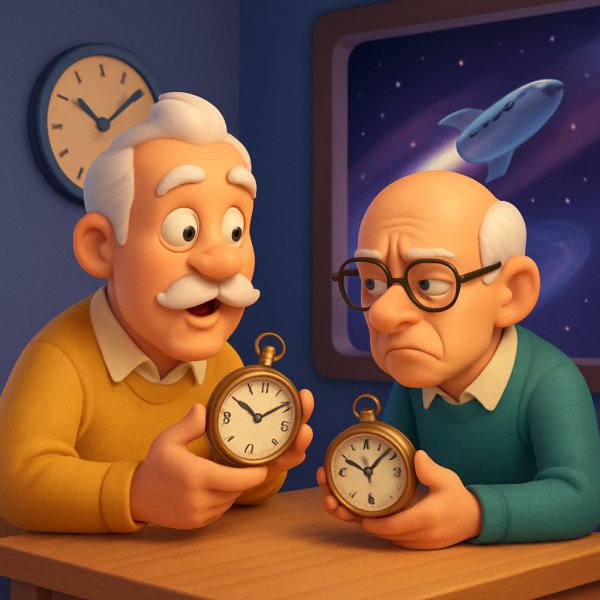
<h2>That moment your clock disagrees with your twin - a curious opening</h2>
Imagine you and a friend decide to settle an argument by splitting up, agreeing to reunite in 20 years. Your friend hops on a spaceship that zips away at a huge fraction of the speed of light, then comes back. To both of your surprise, your friend is noticeably younger than you, as if time decided to bend the rules for them. Strange as it sounds, this is not science fiction but a genuine consequence of the "relativity thing" that Albert Einstein discovered. The world, it turns out, does not keep time the same way for everyone when they are moving relative to each other, and this discovery has real-life consequences that ripple from GPS satellites to black hole collisions.
<h2>What Einstein really found out - a compact, friendly statement</h2>
Einstein showed that space and time are not fixed, absolute stages on which events play out, as Sir Isaac Newton once assumed. Instead, space and time form a single, flexible fabric called spacetime, and measurements of length, time, and simultaneity depend on the observer's motion. For fast-moving observers, clocks tick more slowly, rulers shorten, and what looks like two simultaneous events to one person may not be simultaneous to another. In his 1905 paper Einstein set out special relativity, which applies when gravity is negligible and motion is uniform, and in 1915 he generalized that idea to include gravity as a geometric property of spacetime - this is general relativity.
<h3>The surprising roots - why the old rules failed</h3>
Classical physics assumed there was an absolute time running the same for everyone. But around the turn of the 20th century, experiments failed to find the hypothesized "ether" - a medium thought to carry light waves. The Michelson-Morley experiment, designed to detect the Earth's motion through this ether, came up empty, suggesting the speed of light is the same for all observers. Einstein took that null result seriously and started from two simple principles - the laws of physics are the same in all inertial frames, and the speed of light in vacuum is constant for every observer, no matter how they move. These two ideas together forced a radical rethink of space and time.
<h2>Core ideas of relativity, explained with everyday analogies</h2>
- Principle of relativity - The rules of physics look the same whether you are sitting at a cafe, riding a train at constant speed, or drifting in empty space. There is no privileged "rest frame." Think of laws of physics as the rules of a board game that do not change if you move the table a little.
- Constancy of the speed of light - No matter how fast you drive or throw a ball, light in vacuum always travels at about 299,792 kilometers per second (call it c). If you ride toward a beam of light, you do not reach or overtake it in the everyday sense.
- Relativity of simultaneity - Two events that seem simultaneous to someone standing on the ground may occur at different times for a passenger on a moving train. Imagine lightning striking both ends of a moving train - a passenger sitting in the middle may see them at different times depending on the train's motion.
- Time dilation - Moving clocks run slow compared to stationary ones, from the perspective of another observer. This is not a mechanical failure but a real difference in the passage of time.
- Length contraction - Objects moving past you at high speed appear shortened in the direction of motion.
- Mass-energy equivalence - E = mc^2 means mass and energy are interchangeable; a small amount of mass corresponds to a very large amount of energy.
Each of these ideas feels odd because they move away from common sense shaped by everyday speeds and sizes, but they are testable and well confirmed.
<h3>Small table - quick examples you can picture</h3>
<table>
<tr>
<th>Phenomenon</th>
<th>Plain description</th>
<th>Where you see it</th>
</tr>
<tr>
<td>Time dilation</td>
<td>Moving clocks tick slower</td>
<td>Particles in accelerators, GPS satellites</td>
</tr>
<tr>
<td>Relativity of simultaneity</td>
<td>Simultaneous events for one observer may not be for another</td>
<td>Thought experiments - train and lightning</td>
</tr>
<tr>
<td>Gravity as curvature</td>
<td>Mass tells space how to curve, curved space tells mass how to move</td>
<td>Orbit of Mercury, gravitational lensing, GPS corrections</td>
</tr>
</table>
<h2>Weird but true consequences and how we tested them</h2>
Some consequences are counterintuitive yet measurable. For example, muons - tiny particles created high in the atmosphere - live too briefly to reach Earth if viewed from a classical standpoint, yet many arrive at the surface. That is because, from our viewpoint, their internal "clock" runs slower due to their high speed, letting them survive the trip. Similarly, atomic clocks flown on airplanes show measurable time differences when compared to clocks on the ground - these are clockwork confirmations of relativity. Early evidence included the 1919 solar eclipse observations that showed light from stars is deflected by the Sun's gravity, consistent with general relativity, and modern detectors like LIGO have measured ripples in spacetime from colliding black holes, a dramatic confirmation of Einstein's 1915 theory.
A simple equation captures time dilation: gamma = 1 / sqrt(1 - v^2/c^2). At everyday speeds v is tiny compared to c, so gamma is almost 1 and effects are negligible. But as v approaches c, gamma grows large, and time dilation becomes noticeable. This is why ordinary life does not feel relativistic, yet the effects are critical in high-speed and high-precision contexts.
<h3>Reflective question - what would you notice?</h3>
If you could ride a spacecraft at 80 percent of the speed of light for what your ship's clock measures as ten years, how much time would pass for people back on Earth? Try calculating gamma for v = 0.8c - it equals about 1.667, so Earth would age about 16.7 years while you would age 10 years. This is a simple mental exercise that reveals how motion changes the passage of time in different frames.
<h2>Gravity is geometry - Einstein's elegant leap</h2>
Einstein's general relativity replaced the Newtonian picture of gravity as a force pulling between masses with a geometric view - mass and energy tell spacetime how to curve, and curved spacetime tells objects how to move. Picture a stretched rubber sheet representing space - place a heavy ball and the sheet dips. A smaller ball rolling nearby follows a curved path because of that dip, not because an invisible force is tugging it in a Newtonian sense. This geometric vision explains why Mercury's orbit deviated slightly from Newtonian predictions, and it predicts phenomena like gravitational time dilation - clocks run slower in stronger gravitational fields - and gravitational lensing, where light bends around massive objects.
The theory has practical teeth. Tests include the precession of Mercury, the gravitational redshift measured by Pound and Rebka in 1959, precise timing of binary pulsars, and direct detection of gravitational waves by LIGO beginning in 2015. Each test added confidence that spacetime geometry is the right picture.
<h3>Case study - GPS satellites need relativity to work</h3>
Global Positioning System satellites carry atomic clocks. Those clocks tick differently than identical clocks on Earth's surface for two reasons - they move relative to observers on Earth, producing special relativistic time dilation, and they sit higher in Earth's gravitational well, producing general relativistic time dilation in the opposite direction. The net effect would cause about a 38 microsecond-per-day discrepancy if uncorrected, which would translate to navigation errors of kilometers per day. Engineers correct the satellite clocks using relativity, otherwise GPS would be practically useless. This real-world case shows Einstein's ideas are not only philosophically deep but technologically essential.
<h2>Common misunderstandings, corrected</h2>
There are several common misconceptions about relativity that deserve clearing up. One is that "everything is relative," as in there are no facts - that is false. Relativity means the measurements of space and time depend on the observer's frame, but physical laws and invariant quantities, like the spacetime interval and the speed of light, remain objective. Another misconception is that relativity prevents any faster-than-light travel. Special relativity forbids sending information or matter faster than light in vacuum because that would break causality - cause and effect - but there are subtle discussions about apparent superluminal phenomena that do not transmit information. People also sometimes think E = mc^2 means mass magically turns into energy without conditions. In reality, mass-energy equivalence means mass contributes to the total energy budget of a system, and conversion processes obey conservation laws and require specific interactions.
A useful correction is about time travel. While some solutions to Einstein's equations allow closed timelike curves that look like paths into the past, these are exotic and likely unphysical. For all practical purposes and engineering, relativity does not give us a mechanism for the casual science-fiction jumping backwards in time.
<h3>Quick list - what relativity is not</h3>
- Not a license for subjective truth - objective invariants remain.
- Not a description only for outer space - it matters in precise technology on Earth.
- Not an easy route to build a time machine - practical constraints and causality make time travel thorny.
- Not opposed to Newtonian physics - Newton is an excellent approximation at low speeds and weak gravity.
<h2>Playful exercises to deepen intuition</h2>
Try these small thought experiments and calculations to engage actively. First, compute gamma for v = 0.6c and v = 0.99c and compare how quickly the time dilation grows. This simple math reveals how relativistic effects accelerate as v approaches c. Second, imagine two synchronized clocks at different altitudes - one at sea level, one on a mountain. Which runs faster? General relativity predicts the higher clock runs faster because gravity is weaker there. Finally, think about how a beam of light looks to someone moving toward it - do they catch up to it? The correct answer is no; light's speed remains c, but its frequency shifts, a phenomenon known as the Doppler effect.
Small challenges like these force you to translate abstract principles into concrete numbers and deepen your feeling for the physics.
<h2>Where the evidence sits - key experiments and observations</h2>
Relativity is not just elegant math - it is one of the most experimentally tested theories in physics. The Michelson-Morley experiment set the stage by showing no preferred ether wind. Time dilation is confirmed by observations of particle decay rates and by flying atomic clocks around Earth in the Hafele-Keating experiments. The 1919 solar eclipse expedition led by Eddington provided the first successful test of light bending by the Sun. The Pound-Rebka experiment measured gravitational redshift, and the timing of pulsars in binary systems matched general relativity's predictions for energy loss due to gravitational waves. The direct detection of gravitational waves by LIGO opened a new window on the universe, allowing us to hear spacetime itself vibrating when massive objects merge. These multiple, independent lines of evidence give strong scientific confidence in Einstein's insight.
<h2>Why it matters - practical usefulness and philosophical beauty</h2>
Relativity matters for practical reasons - navigational systems, particle physics, cosmology, and modern technology all rely on it. Particle accelerators account for relativistic mass-energy relations when designing collisions and interpreting results, and models of the cosmos use general relativity to describe the evolution of the universe. At the same time, there is a poetic shift - Einstein taught us that the universe is stranger and more interconnected than intuition suggests. Space and time are knitted together, and our measurements are part of a larger relational fabric. This changes how we think about motion, measurement, and what it means to observe.
Humor helps here - you may not need to be a rocket scientist to use relativity, but if you ever build a GPS, you will become one whether you like it or not. The intellectual payoff is that relativity replaces a comfortable, absolute picture with a deeper, more flexible framework that continues to inspire physics a century later.
<h2>Final takeaway - a friendly summary and next steps</h2>
Einstein's "relativity thing" is twofold - special relativity, which fuses space and time and shows how measurements depend on motion, and general relativity, which recasts gravity as geometry. Together they altered our understanding of the universe and gave us predictive power that shows up in laboratory tests and everyday technology. The concepts are odd at first - clocks slowing down, rulers contracting, light bending around mass - but repeated experiments and real-world corrections confirm these ideas again and again.
If you want to explore further, try reading popular books like "Relativity: The Special and General Theory" by Einstein, or accessible modern introductions by physicists such as Brian Greene or Sean Carroll. Watch short videos with animations of spacetime curvature and play with interactive simulations of time dilation. Most of all, nurture curiosity - ask what-if questions, do the basic gamma calculations, and enjoy the way thinking about relativity stretches both your mind and your sense of wonder. As Einstein famously said, "Imagination is more important than knowledge," but in this case, imagination with a healthy dose of evidence will take you a long way.