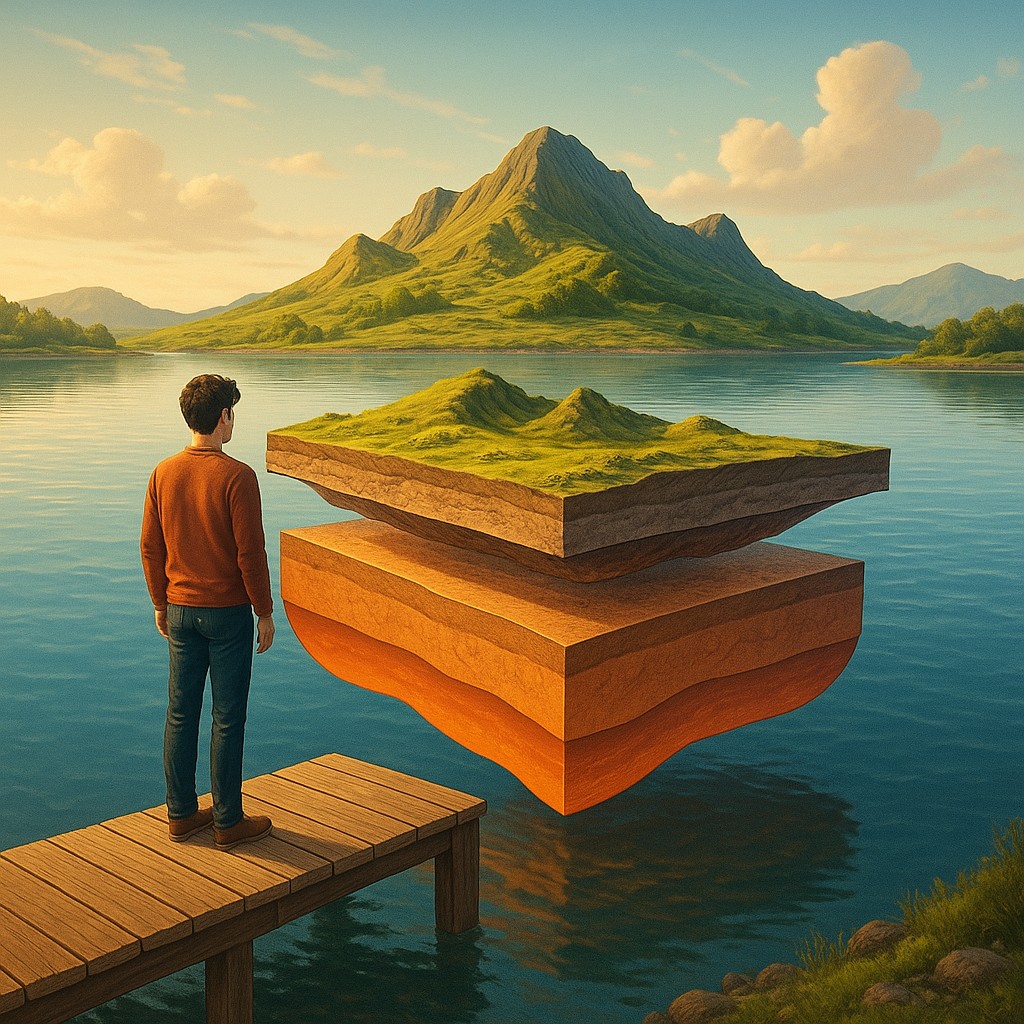
Imagine for a moment that you are standing on a sturdy wooden pier at the edge of a calm lake. When you step onto the boards, the structure feels as solid as a rock. You might assume the ground beneath your feet is just as immovable, a permanent foundation that has stayed exactly where it is since the beginning of time. However, if you were to zoom out and look at the Earth from the perspective of a giant, you would see that our planet's crust is actually more like a very slow, very heavy raft. It isn't bolted onto the Earth; it floats on a sea of hot, semi-fluid rock called the mantle. This means that if you put something heavy on the crust, it sinks, and if you take that weight away, it pops back up.
This hidden dance of the Earth’s surface is a concept scientists call isostasy. It is the reason why mountains can stand tall without immediately sinking into the depths, and it explains why ancient coastlines sometimes find themselves high and dry, miles away from the ocean. While we see the ground as the ultimate symbol of stability, it is actually in a constant state of adjustment, seeking a perfect balance between the weight of what is on top and the buoyancy of what is underneath. Understanding this process is like learning the secret physics of how our home is built. It changes the way you look at every hill, valley, and shoreline, revealing a world that is much more flexible than it first appears.
The Giant Raft of the Continents
To understand isostasy, we have to rethink our definition of "solid." The Earth is structured a bit like a giant peach. The skin is the crust, the fleshy part is the mantle, and the pit is the core. While the crust is made of hard rock, the mantle underneath is what scientists call "viscoelastic." This is a technical way of saying it behaves like a very thick, gooey liquid over long periods. Think of cold honey or Silly Putty. If you poke it quickly, it feels solid, but if you leave a heavy weight on it for a week, it will slowly deform and flow out of the way.
Because the mantle is denser than the crust, the crust literally floats on top of it. This creates a state of gravitational balance. Just as a large ship displaces a certain amount of water to stay afloat, a massive mountain range "displaces" a portion of the mantle. This is why mountains have "roots." For every mile of mountain you see poking up toward the clouds, there are several miles of crust pushing down into the mantle to support that weight. The taller the mountain, the deeper the root required to keep it buoyant. It is a natural seesaw where gravity pulls the crust down and buoyancy pushes it back up, constantly searching for a middle ground.
When Glaciers Turn the Earth into a Trampoline
One of the most dramatic examples of isostasy in action involves the massive ice sheets that covered much of the Northern Hemisphere during the last Ice Age. Imagine a glacier that is two miles thick. That is a staggering amount of weight, equivalent to stacking hundreds of skyscrapers on top of each other across an entire continent. When those glaciers formed, their sheer mass pressed the Earth's crust down into the mantle. In some places, the ground actually sank hundreds of feet. The mantle underneath didn't just disappear; it was squeezed outward, creating "forebulges," or slight rises in the land around the edges of the ice.
Then, about 10,000 years ago, the climate warmed and the ice began to melt. Suddenly, the crushing weight was gone. However, because the mantle is so thick and gooey, the crust couldn't just snap back like a rubber band. Instead, it began a process called "post-glacial rebound." The land started rising back toward its original position at a rate of about a centimeter per year in the most extreme cases. This is why parts of Canada, Scandinavia, and the northern United States are literally getting taller every year. If you visit certain parts of Sweden, you can find old Viking boat rings for tying up ships that are now located hundreds of yards away from the water and high up on hillsides. The land rose right out from under the sea.
Why Geologic Time Is Not Human Time
The biggest hurdle in understanding isostasy is our human perspective on time. We live in a world of seconds and minutes, while the Earth operates on a schedule of millennia. If you were to watch a video of the Earth’s crust rebounding after an ice age, but sped up by a factor of a million, the planet would look like a jiggly bowl of gelatin. You would see the crust dipping under the weight of advancing ice and then slowly bulging back out as the ice retreated. Because we only live for 80 or 90 years, we see only a single "still frame" of this process and assume nothing is moving.
This slow pace is actually a good thing for us. If the Earth were to "rebound" instantly, the resulting earthquakes and volcanic eruptions would be catastrophic. The slow, viscous nature of the mantle acts as a shock absorber. It allows the crust to adjust to changes without shattering into a billion pieces. However, this also means that the Earth is still reacting to things that happened thousands of years ago. We are currently living through the "after-party" of the last Ice Age. The geological shifts we see today are not just a response to current conditions, but a long-delayed echo of the ancient past.
Balancing the Scales of the Earth
While ice is a major player, it is not the only thing that changes the weight of the crust. Erosion and sediment deposits are constantly shifting mass around the planet like a global delivery service. When a river like the Mississippi carves out a canyon, it removes weight from that specific spot. In response, the crust underneath that canyon will slowly rise. Conversely, when that river dumps its sediment into the Gulf of Mexico, it adds weight to the seafloor, causing it to sink. To better understand how different factors influence this balance, we can look at the following comparison:
| Factor |
Change in Load |
Crustal Response |
Timeframe |
| Glaciation |
Massive weight addition |
Subsidence (sinking) |
Thousands of years |
| Glacial Melting |
Massive weight removal |
Rebound (rising) |
Thousands of years |
| Mountain Erosion |
Gradual weight removal |
Isostatic Uplift (rising) |
Millions of years |
| Delta Formation |
Gradual weight addition |
Subsidence (sinking) |
Millions of years |
| Volcanic Growth |
Rapid weight addition |
Localized sinking |
Hundreds to thousands of years |
As the table shows, the Earth is essentially an accountant, constantly balancing its books. If mass is lost in one area through the grinding power of wind and rain, the crust will rise to compensate. This creates a fascinating cycle: as a mountain is eroded and becomes lighter, it rises up, which exposes even more of the mountain to be eroded. This is why some mountain ranges seem to last much longer than they should based on erosion rates alone. They are being replenished by the buoyant force of the mantle from below.
Correcting the Great Misconception of Solid Ground
One of the most common myths about our planet is that the continents are "solid all the way down." Many people imagine that if you dug a deep enough hole, you would eventually hit a floor of unbreakable granite. In reality, the "lithosphere" (the crust and the very top of the mantle) is relatively thin. Beneath it lies the asthenosphere, which is hot enough to flow. If the Earth were the size of an apple, the part we live on would be thinner than the skin. This fragility is exactly what allows isostasy to work.
Another misconception is that sea-level rise is the same everywhere. We often hear that the oceans are rising due to climate change, which is true. However, in places like Hudson Bay in Canada, the land is actually rising faster than the ocean. To an observer on the ground there, it looks like the sea level is falling. Meanwhile, in places like the US Gulf Coast, the land is sinking because of the weight of sediment and groundwater extraction, making the sea-level rise appear much faster than the global average. Without understanding isostasy, it would be difficult to explain why the water seems to behave differently in different parts of the world.
The Future of Our Shifting Shorelines
Isostasy is not just a curiosity for history books; it is a vital tool for modern scientists. By measuring how fast the land is rising or sinking, geologists can calculate the "viscosity" or thickness of the mantle. This tells us how hot and fluid the inside of our planet is, which in turn helps us understand the engine that drives plate tectonics. If we know how the mantle flows, we can better predict where earthquakes might occur or how tectonic plates will settle over the next million years. It is like inspecting a car's engine to see how much life it has left.
Furthermore, as modern climate change causes glaciers in Greenland and Antarctica to melt, the process of isostasy is starting all over again. The land beneath these melting ice sheets is already beginning to rise. This modern rebound will change the shape of the ocean basins and affect how water is distributed around the globe. By studying the post-glacial rebound of the past, scientists can build models to predict how our coastlines will move in the future. We are watching a high-stakes game of geographic musical chairs, and isostasy is the music that determines where the chairs end up.
A New Perspective on the Ground Beneath Your Feet
Standing on a "solid" hill, it is humbling to realize that you are actually riding on a massive, buoyant raft that responds to the weight of the air, the water, and the ice. The Earth is not a static rock; it is a living, adjusting system that prioritizes balance. Isostasy teaches us that everything is connected. A snowflake falling in the mountains today might, through the collective weight of trillions of others, contribute to the sinking of a continent, while the pebble washed away by a stream helps the Earth beneath it rise just a fraction of a millimeter closer to the stars.
The next time you look at a mountain range or walk along a beach, try to visualize the invisible forces at play. Imagine the deep roots of the mountains reaching down into the mantle like the hull of a ship. Picture the land slowly stretching and exhaling as the weight of ancient ice fades away. You are part of a grand, slow-motion balancing act that has been performing for billions of years. This realization doesn't make the ground feel less stable; it makes the Earth feel more like a partner, a dynamic and responsive vessel carrying us through the cosmos, forever seeking its perfect level.