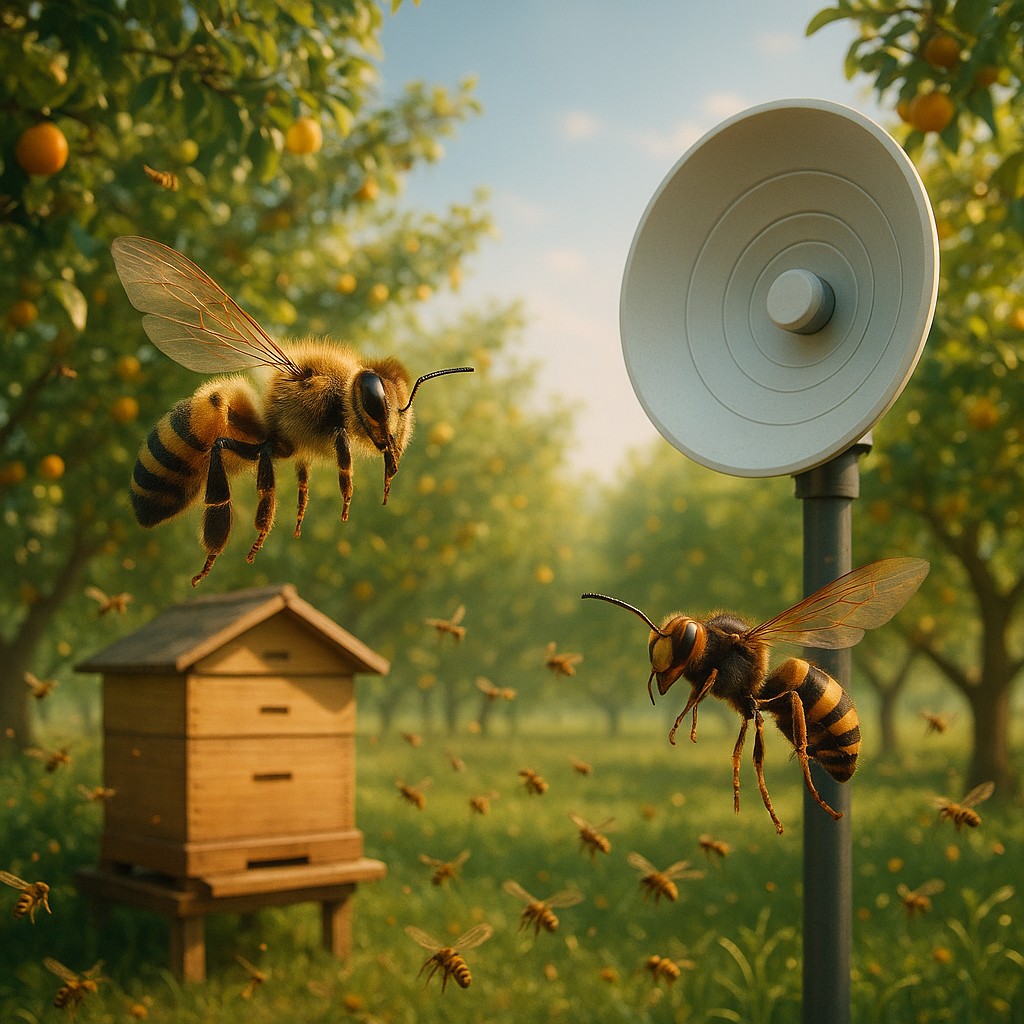
Imagine standing in a sun-drenched orchard where the air is thick with the busy thrum of thousands of honeybees. To most people, this sound is just peaceful white noise, a sign of a healthy ecosystem at work. However, to the trained ear of a conservationist, that collective hum is a complex symphony of data, where every wingbeat is a distinct note. Hidden within this acoustic landscape is a looming threat: the invasive hornet. These predators do not just compete for food; they are experts at tactical destruction, capable of decapitating an entire colony in a few hours and leaving behind a silent, empty hive.
For years, the only defense against these invaders was the "scorched earth" approach of using broad-spectrum pesticides or the slow, exhausting work of tracking nests by hand. Both methods are fundamentally flawed. One poisons the very bees we want to save, while the other is often too slow to prevent a massacre. But a new frontier in conservation is emerging, one that uses the air itself as a diagnostic tool. By using sensitive "acoustic mirrors" and machine learning programs, scientists can now listen for the specific, low-frequency "fingerprint" of a hornet’s flight. This creates a digital early warning system that protects the hive without firing a single chemical shot.
The Physics of a Predatory Hum
To understand how we can pick a single hornet out of a crowd of thousands of bees, we have to look at the relationship between body size and wingbeat speed. Think of a musical instrument: a tiny violin produces high, sharp notes, while a massive cello produces deep, resonant tones. In the insect world, honeybees are the violins. Their smaller bodies require them to beat their wings at a blistering pace, often between 200 and 250 times per second, which creates that familiar, high-pitched buzz. Invasive hornets, such as the yellow-legged hornet or the massive giant hornet, are the heavy cellos of the sky.
Because hornets are significantly larger and heavier, they operate on a different scale of physics. To stay in the air, they move their wings with a powerful, slower stroke, usually hitting a frequency range between 100 and 150 Hertz. This creates a much deeper, more guttural thrum that is physically different from the frantic vibrations of a bee. When a hornet approaches a hive to scout for its next meal, it isn't just flying; it is broadcasting a specific sound signature into the woods. Scientists use specialized microphones, often called acoustic mirrors because they reflect and focus sound waves toward a central sensor, to capture these low-frequency signals from a distance.
Deciphering the Digital Fingerprint
Capturing the sound is only half the battle; the real magic happens when that sound is turned into data. Modern monitoring stations are equipped with microprocessors running smart machine learning models. These models are trained on a library of "insect hits." They have listened to thousands of hours of wind, rain, bird calls, and various bee species until they can ignore the background noise and focus entirely on the hornet’s unique sound profile. This profile is more than just a single note; it includes the "harmonics," or extra tones, that occur as the hornet changes speed or hovers near a hive entrance.
When the system finds a match, it does more than just record the event for a later report; it acts in real time. The moment the software confirms a hornet is present, it can trigger several responses. In some setups, it sends an immediate alert to a beekeeper’s smartphone, allowing them to step in before the scout hornet can return to its nest with the hive’s location. In more advanced versions, the detection can trigger automated traps or shutters that temporarily block the hive entrance. This effectively makes the honeybees "invisible" to the predator during the most dangerous hours of the day.
Comparing the Highs and Lows of Insect Flight
The success of this technology relies on the measurable gap between different species. While humans might struggle to tell two different buzzes apart in a noisy forest, the sensors see a clear distinction in the data. The following table shows the typical acoustic differences that allow these systems to work with such high precision.
| Feature |
Honeybee (Apis mellifera) |
Invasive Hornet (Vespa species) |
Environmental Noise (Wind/Leaves) |
| Primary Frequency |
200 - 250 Hz |
100 - 150 Hz |
10 - 50 Hz (Irregular) |
| Sound Texture |
Consistent, high-pitched whine |
Deep, rhythmic thrumming |
Chaotic, non-rhythmic |
| Flight Pattern |
Fast, zig-zagging movements |
Heavy, hovering pauses |
Randomized movement |
| Detection Status |
Ignored as background noise |
Flagged as critical alarm |
Filtered out digitally |
By mapping these differences, conservationists create a "soft perimeter" around vulnerable areas. This approach is a radical shift from traditional pest control. Instead of looking for the insect, we are listening for the physical impact of its flight. It is a form of quiet surveillance that respects the balance of the ecosystem while targeting the one element that threatens to destroy it.
The Weather Problem and Signal Distortion
As elegant as this solution sounds, nature is rarely a perfect recording studio. One of the main challenges for acoustic monitoring is how sound travels. Sound waves are ripples of pressure moving through the air, and those ripples are highly sensitive to the weather. In a heavy rainstorm, the sound of thousands of raindrops hitting leaves creates a "noise floor" so loud that it can drown out the low-pitched hum of a hornet. Furthermore, extreme humidity or thick fog can change the density of the air, causing the sound waves to bend or lose energy more quickly than they would on a clear day.
Extreme weather can also cause "false positives," which are the main weakness of any automated system. High winds whipping through hollow trees or over certain rock formations can occasionally mimic the deep resonance of a hornet’s wings. If the software is too sensitive, the system might trigger alarms every time a thunderstorm rolls through. To combat this, developers are teaching their AI to check "secondary indicators," such as how long the sound lasts and how it moves. A hornet has a specific way of hovering and weaving that a gust of wind does not. By adding these behavior layers to the acoustic data, the systems are becoming much more reliable, even in bad weather.
Beyond the Hive: A New Philosophy of Protection
The use of acoustic mirrors represents a broader shift in how we protect the environment. We are moving away from "clumsy" interventions, like chemical sprays that affect every living thing they touch, and entering an era of intelligent precision. This technology is a form of bio-acoustics that turns the environment itself into a sensor network. By listening carefully, we can detect the very first signs of an invasive species, often weeks or months before a human would spot them. This early warning is the difference between a small, manageable problem and a full-scale ecological disaster.
This method also provides scientists with valuable data about how invasive species move through a new area. By linking multiple acoustic stations together, researchers can track a "sound trail" of hornets as they migrate. This helps identify the paths they use and the environmental factors that help them spread. This isn't just about killing pests; it is about understanding how an invasion works so we can better manage the land. We are essentially giving honeybees a digital "immune system" that can sense a threat before it even reaches the colony.
As we continue to polish these tools, the potential for acoustic monitoring extends far beyond the beehive. The same principles used to identify a hornet can be adapted to track endangered birds, monitor the health of coral reefs through underwater microphones, or even detect illegal logging in the Amazon by listening for the specific sound of a chainsaw. We are learning that the world is much louder and more informative than we once realized. By tuning our ears to the right frequencies, we can find a way to live alongside nature that is both technologically advanced and deeply respectful of the delicate vibrations that keep our planet hummimg.
The next time you hear the distant buzz of an insect, remember that you aren't just hearing a bug; you are hearing a data point. When we learn to listen to the specific songs of our forests, we gain the power to protect them with a level of grace and accuracy that was once unimaginable. Through the marriage of basic physics and modern computer chips, we are ensuring that the orchard's symphony continues to play for generations to come, one wingbeat at a time.