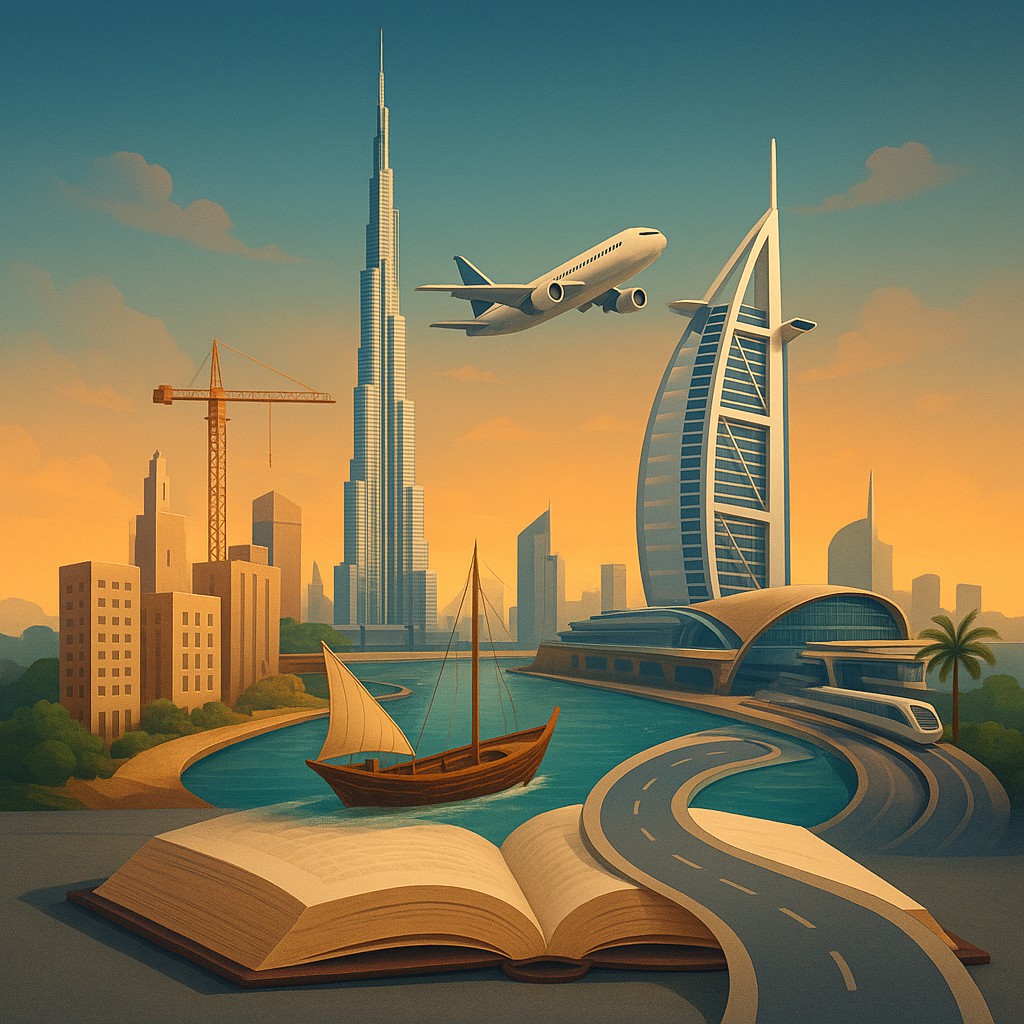
Dubai can feel like a city-sized magic trick: one minute it is a sleepy trading port at the desert’s edge, the next it is a glass-and-steel skyline, a global aviation crossroads, and a place where you can ski indoors while the summer sun tries to melt everything outside. It is tempting to explain all of this with a single word: oil. It is a neat story, and neat stories are often wrong.
The real story of Dubai is messier, more interesting, and far more useful if you want to understand how places get rich. Dubai is a case study in geography, trade, risk appetite, branding, and policy. It is also the story of a small ruling family placing big bets, of people arriving from everywhere to build a future, and of a city that keeps reinventing itself because it has to.
If you want to learn “everything” about Dubai, the trick is to stop treating it as one miracle and start seeing it as a chain of choices, shocks, and adaptations. Follow that trail from fishing village to global city, and along the way we can brush off the myths that cling to the skyscrapers like desert dust.
A creek, a desert, and an early habit of doing business
Dubai’s first advantage was not gold, oil, or futuristic design. It was Dubai Creek, a saltwater inlet that made the area a natural anchorage on the Arabian Gulf. In a region where overland travel was punishing and fresh water was scarce, a sheltered harbor is basically a free “open for business” sign. Communities formed around fishing, pearl diving, and small-scale trade, with life set by the rhythms of sea and season.
For centuries, the wider region sat between major commercial worlds: India to the east, the Persian coast to the north, East Africa to the south, and the Ottoman and later European spheres to the west. Dubai was not the dominant power, but it learned a crucial skill: making exchange easy. That may sound modest, but it is the backbone of many wealthy places. When you help other people trade, you take a small cut of almost everything.
In the 1800s, Dubai’s political identity hardened under the Al Maktoum family, which has ruled since 1833. The area was part of the “Trucial States,” a set of coastal sheikhdoms that entered agreements with Britain aimed at reducing maritime conflict. Whatever your view of imperial geopolitics, those arrangements reduced one major economic killer: uncertainty at sea. Trade likes safety, and Dubai’s leaders treated that as a practical fact of life.
Pearls, setbacks, and the early lesson that Dubai must adapt
Before oil, pearls were the Gulf’s glamour industry. For a time, pearling generated serious income and linked the region to luxury markets far away. But it was a delicate prosperity, dependent on nature, labor, and demand. Then came two heavy blows in the early 20th century: the Great Depression crushed luxury spending, and cultured pearls from Japan upended the natural pearl market. Picture your main export being undercut by a cheaper, more reliable substitute. That is exactly what happened.
Dubai did not sit back and sulk. It pivoted toward trade and services and did something quietly radical: it tried to become the easiest place in the region to do business. One of the most cited steps came under Sheikh Saeed bin Maktoum, who reduced certain taxes and encouraged merchants to set up shop. The result was an influx of Iranian, Indian, and other traders, turning Dubai into a commercial magnet even before it had large state revenues.
This era matters because it established a pattern that shows up again and again in Dubai’s later story: a shock lands, Dubai adjusts, and the adjustment becomes the next version of its identity. Modern Dubai is not only a resource story, it is an adaptation story.
Oil arrives, but it is not the whole plot
Oil was discovered in Dubai in 1966, later than in some neighboring areas. Exports began around 1969. The revenue mattered enormously, especially because it arrived when the city was ready to invest and when the region’s strategic importance was rising. But Dubai never had the vast reserves of Abu Dhabi. Even at its peak, oil represented a smaller share of Dubai’s long-run economic base than many outsiders assume.
What matters is what Dubai did with oil money. Rather than building an economy that mostly depends on pumping, it used early hydrocarbon income as seed capital for infrastructure: ports, roads, airports, electricity networks, telecommunications, and later, real estate and tourism assets. If you want an analogy, oil was not the main course, it was the starter that paid to build the restaurant.
Dubai’s leaders also pursued a deceptively simple, difficult-to-execute philosophy: if you cannot be the biggest producer of a commodity, become the best platform for commerce. That meant building the physical and legal systems that let goods, money, and people move with minimal friction.
A quick myth check: “Dubai is rich because of oil”
This is the most common misconception, and it sticks because it feels logical. Oil made the Gulf rich, so Dubai must be oil-rich. In reality, Dubai’s economy today is driven largely by trade, logistics, real estate, financial services, tourism, and aviation. Oil still exists and still brings revenue, but it is not the dominant engine people picture.
A better summary is: Dubai used a window of oil income to build a diversified, globally connected city that can make money in many different ways.
The big bets: ports, airlines, and the art of being a hub
Dubai’s geography is both harsh and promising. It sits in a hot desert with limited natural freshwater and virtually no farmland, but it is within a few hours’ flight of Europe, South Asia, and much of Africa. That makes it well suited to hub economics, the idea that you can get rich by connecting other places efficiently. In other words, it is the world’s most organized layover.
Two flagship bets defined this hub strategy:
First, logistics. Port Rashid opened in the early 1970s, and Jebel Ali Port followed later in the decade, becoming one of the largest man-made harbors in the world. Ports are not just places where ships sit. They are movement factories, with cranes, customs systems, warehousing, and shipping networks that turn location into income.
Second, aviation. Emirates airline launched in 1985 and grew into a global carrier that helped make Dubai International Airport one of the world’s busiest for international travel. Airlines and airports create network effects: the more routes and passengers you have, the more valuable the hub becomes. That value then spills into hotels, restaurants, conferences, retail, and regional corporate offices.
Dubai also built specialized zones and policies to speed this growth. Jebel Ali Free Zone, established in the 1980s, offered incentives such as 100 percent foreign ownership within the zone and streamlined business processes. Later, other free zones targeted media, finance, tech, health care, and more. The logic was consistent: reduce friction for global companies and attract talent and capital.
How Dubai turned policy into a product
Dubai does something many places manage only by accident: it treats the business environment like a product that can be designed. That includes regulations, licensing, dispute resolution, infrastructure quality, and even the way the city feels for visitors and expatriate workers. You do not have to agree with every choice Dubai has made to see how deliberate the approach is.
A few policy themes appear again and again:
- Speed and clarity: Decisions are often made faster than in many large democracies, which can appeal to investors, even if it comes with tradeoffs in transparency and public debate.
- International friendliness: Dubai has built systems that let foreign companies and professionals operate at scale, including across many free zones.
- Safety and predictability: Low crime and strong enforcement create a sense of order that businesses tend to value.
- Visibility and branding: Dubai markets itself relentlessly, and it likes to build “proof” you can photograph.
It is worth saying the quiet part out loud: cities do not only compete on taxes and laws. They compete on confidence. Dubai’s government has repeatedly projected competence and ambition, and that image can become self-fulfilling when it pulls in investment and skilled workers.
The skyline is not just ego, it is an economic strategy
Dubai’s construction boom was not only about architecture or bragging rights, though it certainly includes some swagger. Real estate and mega-projects became a way to accelerate growth by attracting foreign capital, tourism, and global attention. Projects like Palm Jumeirah and Burj Khalifa were not just structures, they were advertisements you could live inside.
Real estate also became a financial engine. Property sales, rentals, development fees, and related services can generate enormous economic activity. But the engine comes with a familiar risk: boom-and-bust cycles. Dubai saw a major correction around the 2008 global financial crisis, when credit tightened and property prices dropped sharply. The recovery involved restructuring, support from Abu Dhabi, and a renewed focus on regulation and longer-term planning.
Another myth check: “Dubai built itself overnight”
Dubai’s rise has been rapid, but it was not instantaneous. The foundations were laid over decades: ports, governance systems, road networks, airport capacity, and a steady buildup of reputation. The skyscrapers are the visible part, like foam on a wave. The wave itself is infrastructure plus policy plus global networks.
A city of newcomers: migration, labor, and the human engine
Dubai’s population is famously international, with expatriates making up a large majority. That is not a footnote, it is central to how the city works. Dubai imports labor and talent at immense scale, from construction and service work to engineering, finance, design, and medicine. The result is a city that can expand quickly because it can scale its workforce quickly.
This model also raises serious questions about labor rights, working conditions, and long-term security for residents who are not citizens. Dubai has introduced reforms in recent years, but debates continue around fairness, mobility, and protections. To understand Dubai honestly, you have to hold two truths at once: openness to global workers is a key ingredient in its success, and the terms of that openness carry real human consequences.
One helpful way to think about Dubai is as a global workplace city. Many people arrive to earn, learn, and move on, while others build long-term lives. That circulation keeps the economy dynamic, but it can also make community and belonging more complicated than in places where citizenship and residency connect more easily.
The federation that made the leap possible
Dubai is one of seven emirates that make up the United Arab Emirates, established in 1971. That matters because Dubai’s rise took place inside a broader political and economic framework that delivered stability and shared national development. Abu Dhabi’s oil wealth, federal institutions, and regional diplomacy all helped create a secure environment in which Dubai could pursue its commercial strategy.
Dubai has its own economic model, but it is not operating in isolation. It benefits from being part of a country with significant resources, strategic alliances, and coordinated infrastructure. If Dubai is the nimble merchant, the UAE is the sturdy ship it sails in.
A snapshot of the transformation (table)
| Era |
Main economic drivers |
Big challenge |
Dubai’s key move |
| Pre-1900s |
Fishing, pearling, local trade |
Harsh environment, limited resources |
Use the creek and maritime links to facilitate trade |
| Early 1900s to 1960s |
Trade and remaining pearling |
Pearl collapse, global downturns |
Attract merchants, reduce frictions, build a trading identity |
| 1970s to 1980s |
Oil revenues plus trade |
Building a modern state quickly |
Invest in ports, roads, airport, utilities |
| 1990s to 2000s |
Logistics, aviation, real estate, tourism |
Global competition, property cycles |
Free zones, Emirates growth, global branding |
| 2010s to today |
Services, finance, tech, tourism, logistics |
Diversification, sustainability, regional rivalry |
Regulatory reforms, mega-events, innovation and green initiatives |
Tourism, shopping, and “events as infrastructure”
Dubai’s tourism strategy is not simply “come see tall buildings.” It is built around being easy to visit, easy to spend money in, and easy to pair with business travel. The city developed beaches, resorts, malls, museums, entertainment, and a year-round calendar of conferences and exhibitions. This is sometimes dismissed as shallow, but economically it is coherent: tourism brings in foreign currency, supports jobs, and feeds airlines and real estate.
Dubai also uses major events to speed investment and boost global visibility. Expo 2020 (held in 2021-2022 due to the pandemic) is a strong example. Events create deadlines, and deadlines are surprisingly effective at finishing infrastructure and coordinating public and private investment. The long-term payoff depends on what happens after the spotlights move on, but “event momentum” is very much part of Dubai’s playbook.
The less shiny constraints: water, energy, heat, and risk
Dubai’s success is real, but it is not effortless. The environment imposes costs that many temperate cities never face. Water largely comes from desalination, which requires a lot of energy and brings environmental challenges such as brine disposal. Cooling buildings in extreme heat consumes power, and as the city grows, demand grows with it.
There are economic risks, too. Dubai is tightly tied to global trade and travel, so global shocks hit hard. The 2008 financial crisis and the COVID-19 pandemic both hurt sectors like aviation, tourism, and real estate. Dubai’s rebound has been notable, but resilience demands constant adjustment, not just confidence.
A final constraint is competition. Other regional hubs, from Doha to Riyadh, are investing heavily in similar ambitions. Dubai’s edge is experience and an established network, but hubs have to keep earning their hub status.
What Dubai teaches about getting rich (without pretending it is a fairy tale)
Strip away the fireworks and the social-media angles, and Dubai still offers clear lessons in how modern wealth can be built:
- Use geography, even when it is not comfortable geography. Deserts are inconvenient, but crossroads are powerful.
- Build infrastructure early, then keep upgrading it. Ports and airports multiply an economy’s reach.
- Design rules and processes that reduce friction. For many businesses, time and certainty matter as much as tax rates.
- Diversify on purpose. Depending on one revenue source is like parking your life savings in a single stock.
- Branding matters, but it has to be backed by delivery. Dubai’s bold image worked because it often matched real capacity.
Dubai is not a universal template. Its political system, demographics, and location are unique, and some of its methods would be difficult or undesirable elsewhere. But as a learning case it is exceptional because you can see the machinery at work: trade, policy, infrastructure, talent, and narrative all locking together.
Walking away smarter: seeing Dubai as a machine, not a miracle
Dubai did not get rich because it found a magic lamp under the dunes. It got rich by repeatedly building a machine that turns connection into value: ships into port revenue, planes into passenger flows, people into opportunity, and reputation into investment. Oil helped pay for early parts of that machine, but it never dictated the whole design.
If you take one idea with you, let it be this: Dubai treats reinvention as a habit. That habit is harder than it looks. It requires long-term planning, tolerance for risk, and a willingness to be judged loudly on a global stage. Whether you admire the model, critique it, or do both at once, understanding Dubai gives you a sharper way to see how modern cities compete, grow, and endure.
And that perspective is empowering. Once you can spot the strategy beneath the skyline, you start seeing it everywhere: in ports and policies, in airports and zoning maps. Dubai stops feeling like a mystery and starts reading like a text, written in concrete, contracts, and very ambitious air-conditioning.