Imagine you are standing in a grocery store, staring at a row of breakfast cereals. For decades, the companies making those cereals have used one main yardstick for success: "More." They want to sell more boxes than last year, earn higher profit margins, capture more market share, and see a constantly climbing stock price. This obsession with a single upward line - known as Gross Domestic Product (GDP) on a national scale - has been the compass for our global ship for over seventy years. But there is a glaring problem with a compass that only points "Up": it doesn't tell you if you are about to sail over a waterfall or crash into a reef. We have been so busy measuring our speed that we forgot to ask where we are going and whether the ship's hull can even take the pressure.
As it turns out, this "More" philosophy is starting to crack. We see the signs in warming oceans and the widening gap between people who have too much and those who don't have enough to eat. Economists and thinkers have long searched for a better way to picture a world that works for everyone without breaking the planet. This is where the "Doughnut" comes in. It isn't a literal pastry, but a bold new way of thinking about how humans can thrive together. It suggests that instead of chasing an endless upward line on a graph, we should aim for a circular "sweet spot" where no one is left behind and the environment isn't pushed past its breaking point.
Moving Beyond the Obsession with Infinite Growth
To understand why the Doughnut model is so revolutionary, we first have to look at what it is trying to replace. Traditional economics was born in an era when the world seemed relatively empty. Resources felt endless, and the human population was much smaller. Back then, growth looked like progress because it brought electricity, medicine, and transport to millions. However, we now live in a "full" world where our industrial activity is so massive that it actually changes the chemistry of the atmosphere. Despite this shift, our economic systems are still hard-wired to demand growth every single year, whether or not that growth actually makes people happier or healthier.
The Doughnut model, created by economist Kate Raworth, challenges the idea that an economy is only "healthy" if it is growing. Think of it like a human body. When a child grows, it is a sign of health and energy. But if that child reaches adulthood and their feet keep growing, or their arms keep getting longer, that isn't health anymore; it is a medical emergency. The Doughnut suggests our global economy needs to reach a "mature" state where it stops expanding its physical footprint and instead focuses on doing things better. This is a shift from quantity to quality. It asks a simple question: what if the goal of the economy wasn't to grow forever, but to bring us all into balance?
Navigating the Two Rings of Human Wellbeing
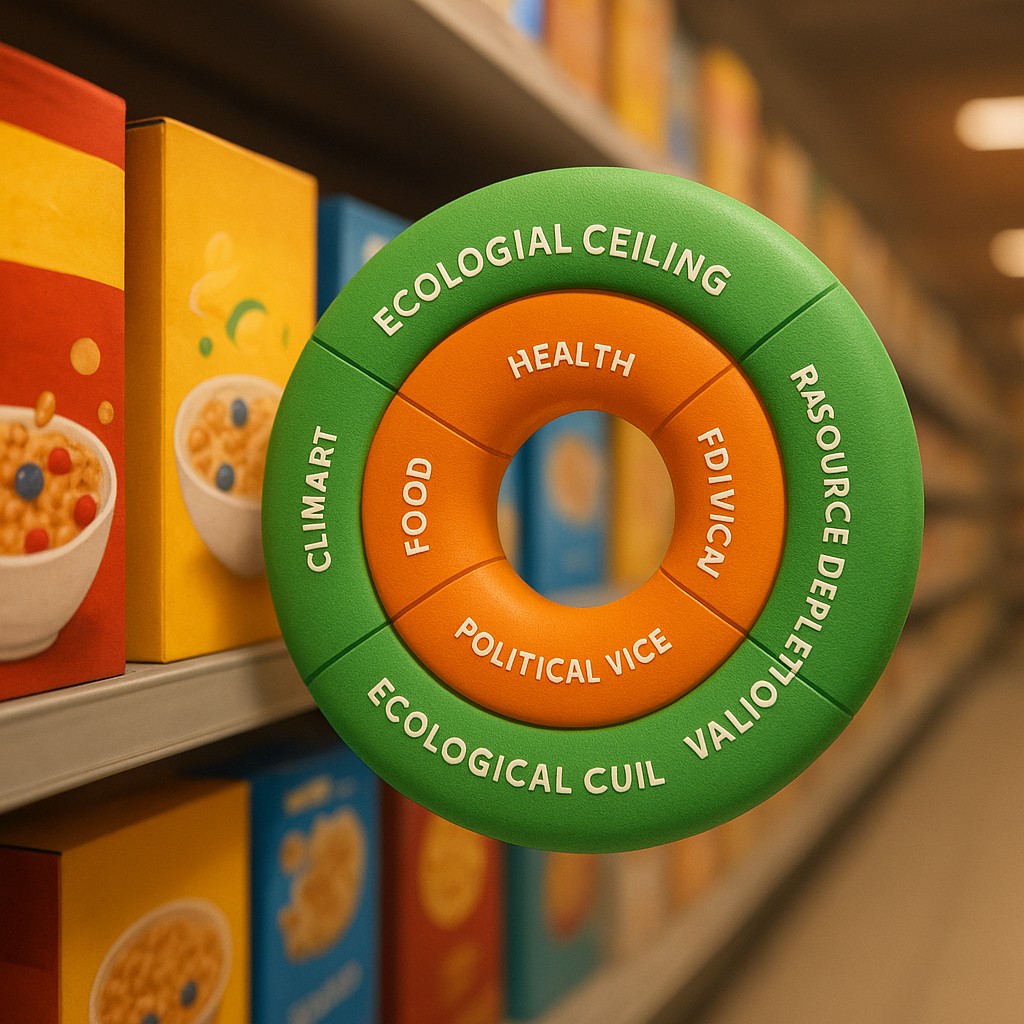
The model is easy to picture because it looks exactly like a classic ring doughnut. It consists of two rings that create a "safe and just space" in the middle. The inner circle is the Social Foundation. This ring represents the life essentials that every person on Earth deserves, such as clean water, healthy food, decent housing, gender equality, and a political voice. If a person falls into the "hole" in the middle of the doughnut, they are suffering from a lack of human rights. A successful economy is one that pulls every single person out of that central hole and onto the solid ground of the doughnut’s dough.
The outer circle is the Ecological Ceiling. This represents the nine planetary boundaries that scientists, such as those at the Stockholm Resilience Centre, have identified as vital for a stable environment. These boundaries include things like climate change, loss of wildlife, chemical pollution, and water use. If we push past this outer ring, we are "overshooting" what the planet can handle. Just as a person cannot survive if they stop eating (falling into the hole), they also cannot survive if they set their own house on fire (overshooting the ceiling). The goal is to live in the space between these two rings, making sure there is enough for everyone without destroying the life-support systems we rely on.
The Twelve Foundations and Nine Boundaries
To make this more than just a vague idea, the Doughnut uses specific data to measure our progress. The social foundation is based on the United Nations' Sustainable Development Goals. It focuses on twelve areas that are necessary for a dignified life. When we look at the world this way, we see we are currently failing millions of people. Huge populations still lack electricity, basic healthcare, or schooling. In the Doughnut model, these failures aren't just "unfortunate side effects" of growth; they are the primary signs that the economy is failing its most basic job.
On the other side, the ecological ceiling is measured by those nine planetary boundaries. Unlike the social foundation, where we want to "fill the gap," the planetary boundaries are limits we must respect. For example, if we pump too much carbon dioxide into the air, we cross the line for climate change, leading to worse storms and rising seas. If we use too much fertilizer in farming, the chemicals run off into the oceans and create "dead zones" where fish cannot live. By mapping our global performance, we can see exactly where we are overstretching. Currently, humanity is overshooting several of these limits, particularly regarding the climate and biodiversity. Essentially, we are "eating" the future to pay for the present.
| Aspect |
The Social Foundation (Inner Ring) |
The Ecological Ceiling (Outer Ring) |
| Goal |
Ensure no one lacks life's essentials. |
Ensure we don't stress Earth’s systems. |
| Key Metrics |
Food, water, energy, health, equity. |
Climate change, ocean health, pollution. |
| Current Status |
Massive gaps (billions lack basics). |
Massive overshoot (past safe limits). |
| Desired Direction |
Move outward toward the "dough." |
Move inward toward the "dough." |
| Economic Logic |
Distributive (sharing resources fairly). |
Regenerative (working with nature). |
Replacing the Circular Flow with a Living Web
One reason we struggle to see flaws in our current system is that economics students are often taught the "Circular Flow" diagram in their first week of university. This drawing shows money moving between households and businesses, but it usually ignores two massive things: the environment and the unpaid work of caregivers. It treats the economy as a closed loop existing in a bubble. The Doughnut model replaces this old view with an "embedded economy" perspective. In this view, the economy is part of human society, and human society is part of the living world.
When we realize the economy sits inside the environment, we stop seeing "nature" as just a warehouse for raw materials or a trash can for our waste. Instead, we see it as the foundation that makes life possible. This shift leads to two major design goals for a healthy economy: it must be distributive and regenerative. Being distributive means designing the economy so that wealth is shared more fairly among everyone who helps create it, rather than letting it pile up at the top. Being regenerative means designing our production to mimic nature, where waste from one process becomes the "food" for another, instead of the "take-make-use-lose" model we have today.
Correcting Common Myths About the Doughnut
When people first hear about the Doughnut, they sometimes assume it is a call for everyone to live in poverty or for technology to stop. This is a major misunderstanding. In fact, the Doughnut model calls for a higher quality of life for the billions of people currently living in the "hole." To get them into the sweet spot, we need incredible innovation. We need better ways to grow food without chemicals, more efficient ways to build homes using recycled materials, and smarter ways to move people and goods using clean energy. The Doughnut doesn't hate technology; it just wants technology to solve the right problems.
Another myth is that the Doughnut is a rigid set of rules or a specific tax plan. It is actually a flexible framework that works at any scale. Cities like Amsterdam, Copenhagen, and even small towns in Sweden have adopted "City Doughnuts." They look at their local policies through the lens of the model, asking: "How can our city be a home to thriving people while respecting the health of the whole planet?" This might lead one city to invest in bike lanes and another to focus on affordable housing or better recycling. The model provides the destination, but it lets each community choose its own path to get there.
The Practical Magic of Regenerative Design
If the old economy was "extractive" (taking what it can), the new economy must be "regenerative." This sounds like a complex word, but it really just means acting like a forest. In a forest, there is no such thing as "waste." A fallen leaf becomes soil, which feeds the tree. Businesses are starting to apply this by using "circular economy" principles. For instance, a carpet company might stop selling carpets and start leasing them instead. When the carpet wears out, they take it back, break down the fibers, and make a brand-new one. This keeps materials in a loop and reduces the need to mine more oil or shear more sheep, helping us stay within that outer environmental ring.
On the social side, being "distributive" means rethinking ownership. Think about a ride-sharing app. In a traditional model, the drivers do the work, but the profits go to a small group of shareholders in a distant city. In a distributive model, the drivers might own the platform together, ensuring that the wealth stays in their own community. This helps pull people out of the social gap (the hole) without needing the whole global economy to grow forever. It is about being smarter with what we already have and making sure it goes where it is needed most.
Reimagining Success for the Twenty-First Century
Ultimately, the Doughnut model invites us to explore a new economic frontier. For a long time, we have been told there is no alternative to the way things are, and that we must accept environmental destruction as the price of "progress." The Doughnut proves that this is a failure of imagination, not a law of nature. We have the technology, the data, and the resources to ensure every human being has a seat at the table without burning down the kitchen. The transition won't be easy, as it requires us to challenge powerful interests and change our own habits, but the reward is a world that is more stable and joyful.
The most exciting part of this shift is that it replaces a narrow metric like GDP with a vibrant, many-sided vision of a thriving society. Instead of asking how much money changed hands today, we can ask how many people were fed, how much carbon was stored, and how much the local wildlife has recovered. It turns economics from a dry study of statistics into a creative mission to design a better home for humanity. As you go about your day, look at the systems around you through the lens of the Doughnut. Ask whether a product or a policy is bringing us closer to that sweet spot in the middle, or pushing us toward the edges. Once you see the Doughnut, it is hard to look at the world any other way, and that new vision is exactly what we need for a future worth living in.