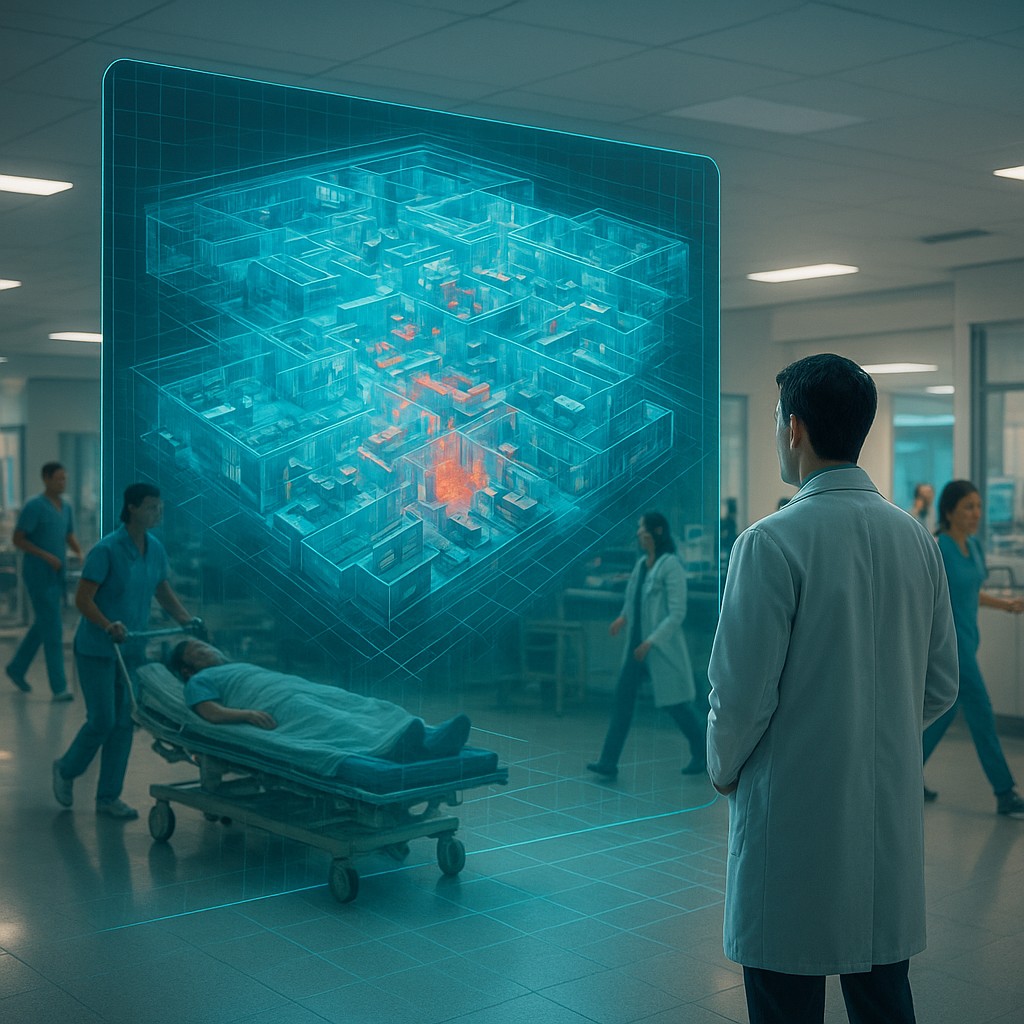
Imagine walking into a massive, bustling city hospital on a Monday morning. The air is thick with organized chaos: the rhythmic beeping of monitors, the rattle of rolling gurneys, and the brisk footsteps of nurses. To a casual observer, it looks like a high-speed game of Tetris where the blocks are human beings and the game never ends. Traditionally, hospital administrators have managed this chaos by looking in the rearview mirror, analyzing yesterday’s data to guess what might happen today. They might see that the emergency room was overcrowded at noon, but by the time they realize it, the bottleneck has already formed, the staff is exhausted, and the patients are frustrated.
Now, imagine if that same hospital had a "ghost" version of itself living inside a high-powered computer. This isn't just a static map or a 3D model; it is a breathing, reactive replica that knows exactly how many patients are in the waiting room, which elevators are out of service, and how many surgeons are currently scrubbing in. This virtual shadow is what tech experts call a Digital Twin. It acts as the hospital’s personal crystal ball, allowing managers to fast-forward into the future to see where "traffic jams" will occur before they even start. By turning data into a living simulation, healthcare is shifting from reactive firefighting to a proactive, strategic game of chess.
Mirroring Reality in the Silicon Realm
The concept of a Digital Twin might sound like science fiction, but it is actually a practical evolution of how we use data. At its core, a Digital Twin is a virtual model of a physical object, process, or system. While architects have used 3D models for years, those models are usually "dead" because they do not change once the building is finished. A Digital Twin, however, is very much alive. It stays connected to the real world through a constant stream of information. Sensors in hospital beds, GPS trackers on portable X-ray machines, and real-time updates from the pharmacy all feed into this digital replica. If a sudden rush of patients arrives at the ER, the digital version reflects that surge instantly.
This synchronization allows for something remarkable: the ability to run "what-if" scenarios without risking human lives. If an administrator wonders what would happen if they diverted three ambulances to a nearby facility, they can test it in the digital world first. They can see how that decision ripples through the entire system, affecting everything from bed availability to the cleaning crew’s schedule. This removes the guesswork from management. Instead of waiting for a crisis to emerge, the Digital Twin flags the problem hours in advance. This gives the hospital time to call in extra staff or prep an additional operating room.
The Ingredients of a Living Digital Shadow
Building a Digital Twin requires more than just a fast computer; it needs a massive amount of high-quality data. Think of it like a gourmet meal where the data points are the ingredients. You need admission records to understand the flow of people, electronic health records to gauge the severity of illnesses, and even external data like weather or traffic patterns. If a massive snowstorm is in the forecast, the Digital Twin can account for the fact that staff might arrive late and slip-and-fall injuries will likely spike. Artificial intelligence weaves all these different threads together to create a clear, predictive picture.
This data is processed through two main types of mathematical models. The first is "discrete-event simulation," which treats every patient movement as a specific step in a process, like a car moving through an assembly line. The second is "agent-based modeling," which treats people like independent actors with their own unique behaviors. By combining these, the Digital Twin can simulate both the rigid rules of hospital policy and the unpredictable nature of human behavior. This complexity is necessary because hospitals are not predictable factories; they are ecosystems where a single delayed lab result can cause a chain reaction that stalls dozens of patient discharges later in the afternoon.
| Component |
Physical Hospital Role |
Digital Twin Equivalent |
| Sensors & IoT |
Collecting vital signs and locations |
The "Nervous System" sending data |
| Cloud Computing |
The physical structure and offices |
The "Brain" where simulations run |
| Artificial Intelligence |
Staff making decisions |
The "Predictor" identifying patterns |
| Feedback Loop |
Adjusting workflows on the fly |
The "Action" taken based on simulation |
Moving Beyond Maps to Predictive Intelligence
Some people mistakenly believe a Digital Twin is just a fancy version of Google Maps for a building. While it does track locations, its true power lies in its ability to understand "throughput" (how fast patients move through the system) and "capacity." In a hospital, capacity involves more than just the number of beds. It requires a bed, a nurse to monitor it, a doctor to oversee the patient, and a cleaning crew to sanitize the room once the patient leaves. A Digital Twin looks at all these moving parts at once. It knows that you cannot open a new ward if you do not have enough sterilized linens, even if the rooms themselves are empty.
This predictive power is vital for managing staffing levels, which is one of the most expensive and difficult parts of running a hospital. Traditionally, staffing is handled using fixed ratios, such as one nurse for every four patients. However, some patients require much more attention than others. Digital Twins can analyze the "acuity," or the severity of the patient load, and predict that the intensive care unit will be overwhelmed by 10:00 PM based on surgeries currently in progress. Managers can then move a nurse from a quieter wing to the ICU before stress levels reach a breaking point. This prevents staff burnout and ensures that patients receive the specific care they need.
Correcting the Myths of the Digital Mirror
Because this technology is so new, several misconceptions have started to spread. One common myth is that the Digital Twin will eventually replace human managers or doctors. In reality, the twin is more like a world-class assistant. It provides the data and the forecast, but it cannot account for human empathy or the ethical complexities of medical care. A person must still decide how to prioritize resources when the simulation shows a shortage. The goal is to support human intelligence, not replace it, by removing the mental burden of tracking thousands of variables at once.
Another misconception is that Digital Twins are primarily used to invade privacy or track employees. While the system does monitor locations, its focus is on "aggregate flow" rather than individual surveillance. The objective is not to see if a specific nurse took a five-minute break; it is to see if five nurses are getting stuck at a medication station because the software is slow. By fixing the system rather than policing the people, Digital Twins actually improve the working environment. When the "machine" of the hospital runs smoothly, the people inside can focus on what they do best: healing.
The Invisible Architecture of the Future
When we think about the evolution of medicine, we often focus on new drugs or robotic surgeries. However, the invisible architecture of how hospitals function is just as important. A hospital could have the best surgeons in the world, but if a patient is stuck in a hallway for six hours because of a scheduling error, the quality of care suffers. Digital Twins are the hidden foundation of the modern "smart hospital." They allow us to treat the entire building as a single, integrated organism. This holistic view is necessary because the different parts of healthcare are so tightly linked that you cannot change one without affecting the others.
As this technology becomes more affordable, it will likely spread from major urban medical centers to smaller clinics and long-term care facilities. The ultimate dream is a "Patient Twin," where every individual has their own digital replica. Doctors could use these to test medications or surgical procedures before performing them on the actual person. While we are still a few steps away from that level of personalization, the operational Digital Twin is already here. It works quietly in the background to ensure that when a crisis hits, the hospital is ready, rested, and one step ahead of the clock.
This transition represents a profound shift in how we handle the complexity of human health. It shows how technology can bring order to chaos and provide a safer, more efficient environment for both patients and providers. As you look toward the future, remember that some of the most life-saving innovations are not just the ones that go inside the body, but the ones that manage the world around it. You now have a window into the digital pulse of the modern hospital, a tool that turns the unpredictable into the manageable.