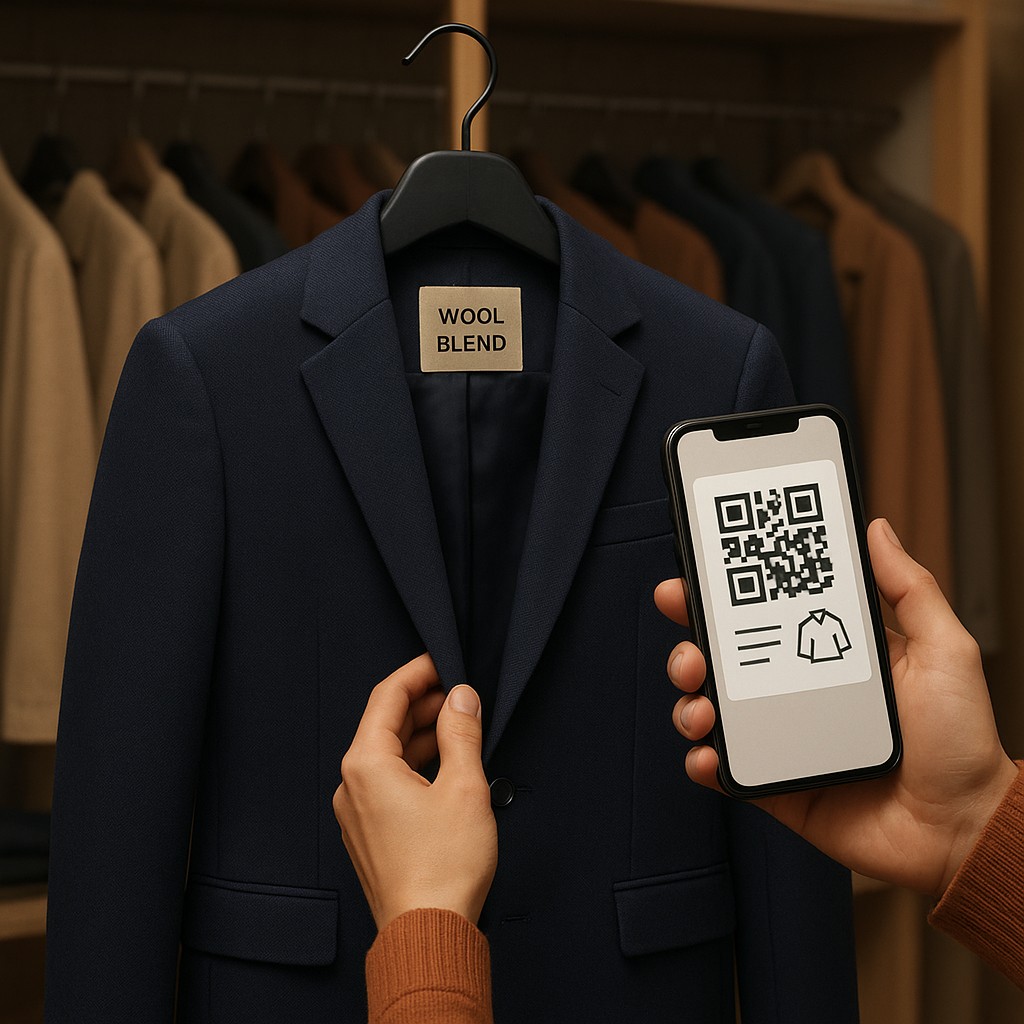
Imagine you are standing in a thrift store, holding a sleek, dark navy blazer. The label says it is a wool blend, but it feels suspiciously soft, as if it might contain cashmere or perhaps a touch of polyester. Under today’s global waste system, that blazer is a mystery box. If you get tired of it and toss it into a recycling bin, a technician at a sorting plant has to play a high-stakes guessing game. Because they cannot be 100 percent sure if the lining is acetate or nylon, or if the buttons are real horn or plastic, the garment is usually labeled unrecyclable and sent to a landfill. It is a tragic end for a piece of clothing that took thousands of liters of water and a massive amount of energy to create.
The fashion industry produces roughly 100 billion garments every year, and a staggering 85 percent of them end up in the trash. This does not happen just because we are fickle about style; it happens because our logistics networks have no collective memory. Once a garment leaves the factory, its chemical history, repair record, and exact material makeup are wiped clean. However, a new technological shift is trying to give these objects a permanent memory through something called a Digital Product Passport (DPP). By attaching a scannable layer of data to every item, we are moving from a world of anonymous junk to a world of intelligent, traceable assets.
Decoding the Molecular Autobiography
At its core, a Digital Product Passport is not a physical paper document like the one you use to travel. Instead, it is a digital "twin" of a physical object. Think of it as a cloud-based diary that begins its first entry the moment a farmer harvests cotton or a lab creates a synthetic fiber. You access this diary through a permanent ID on the garment, such as a QR code stitched into the hem, a chip embedded in a button, or a tiny RFID tag that can be read from several feet away.
The passport creates a bridge between the physical item and a digital record. When a mill processes raw fibers, it uploads data about the pesticides used on the crop and the dyes applied to the yarn. As the item moves to a factory, the passport records every chemical treatment, including flame retardants or water-repellent coatings. This is vital because many recycling processes are "allergic" to certain chemicals. If a recycler knows exactly what is in the fibers at a molecular level, they can use precise chemical methods to break the garment down into high-quality new materials. This prevents "downcycling," where clothes are shredded into low-grade items like carpet padding or insulation.
The Architecture of Transparent Logistics
For this system to work, global supply chains must change how they communicate. Currently, most companies guard their supplier lists like state secrets. However, the DPP framework ignores these private silos in favor of a shared data language. This isn't just about knowing who made the shirt, but how it was made and what has happened to it since it left the shop floor. This transparency acts as a powerful deterrent against "greenwashing," which is when companies make vague, unsupported claims about being eco-friendly.
| Feature |
Conventional Labeling |
Digital Product Passport |
| Material Detail |
Basic percentages (e.g., 60% Cotton) |
Exact fiber origin and chemical additives |
| Durability Data |
None |
Repair history and care instructions |
| Recyclability |
General symbols (often misleading) |
Specific instructions for sorting and recycling |
| Verification |
Self-reported by the brand |
Verified by independent data on a shared record |
| Ownership Link |
None |
Possible to track resale and proof of authenticity |
Because the DPP is updated throughout the garment’s life, it also captures the middle of the story. If a high-end brand offers a repair program, every new zipper or sewn patch is logged. This creates a history that adds value to the item. In the luxury resale market, a buyer can scan a jacket and see a certified record of its upkeep. This ensures they aren't buying a counterfeit or a poorly maintained knockoff. It transforms a piece of clothing from a disposable product into a durable vessel of information.
Overcoming the Tower of Babel Problem
One of the biggest hurdles to a universal passport system is the lack of a common language. If a cotton plant in India uses one type of software and a dye house in Italy uses another, the data gets lost. Engineers call this a lack of interoperability, meaning the systems cannot "talk" to each other. To solve this, international organizations and the European Union are pushing for standardized data rules. These rules act like a universal translator, ensuring that a scanner in a French recycling plant can understand data uploaded by a machine in Vietnam.
This standardization also balances the tension between privacy and transparency. Brands are understandably hesitant to show their entire list of secret suppliers to competitors. To handle this, the DPP uses layered access. A shopper might scan the QR code and see a fun map of where their clothes came from and how to wash them. A professional recycler, however, would use a different digital "key" to see technical data about polyester blends and chemical finishes. This selective transparency makes the system work for the planet without hurting the business.
The Recycler's Secret Weapon
The real magic happens at the end of a garment's life. Currently, most textile sorting is done by hand or by light-based sensors that struggle with dark colors or complex fabric blends. When every garment has a digital passport, the sorting facility becomes an automated, high-precision laboratory. Instead of guessing, a robotic arm scans the tag and immediately knows that a "wool" coat actually contains 5 percent elastane, which requires a specific chemical bath to dissolve.
This level of detail solves the purity problem in recycling. In the past, recycled cotton was often weaker than new cotton because the recycling process was a blunt instrument. With the data from a DPP, we can sort materials so accurately that the recycled fibers are almost identical to brand-new ones. This "closes the loop," allowing a shirt to become a shirt again indefinitely, rather than ending up as a rag or landfill filler. It turns a waste problem into a data problem, and data is something modern logistics can handle well.
A Future Where Objects Have Memories
Imagine a world where you are no longer just a consumer, but a "steward" of the materials you wear. When you buy a pair of jeans, you are essentially checking them out of a global library of atoms. The Digital Product Passport ensures you know exactly what those atoms are, where they have been, and where they need to go next. This shift in perspective is the ultimate goal of the "circular economy," which is a system designed to eliminate waste. It moves us away from a "take-make-waste" model and toward a system that respects the labor and energy in every stitch.
As these passports become mandatory in major markets like Europe, we will see a fast change in how we view our belongings. Your wardrobe will no longer be a collection of mystery fabrics, but a curated library of stories and facts. By revealing the hidden history of the things we own, we are doing more than just cleaning up the fashion industry; we are building a more honest and efficient relationship with the physical world. The next time you scan a tag, remember that you aren't just looking at a price, you are reading the autobiography of an object built to last.