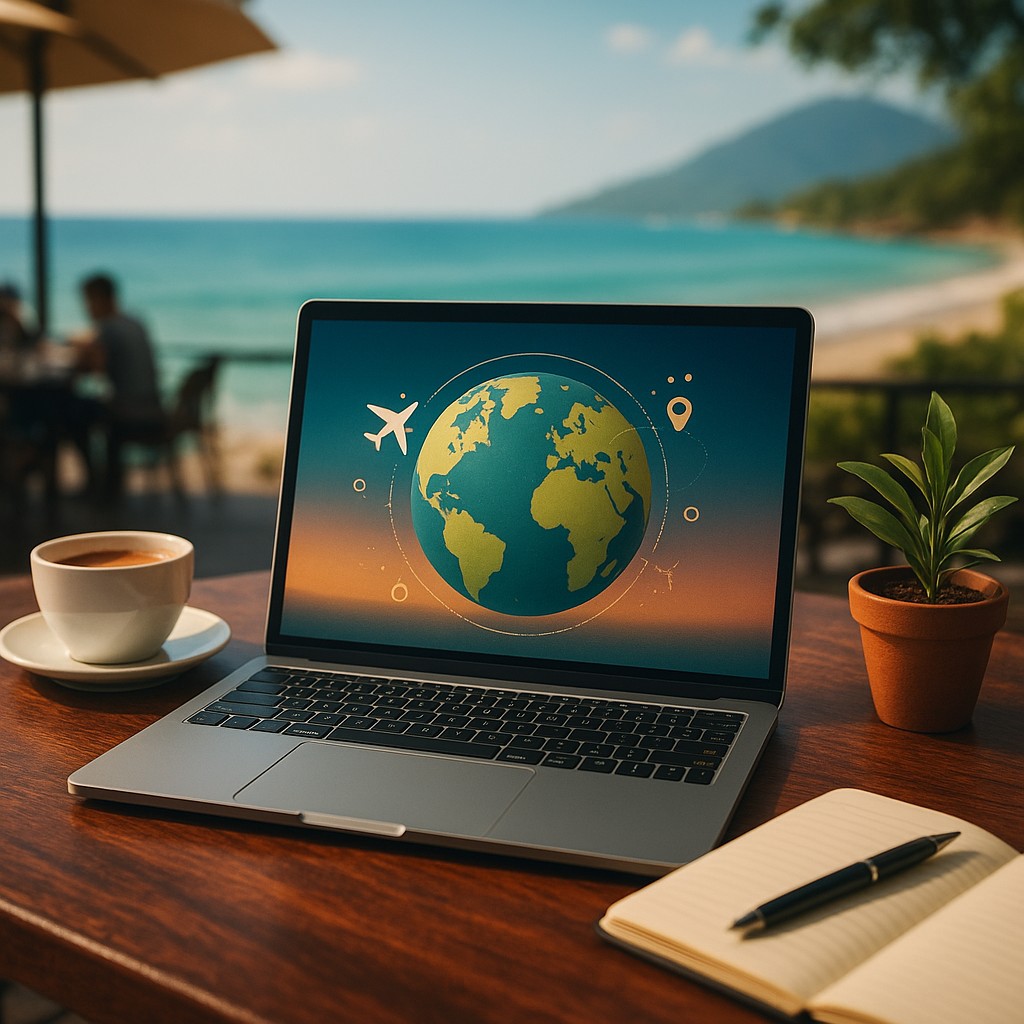
Imagine for a moment that your desk is a mahogany table in a bustling Lisbon cafe, your view is the turquoise coast of Bali, or your office is a lodge high in the Colombian Andes. For decades, this lifestyle was reserved for travelers with inheritance money or niche freelancers living in a legal gray area. Most countries viewed residency through an industrial lens: they assumed that if you lived in a place, you worked for a local company, used local resources, and paid local taxes. This "Westphalian" model was built on the idea that people are naturally tied to the soil beneath their feet.
The rise of the digital nomad visa has shattered this old connection between geography and legal duty. We are witnessing a quiet revolution in international law as nations compete for "portable" talent. By separating where you earn from where you spend, governments are rewriting the social contract. They are essentially saying: "We want your coffee money and your rent, but we don’t want the headache of managing your foreign employment taxes." This shift marks a move away from strict borders toward a more flexible, individual way of belonging.
The Legal Lag of the Industrial Age
To understand why these new visas are so radical, we have to look at the "legacy code" of international tax and immigration law. Most modern tax treaties are based on systems established after World War I. These rules were designed for a world of physical factories and slow-moving ships. The core concept was "Permanent Establishment" - the idea that if a business operated in a country, it had to have a physical footprint there. For individuals, residency was usually decided by the "183-day rule," which assumed that if you spent more than half the year in a country, you were "established" there and owed the state a cut of your total global income.
The problem is that digital work moves at the speed of light, while law moves at the speed of bureaucracy. Before nomadic visas existed, a remote worker entering a foreign country on a tourist visa was a legal anomaly. If they opened their laptop to answer emails, they were technically working illegally, since tourist visas usually forbid local employment. However, they weren't "locally employed" in the traditional sense because their boss was 5,000 miles away. This created a massive "gray market" of productive people who were technically breaking their visa terms just by doing their jobs.
Countries have realized that strictly enforcing these old rules actually hurts them. If a country deports a remote worker for sending an email, they lose the thousands of dollars that worker would have spent on local housing, dining, and tourism. The digital nomad visa is the "patch" for this outdated legal software. It creates a third category of resident: the "long-term guest" who produces value elsewhere but consumes it locally. By making this status official, countries are moving away from the idea that being present automatically equals a tax grab.
The 183-Day Limit and the Tax Shield
The engine driving most digital nomad visas is a carefully calculated "stay threshold." In classic international tax law, the 183-day mark is often the point of no return. Once you cross it, you are frequently considered a tax resident. This means the local government wants a slice of everything you earn, regardless of where the company paying you is located. For a remote worker earning a high salary in US dollars or Euros, being taxed at local rates in a country like Spain or Greece could be a massive financial deal-breaker.
To solve this, nations like Romania and Spain have introduced specific exemptions within their nomad visa programs. For example, some programs allow a professional to stay for a year (or longer with renewals) while explicitly exempting them from local income tax or social security payments, provided they don't exceed a certain number of days or meet specific "non-resident" criteria. This creates a "tax shield" that lets the worker enjoy the country's infrastructure without falling into its tax net.
This system represents a huge shift in how we think about the "cost" of a citizen. Normally, a citizen pays taxes in exchange for a bundle of services: healthcare, schools, police, and a social safety net. Digital nomads, however, are essentially "buying" a subscription to the country’s lifestyle and infrastructure while opting out of the safety net. They use the roads and parks, but they typically keep their own private health insurance and don't expect the host country to provide a pension or unemployment checks.
Comparing the New Legal Landscapes
Different countries have taken very different paths to attract the remote workforce. Some focus on bringing in high-earners to boost luxury businesses, while others look for long-term residents who can help breathe life back into emptying rural areas. The following table shows how various regions have designed their nomad "subscriptions" to balance economic gain with simple legal rules.
| Country |
Minimum Income Requirement |
Duration of Stay |
Primary Tax Benefit |
| Spain |
Generally 200% of national minimum wage |
1 year (renewable up to 5) |
Potential 15% flat tax (Beckham Law) |
| Romania |
Approx. €3,700 per month |
6 months (renewable) |
No local income tax if staying <183 days |
| Barbados |
$50,000 USD per year |
12 months |
No local income tax on remote earnings |
| Greece |
€3,500 per month |
Up to 2 years |
50% income tax reduction for 7 years |
| Dubai (UAE) |
$3,500 USD per month |
1 year |
0% personal income tax |
As you can see, the "entry price" for these visas varies quite a bit. Countries like Dubai use their existing zero-tax status to attract nomads, while European nations like Greece use tax discounts to lure professionals who might otherwise choose more established tech hubs. These variations reflect a new kind of global competition. Instead of competing for factories, nations are now competing for a person’s "taxable presence" or, at the very least, their spending power.
The Split Between Labor and Welfare
One of the deepest parts of this shift is the fading of the traditional "social contract." Historically, the deal was simple: you live here, you work here, you pay in, and the state takes care of you when you're old or sick. Digital nomad visas skip this entire structure. Because the nomad is not a "tax resident" in the usual sense, they are rarely eligible for the welfare benefits that locals receive. Legally speaking, they are permanent tourists with extra privileges.
This creates a "tiered" residency system. In the first tier are traditional citizens who are fully part of the tax and benefit system. In the second tier are digital nomads who have "unbundled" their lives. They have the right to live in the country but no right to its public wealth. For the host country, this is a very efficient economic move. They get the high-speed spending of a high-earner without the long-term cost of providing for that person’s retirement or healthcare.
However, this split also makes the worker's life more fragile. A nomad’s right to stay depends entirely on their ability to keep making money. Unlike a permanent resident or a citizen, a nomad who loses their job often loses their right to stay almost immediately. There is no safety net in a country where you are only a guest because of your outside income. This turns the nomad into a "stateless professional" in some ways: someone who is physically in one society but legally anchored in another, or perhaps anchored nowhere at all.
Sovereignty in a World Without Borders
These visas challenge our very definition of national power. Traditionally, a state’s authority was defined by its ability to control everything within its borders. If you stood on French soil, you were subject to French labor laws, taxes, and rules. The digital nomad visa creates a "legal bubble" around the individual. Inside that bubble, the person follows the labor laws of their home country (like the USA or Canada) even if they are sitting in a workspace in Tokyo or Lisbon.
This "legal teleportation" suggests we are moving toward a world where your legal status is determined more by who you are and who you work for than by where you are standing. It is a shift toward "functional sovereignty." Governments are starting to realize they don't need to control every part of a resident's life to benefit from them. By letting go of the desire to tax a nomad's income, they gain the ability to tax their spending (through sales tax and local business) and strengthen their housing markets.
We might eventually see a world where residency is "modular." You might choose to buy your "health and safety package" from Norway, your "business and tax package" from Estonia, and your "lifestyle and climate package" from Mauritius. The digital nomad visa is the first step toward this buffet-style approach to citizenship. It treats the state not as a sacred fatherland, but as a service provider in a competitive global market.
Navigating the Myths of Global Nomadism
A common mistake is thinking that digital nomad visas are a "get out of tax free" card. In reality, the legal landscape is a minefield of double-taxation risks. Just because a host country like Barbados doesn't tax your income doesn't mean your home country won't want its share. The US, for example, taxes based on citizenship no matter where you live. The nomad isn't escaping the system; they are just navigating a more complex version of it.
Accidental residency is another major trap. Many nomads assume that having the visa makes them safe. However, if they start doing business with local clients, or if their stay triggers a different legal status by mistake, they can suddenly owe years of back taxes. These visas are precision tools, not open-ended permissions. They require the worker to stay within strict limits - specifically those "stay thresholds" mentioned earlier - to keep their guest status.
Furthermore, these visas rarely lead to citizenship. Unlike traditional work visas, which often provide a path to permanent residency and eventually a passport, nomad visas are usually "dead-end" documents. They are meant to be temporary, even if they can be renewed. This ensures the nomad remains a consumer and never becomes a "burden" on the state. For the individual, this means they must always have an exit strategy or a home base. It highlights the fact that while work has become digital, our need for a permanent legal home is still very real.
As the world continues to move online, the friction between geography and labor will only grow. The digital nomad visa is a clever, if imperfect, solution to a modern puzzle: we can work from anywhere, yet we must always be somewhere. By understanding these new legal systems, you aren't just learning about travel; you are watching the birth of a new kind of global belonging. The future of work isn't just about where you sit, but about how you navigate the invisible web of laws connecting your screen to the ground beneath you. Approach this freedom with both curiosity and caution, for the world is no longer just a map of countries, but a menu of possibilities.