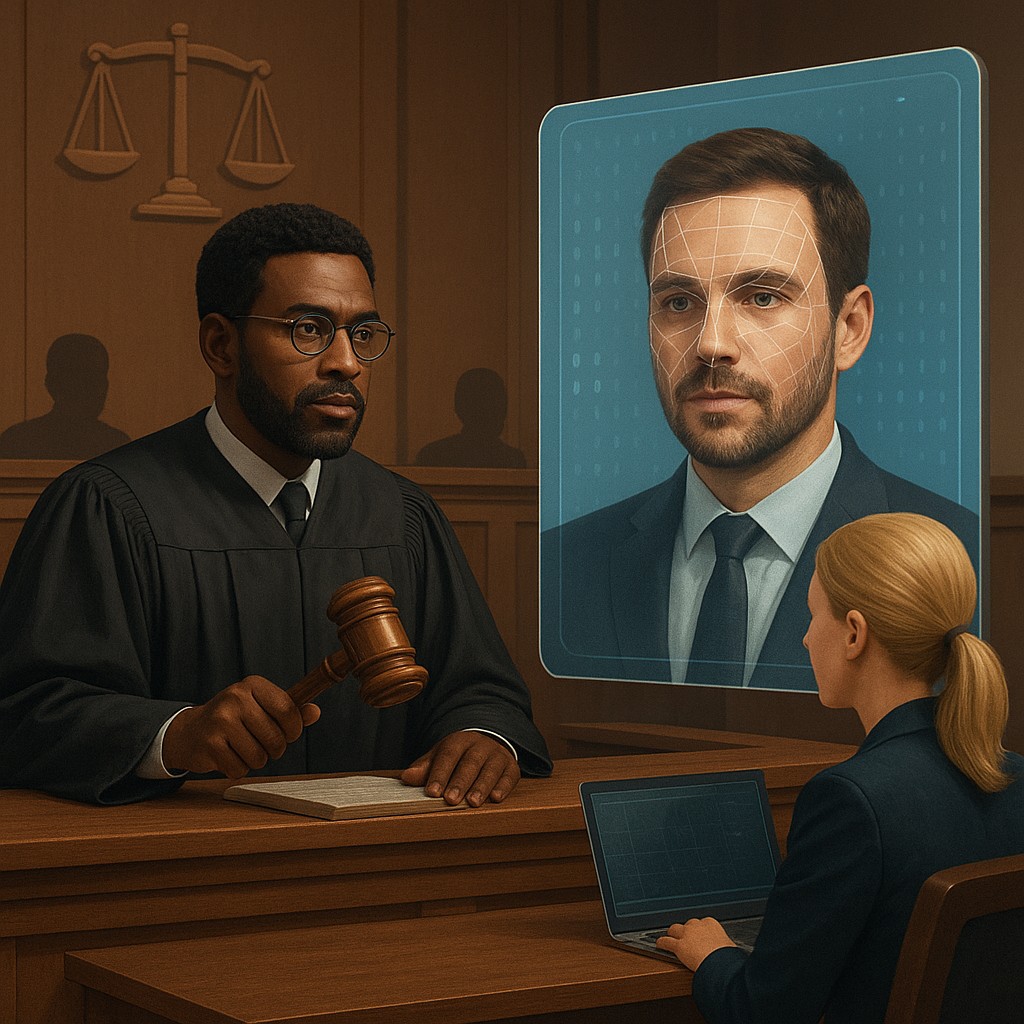
For over a century, the courtroom has operated under a simple visual contract: "seeing is believing." When a grainy security camera caught a robbery or a shaky phone video documented an accident, the legal system treated that footage as a silent witness - a frozen slice of objective reality. Lawyers might argue about the camera angle or the lighting, but they rarely stopped to ask if the person in the video existed at all. We have spent decades shaping the rules of evidence around the idea that while humans might lie, the camera's mechanical eye generally tells the truth.
That contract has officially expired. We have entered the era of the "Liar's Dividend." This is a psychological and legal phenomenon where the mere existence of high-quality deepfakes allows a defendant to claim that real, incriminating evidence is actually a computer-generated fake. As AI-made media becomes impossible to tell apart from reality, the "presumption of authenticity" - the basic trust that kept our legal gears turning - is seizing up. To save the justice system from a total collapse of trust, legal experts and engineers are building a new digital architecture. This system aims to prove a file is real not by how it looks, but by where it has been.
The Death of Optical Intuition
In the past, spotting a fake was like identifying a bad toupee; you didn't need to be an expert to notice something was off. You looked for "uncanny valley" glitches, such as eyes that never blinked or fingers that seemed to melt into pockets. However, generative AI has moved past those amateur mistakes with terrifying speed. We are reaching a point of "perfect mimicry" where even forensic software struggles to detect a deepfake based purely on pixels or audio frequencies. This creates a massive problem for judges who must decide what evidence a jury is allowed to see.
The legal system relies on a concept called "authentication," which basically asks: is this what the person offering it claims it is? Under traditional rules, like the Federal Rules of Evidence in the United States, you could verify a photo just by having someone testify that "this accurately shows the scene I saw." But if an AI can create a perfect copy of that scene, that testimony becomes fragile. We can no longer rely on our visual instincts to separate truth from fiction, because AI is essentially a master forger that learns from the very mistakes it made yesterday.
This shift forces us to move from "output-based" verification to "process-based" verification. Instead of looking at the final picture and trying to find a flaw, we are forced to look at the "birth certificate" of the file. If we can't trust the image, we must trust the path the data took from the camera sensor to the courtroom. This is a fundamental change in how humans process information, moving away from our biological senses and toward a reliance on mathematical proofs.
Building the Digital Chain of Custody
To fight the rise of synthetic evidence, forensic experts are using a framework known as "provenance tracking." Think of this as a digital GPS for information. In a traditional criminal case, the "chain of custody" is a physical log showing that a bag of evidence was locked in a specific cabinet and handled only by authorized officers. Provenance tracking does the same for a digital file by using digital watermarking and data trail analysis.
When a photo is taken with a "provenance-aware" camera, the device immediately creates a unique digital signature. This signature is electronically tied to the image data, the timestamp, and the GPS coordinates. If that photo is later edited, moved, or shrunk, those changes are recorded in a permanent, tamper-proof log. By the time that file reaches a courtroom, a lawyer can present a complete "history of the pixel," proving the file came from a specific device at a specific time and hasn't been altered by an AI model.
| Feature |
Traditional Digital Evidence |
Provenance-Verified Evidence |
| Source Validation |
Relies on witness testimony |
Digital hardware signature |
| Edit History |
Hard to detect subtle changes |
Recorded in a tamper-proof audit trail |
| AI Resistance |
High risk of "Liar's Dividend" |
Mathematically linked to a physical sensor |
| Metadata |
Can be easily stripped or faked |
Protected by encryption and hashing |
| Trust Model |
Trusting the eye and the expert |
Trusting the mathematical protocol |
The C2PA Standard and the Hardware Revolution
The push for this new standard is being led by groups like the Coalition for Content Provenance and Authenticity (C2PA). This group, which includes tech giants, media outlets, and camera makers, is developing the "Content Credentials" system. You might have already seen it as a small "cr" icon in the corner of images online. This isn't just a sticker; it's a doorway to a digital ledger. It allows a user to click and see exactly which AI tools (if any) were used to create or change the media they are looking at.
For the legal world, this means a shift in hardware. We are likely moving toward a future where "law enforcement grade" cameras will have specialized security chips, similar to the ones that handle credit card transactions. These chips will "sign" every frame of video the moment it is filmed. If a police officer records a confession on a body camera, the C2PA data will act as an unbreakable seal. If a defense attorney tries to claim the video was "deepfaked" to make the defendant look guilty, the prosecution can point to the digital seal and prove it hasn't been touched since the record button was pressed.
However, this creates a new kind of "digital divide" in the courtroom. Large news organizations and police departments might be able to afford these verified systems, but what happens to the citizen journalist or the victim of a crime who records a video on an old smartphone? There is a growing concern that the legal system might accidentally create two tiers of truth: "Verified Truth" for those with the right technology, and "Questionable Truth" for everyone else.
The Ghost in the Analog Machine
One of the most complex challenges for legal experts is how to handle "legacy evidence." While we can build secure systems for the future, we have over a century of film, taped audio, and standard digital files that lack any digital signatures. If the standard for "truth" in court becomes a digital certificate, how do we treat a 20-year-old home movie or a grainy 1990s surveillance tape? These files have no traceable origin in the new world of provenance.
Forensic specialists are currently debating "bridge protocols" to handle this. One approach is to use AI itself to defend against AI. Forensic tools can look for specific marks left behind by AI models, such as inconsistencies in audio or "biological anomalies" in video - like blood flow patterns in the skin that AI often fails to copy correctly. However, this creates a cat-and-mouse game. As soon as a detection method is found, AI developers use that information to train their models to stop making those specific mistakes.
This leads us to a "context-first" approach to evidence. Instead of looking at a file in a vacuum, forensic experts are placing more weight on the "digital exhaust" surrounding a piece of evidence. This includes things like cell tower pings, Wi-Fi logs, and even weather reports from the day an image was supposedly taken. If a video shows a sunny day but local weather stations recorded a blizzard, the internal data doesn't matter; the context proves the forgery. This broad view ensures that even if the digital chain is missing, we can still use common sense and hard data to anchor an image to reality.
The Psychological Jury Problem
Even if we solve the technical and legal hurdles, we are left with the human problem: the jury. For thousands of years, humans have evolved to trust their eyes. We are creatures ruled by what we see. Telling a juror to ignore a video that looks 100% real because a "mathematical signature" is missing is a massive psychological ask. There is a risk that juries will become so cynical about deepfakes that they stop believing any evidence at all, leading to a "truth decay" where no one can ever be convicted of anything recorded on camera.
Legal experts are currently developing new "jury instructions" specifically for the AI age. These instructions teach jurors about the existence of synthetic media and the importance of looking for the "Content Credential" or the provenance trail. We are essentially retraining the public to be digital detectives. We have to teach people that a video is no longer a "window" into the past; it is a "claim" about the past that requires a receipt.
This education process is vital because the "Liar's Dividend" works both ways. A guilty person can claim a real video is a fake, but an innocent person can also be framed by a fake that looks perfectly real. The only way to navigate this landscape is by moving away from our gut feelings and toward a rigorous, systematic check of how data is handled. It is an uncomfortable transition, but it is the only way to keep the scales of justice balanced in a world where "reality" is becoming a choice rather than a fact.
Embracing the New Era of Verification
As we stand on the edge of this post-truth environment, it is easy to feel a sense of dread. The idea that we can no longer trust our own eyes feels like the loss of something fundamental. Yet, every time humanity has invented a tool that challenges our perception, from the printing press to early photo-editing software, we have adapted by creating stronger ways to verify the truth. We are simply doing what we have always done: building new ways to hold each other accountable.
By using provenance tracking and digital standards, we aren't just protecting the courtroom; we are protecting our shared reality. We are learning to value the "unseen data" just as much as the "seen image." While the technology might feel cold or complex, its purpose is deeply human: to ensure that the truth remains something that can be proven, defended, and upheld. As you move through a world increasingly filled with synthetic voices and faces, remember that your greatest power isn't just your ability to see, but your willingness to ask where the information came from. Stay savvy, stay skeptical, and always look for the digital receipt.