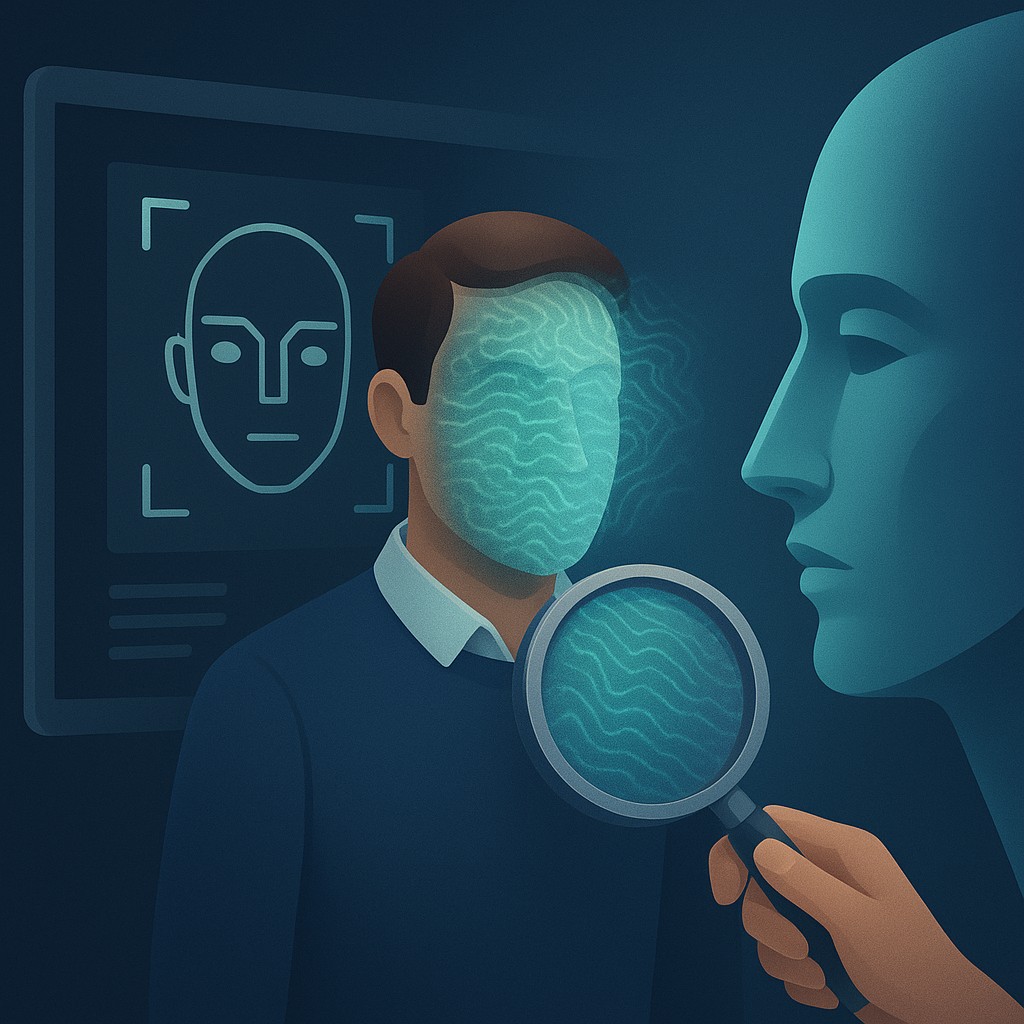
Imagine if every time you stepped out your front door, a tirelss, invisible librarian followed you with a massive scrapbook. Every time you smiled, frowned, or simply walked past a window, they snapped a high-resolution photo. They filed it away, cross-referencing your face with your home address, your bank account, and your friends. In the digital world, this isn't a paranoid conspiracy theory; it is standard practice for facial recognition "scrapers." These automated programs crawl through social media, dating apps, and job sites to build giant, searchable databases of human faces, often selling access to the police or private firms without your permission.
Until recently, the only way to stop this was to delete your digital presence entirely or wear a mask in every photo. However, a new frontier in digital privacy has arrived, one that uses the internal logic of Artificial Intelligence to defeat it. By adding a layer of mathematically engineered "noise" to our photos, researchers have found a way to make us invisible to machines while we remain perfectly recognizable to our friends. This technique, known as adversarial perturbation, acts as a digital cloaking device. It exploits the tiny gaps between how a human brain understands an image and how a computer algorithm processes pixels.
The Blind Spots of Machine Vision
To understand how we can trick an AI, we first have to understand how it "sees." A human perceives a face as a whole collection of features like eyes, a nose, and a mouth. In contrast, a "deep learning" model - a type of AI trained on vast amounts of data - sees an image as a massive grid of numbers representing pixel values. The AI looks for specific mathematical patterns, such as gradients of light and shadow that represent the distance between pupils or the curve of a chin. When it finds enough of these patterns, it labels the image as "Person A." This process is incredibly fast, but it is also surprisingly fragile because it relies on mathematical certainty rather than visual instinct.
Adversarial perturbations take advantage of this fragile nature by introducing "adversarial examples." These are inputs designed to make a machine learning model make a mistake. In facial recognition, this involves changing the values of certain pixels by a tiny amount. These changes are so small that the human eye cannot see them, yet they are enough to throw off the AI’s calculations completely. To the human brain, the photo is a crisp, clear portrait; to the AI, the math no longer adds up to a face. Even stranger, the computer might think it sees the face of a completely different person.
This creates a fascinating paradox. We usually assume that if a photo looks "clear" to us, it must be clear to everyone. However, these attacks prove there is a hidden layer of information in every digital file that only machines can read. By "poisoning" that layer, we can jam the signals that scrapers rely on. It is a form of digital camouflage that doesn't hide us from the world, but hides our identity from the automated systems trying to catalog us.
Engineering the Invisible Cloak
Creating these digital masks is a sophisticated process. It isn’t as simple as tossing random static onto a picture, which would just make the photo look grainy. Instead, software tools like Fawkes (developed at the University of Chicago) or LowKey perform "pixel-level optimization." The software runs the original image through several powerful facial recognition models and identifies the specific features those models use to recognize the subject. Then, it makes the smallest possible changes to those features to nudge the machine's perception away from the correct identity.
Think of it like a master impressionist slightly changing the way they walk or tilt their head to fool a security guard. If the guard is trained only to look for a specific stride length, even a one-inch shift can cause total confusion. In the case of adversarial noise, the software might slightly shift the contrast of a few pixels around the eye socket. To you, it’s just a shadow, but to the AI, the "feature vector" - the mathematical signature of that eye - has moved into different territory. The goal is to maximize the error for the AI while making sure the photo still looks perfect to people.
Once a photo is "cloaked," you can upload it to social media just like any other file. Because the changes are baked into the pixels, they survive basic editing like resizing. A scraper that downloads that photo to feed it into a database will find the results are useless. The machine might report that the photo contains an object instead of a person, or it might incorrectly link the photo to the wrong data, turning the scraper's database into a mess of misinformation.
The Logic of Digital Defense
When we compare traditional privacy to adversarial cloaking, we see a shift from "hiding" to "misleading." Traditional methods try to keep data away from collectors, but adversarial methods let the collector take the data while ensuring it is wrong or unusable. This is a much more practical approach in an age where data is constantly leaked or shared. The following table shows the differences between these strategies.
| Feature |
Traditional Privacy (e.g., Deleting Photos) |
Obfuscation (e.g., Wearing a Mask) |
Adversarial Cloaking (Perturbation) |
| Visibility to Humans |
Zero (The photo is gone) |
Obvious (The face is covered) |
Fully Visible (Looks normal) |
| Machine Readability |
No data collected |
Fails to find a face |
Finds the "wrong" face |
| Social Cost |
High (Disconnected from others) |
Medium (Looks suspicious) |
Zero (Natural experience) |
| Durability |
Permanent if deleted |
Limited to that moment |
Digital, survives most sharing |
| Primary Goal |
Data avoidance |
Blocking identity |
Mathematical misdirection |
This comparison shows why perturbation is gaining ground. It allows us to enjoy digital life without giving up our photos or our social presence. We can still post vacation pictures or professional headshots, but we are effectively "opting out" of the mass surveillance that defines the modern internet. It puts power back into the hands of the individual, letting them decide who gets to "see" them and who is left staring at a mathematical ghost.
The Never-Ending Duel of Algorithms
Of course, in cybersecurity, no defense is ever final. We are currently watching a high-stakes game of "cat and mouse" between the researchers creating these cloaks and the companies building scrapers. As soon as a new cloaking method becomes popular, developers start working on "robust" facial recognition models. These updated models are trained specifically to ignore noise or to "smooth out" images to strip away the protection.
This leads to a phenomenon called "adversarial training," where AI systems are taught to recognize their own weaknesses. If an AI sees millions of cloaked photos alongside the originals, it can eventually learn to see through the camouflage. However, the cloaking developers are constantly updating their algorithms to find new, more complex ways to confuse even the smartest scanners. It is a literal arms race of code, with each side trying to out-math the other for control over digital identity.
One of the biggest challenges for the "cloak" side is that once a photo is online, it is there forever. If you upload a cloaked photo today using 2024 technology, a scraper in 2027 might have the power and the updated algorithms to peel that cloak away. This means adversarial perturbation is a tactical tool, not a permanent fix. It significantly raises the cost and difficulty for scrapers, forcing them to spend more resources for less accurate data. This is often enough to discourage many bad actors, even if it doesn't stop the most determined ones.
Clearing Up Safety Myths
A common mistake is thinking adversarial noise acts like a filter or a blur. People often assume the "noise" will make their photos look like static on an old TV. In reality, the noise is so deeply integrated into the math of the image that you would need a magnifying glass and a side-by-side comparison to notice anything at all. Even then, you might just think one version looks a tiny bit "sharper" or "flatter," but neither looks broken.
Another myth is that this technology is only for hackers or people with secrets. On the contrary, adversarial perturbation is being built into user-friendly apps and browser extensions. The idea is to make privacy a default setting rather than a technical chore. Just as we use secure "HTTPS" connections for banking without needing to understand encryption, we are moving toward a world where photos are protected automatically as we hit "upload." It is a tool for the average person who doesn't want their face used as raw data for a billionaire's next project.
Finally, some skeptics believe that if a machine can be tricked, the AI must be "stupid." This misses the point of how these networks function. An AI isn't "dumb" for being tricked by perturbation any more than a human is "dumb" for being fooled by an optical illusion. Both systems process information in specific ways, and those paths have natural vulnerabilities. Exploiting those gaps is a clever piece of engineering that respects the fundamental difference between how computers and humans perceive the world.
Reclaiming the Digital Space
The rise of adversarial perturbation is a turning point in our relationship with tech. For the last twenty years, power has mostly flowed one way: users provide data, and giant systems harvest it. We have been told that privacy is dead and that "convenience" requires us to be constantly cataloged. But the people building these cloaking tools are proving we don't have to accept total transparency. We can use the same innovation that created facial recognition to build a shield against it.
By adding a few invisible bytes to your next profile picture, you are joining a global movement to reclaim digital identity. You are asserting that your face belongs to you, not to a database. This technology reminds us that the internet is still a place we can shape, where code can be used to protect as well as to exploit. As we navigate this landscape, let the "invisible cloak" remind us that in the battle between the individual and the algorithm, human ingenuity is still the most powerful variable. Stay mindful, and never forget that even in a world of high-speed scrapers, you still have the power to remain unseen.