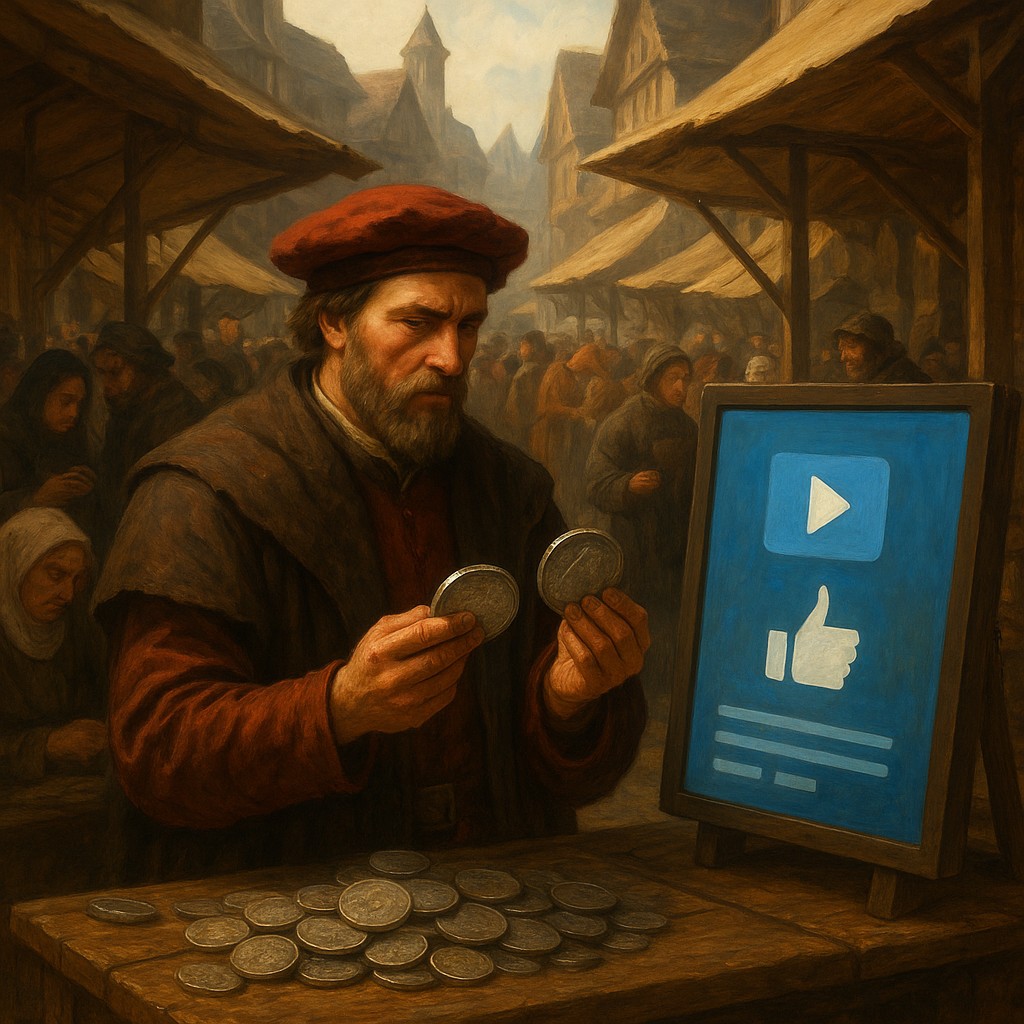
Imagine standing in a crowded medieval market where the local coins have started to feel a bit light. In the 16th century, Sir Thomas Gresham noticed something strange: when a government issued new coins with less silver alongside older, high-quality ones, the "good" coins quickly vanished. People tucked the pure silver away in chests and spent the "bad" coins as fast as possible. This principle, known as Gresham’s Law, famously states that bad money drives out good. Today, we aren't trading silver in a muddy square, but we are trading our most precious resource, attention, in a digital marketplace that works on almost identical logic.
We live in an era where information is the main currency, yet we are witnessing a digital version of cheapened coins. Instead of silver content, we are measuring the "purity" of nuance, accuracy, and depth. The "bad money" of our time consists of sensational headlines, ten-second clips, and emotional outbursts that demand we click right away. Because our mental energy is limited, the massive amount of this cheap, easy-to-swallow information is effectively hoarding our attention. This makes it nearly impossible for high-quality, long-form, and complex explanations to circulate. If we don’t understand how this trade works, we risk living in an intellectual economy where the truth is hidden in a vault while the loud and the shallow run the streets.
The Mechanics of Cognitive Debasement
The shift from the "gold standard" of information to the "clickbait standard" happened so slowly that many of us barely noticed. In the past, there fees and hurdles that acted as quality control, much like a government mint. To publish a book or air a documentary, a creator needed a certain level of fact-checking and editing. While this old system had flaws, like bias and gatekeeping, it ensured that information was generally a "slow-release" product. Today, those barriers are gone. Now, speed has replaced depth as the primary way we measure value.
When information is "debased," it means the messy details that make a story true are stripped away to help it travel faster. A scientific study about the small benefits of a specific berry becomes a headline shouting "Miracle Fruit Cures Everything." The headline is the "bad coin." It is easy to spend, easy to share, and requires almost no brainpower to process. The actual study, with its careful data and modest conclusions, is the "good coin." It is heavy, it takes time to understand, and it doesn't offer an immediate rush of excitement. In the attention economy, the berry headline will always travel further and faster than the actual science.
This creates a structural disadvantage for experts. If you are trying to explain the complexities of the economy or climate science, you are competing against memes that wrap a complex world into a single, punchy, and often misleading sentence. Because the human brain is wired to prioritize threats and social status, information that triggers fear or anger becomes the most "liquid" asset in the market. We spend our mental energy on the sensational because it feels urgent, leaving no room for the quiet, slow work of genuine learning.
Why the Algorithm Prefers the Loudest Voice
To understand why "bad" information is so successful, we have to look at the machinery that moves it. Social media algorithms are not designed to be librarians; they are auctioneers. Their goal is to keep you in the marketplace for as long as possible. High-quality information is often "boring" because it requires us to pause and reflect. These are the exact behaviors that algorithms are programmed to stop. If you stop to think, you aren't scrolling. If you aren't scrolling, the auctioneer isn't making money.
The result is a feedback loop that trains us to expect brevity over accuracy. When we are constantly fed "hot takes" and "TL;DR" (too long; didn't read) summaries, our ability to focus begins to weaken. We start to feel an itch after five minutes of reading a long article, a physical restlessness that demands a quicker hit of info. This expectation of speed forces even the best creators to "debase" their own work just to survive. An expert might spend twenty years studying a topic, but to get anyone to listen, they are often told to condense that life's work into a sixty-second video.
| Feature |
Low-Quality "Bad" Information |
High-Quality "Good" Information |
| Mental Effort |
Low; targets emotions and instincts |
High; requires logic and concentration |
| Speed of Spread |
Viral; travels instantly across networks |
Slow; moves through study and citation |
| Primary Goal |
Clicks, views, and outrage |
Understanding, accuracy, and context |
| Lifespan |
Short-lived; replaced by the next trend |
Long-lasting; builds a foundation of knowledge |
| Complexity |
Over-simplified; black and white |
Nuanced and multi-faceted |
This table shows the basic conflict between the two types of content. Because "bad" information is so good at capturing the market, it creates a crowded room where "good" information simply cannot be heard. It is not that people no longer want the truth; it is that the truth is being priced out of the market by cheaper, shinier alternatives that give the illusion of knowledge without the effort of learning.
The Myth of Natural Selection in Content
One of the most dangerous myths of the digital age is the belief that quality always wins. Many people assume that if a piece of information is valuable and true, it will naturally rise to the top. We like to imagine a "marketplace of ideas" where the best thoughts win because they are the most useful. Unfortunately, Gresham’s Law proves that without a protected environment, the exact opposite happens. In an unregulated market, the bad coins don't just sit next to the good ones; they actively push the good ones out of use.
This happens through saturation. When there is too much sensationalism, the "search cost" for high-quality information becomes too high for the average person. If you have to dig through ten pages of "top ten life hacks" to find one peer-reviewed article, most people will settle for the hacks. We aren't choosing bad information because we prefer it; we are choosing it because it is the only thing right in front of us. The marketplace of ideas only works when the audience has the time and the tools to evaluate what they are seeing, but the internet effectively robs us of both.
Furthermore, "bad" information is often designed to be "sticky." It uses psychological triggers, such as "us vs. them" stories or the "secret they don't want you to know" trope, to stay in your mind and make you share it. High-quality content is nuanced and full of cautions like "we aren't quite sure yet" or "the data suggests a small connection." These are honest, but they are socially weak. They don't provide the certainty people crave, leading them to abandon the accurate scientist for the confident charlatan.
Cultivating an Information Sanctuary
Recognizing that we are living under Gresham’s Law is the first step toward clearing our heads. If the world’s default setting is "debasement," then we must be intentional about creating our own gold standard. This means moving away from passive consumption, where we eat whatever the algorithm serves us, and toward a "curated diet." Just as you wouldn't eat every free sample in a food court and expect to be healthy, you cannot consume every viral post and expect to be informed.
One of the best ways to fight this is to embrace "slow-form" media. This means seeking out books, long essays, and deep-dive podcasts that don't rely on outrage. By choosing media that takes hours rather than seconds to finish, you are opting out of the high-speed attention economy. You are choosing to value the silver in the coin rather than how fast you can pass it to the next person. It is a form of rebellion to say, "I will not have an opinion on this until I have spent three hours reading about it."
Another vital tool is the "Wait and See" rule. Because sensational news is designed to make you react emotionally, simply waiting twenty-four hours before sharing a story can filter out the "bad coins." Bad information usually has a very short life. What felt like a world-ending scandal on Tuesday is often revealed to be a misunderstanding by Wednesday. By slowing down your own clock, you let the dust settle to see if there is actually any substance buried underneath.
The Architecture of Intellectual Integrity
We must also change how we treat experts and creators. If we want high-quality content to exist, we have to reward it with the one thing the algorithm tries to steal: our sustained attention and, when possible, our money. The reason "bad" information is free is that you are the product being sold to advertisers. High-quality information often requires a subscription or a purchase because the creators aren't willing to ruin their work just to compete for pennies in ad revenue. By paying for quality, you help build a "parallel economy" where nuance can survive.
Community curation also plays a huge role. Instead of relying on the loudest voice in a feed, we can rely on trusted hubs, specialized newsletters, and reading lists from experts we respect. Think of these as private vaults for "good money." When we share a well-researched article with a friend, we aren't just sharing a link; we are verifying the currency of our social circle. We are saying that in our corner of the world, we value silver over lead. This deliberate selection acts as a dam against the flood of noise.
Finally, we have to be willing to be "wrong" or "uninformed" in the short term. In a world where everyone has an instant opinion on every event, there is a strange pressure to keep up. But Gresham’s Law suggests that "keeping up" usually means filling your head with low-quality, fleeting junk. Embracing the phrase "I don't know enough about that yet to have an opinion" is perhaps the ultimate defense. It saves your mental energy for the things that actually matter, ensuring that when you do speak, your words are backed by something real.
By understanding the forces that drive out nuance, you are no longer a victim. You can begin to see sensationalism for what it is: a cheap coin designed to be spent quickly. You can choose to be a collector of the rare and the deep. This shift from a passive consumer to an intentional curator is not just an exercise; it is a way to protect the quality of your thoughts. In a world of noise, the person who values silence and depth is the one who truly understands the market. Seek out the "good coins" and keep them, building a treasury of knowledge that will last long after the latest viral trend has faded away.