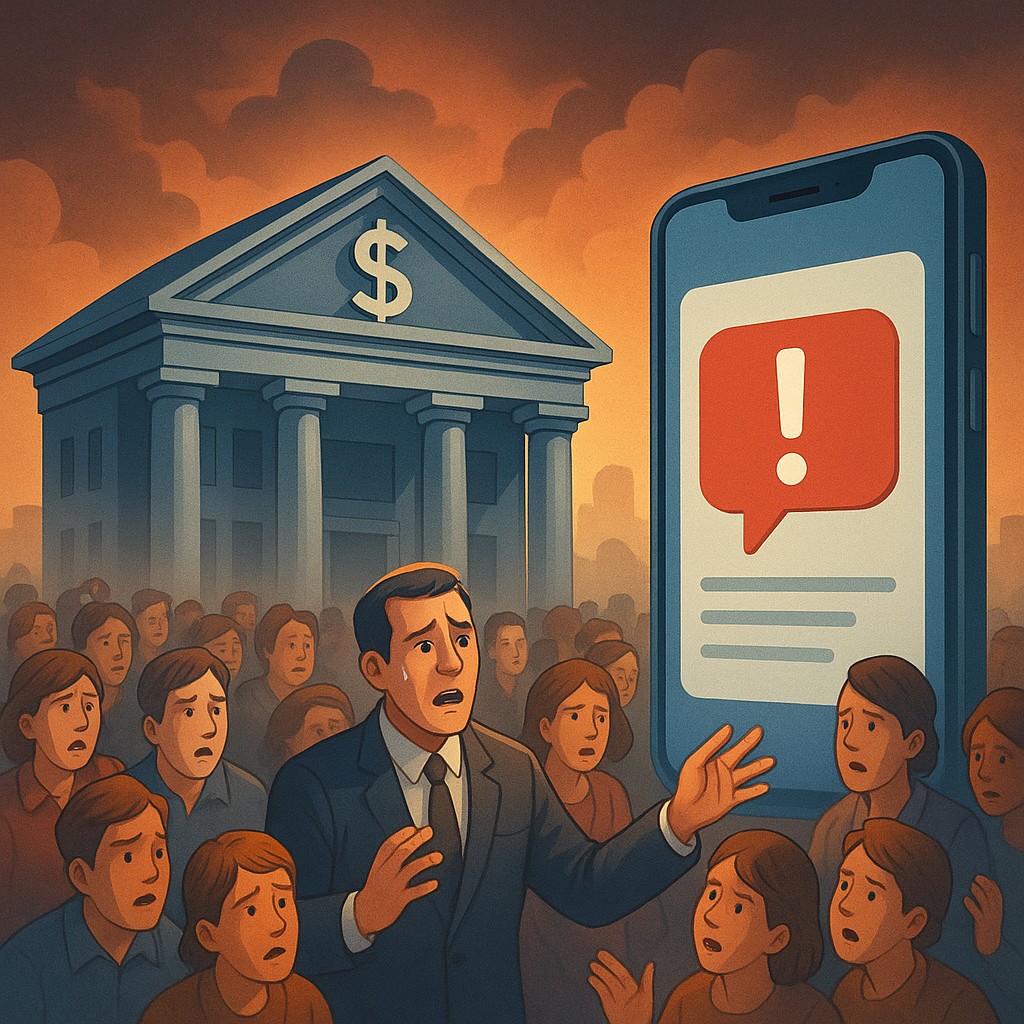
In the classic 1946 film It’s a Wonderful Life, there is a famous scene where a crowd of panicked townspeople huddles outside George Bailey’s building and loan association, demanding their savings. George has to explain, through sweat and desperation, that their money isn't sitting in a vault; it is tied up in their neighbors' houses and the town’s storefronts. That scene defined the popular image of a bank run for nearly a century: a physical line of angry people, limited by how fast they could walk and how late the bank stayed open. It was a slow-motion disaster that a charismatic manager could potentially talk his way out of over a long afternoon.
Fast forward to today, and the logistics of panic have shifted from the sidewalk to the pocket. When rumors about a bank's stability begin to swirl on social media, the "queue" is no longer made of people standing in the rain. It consists of millions of digital requests hitting a server simultaneously from around the globe. In this new era, billions of dollars can vanish from a bank’s balance sheet in a matter of hours, all while the physical branches remain eerily quiet. The speed of information has outpaced traditional banking oversight, forcing the financial world to invent a new defense system known as liquidity stress testing.
The Architecture of a Modern Digital Panic
To understand why banks are suddenly so obsessed with viral posts, we first have to look at the "plumbing" of a bank. Most people imagine a bank as a giant digital piggy bank where their money sits untouched until they need it. In reality, banks operate on a principle of fractional reserves. They take your deposits and lend them out to people buying homes or starting businesses. This is the engine of the economy, but it creates a fundamental mismatch. Your deposit is "liquid," meaning you can ask for it back at any time, but the bank’s assets, like a 30-year mortgage, are "illiquid," meaning the bank cannot simply call the homeowner and demand the full loan back tomorrow.
In a pre-digital world, this system was relatively stable because most people didn't need their money at the exact same time. However, social media acts as a synchronization engine. If a high-profile venture capitalist or a viral financial influencer posts a warning about a bank’s health, thousands of people see it instantly. Because mobile apps allow for one-tap withdrawals, the time it takes to act on that fear has dropped to zero. This creates a feedback loop where the sight of others withdrawing money, proven by screenshots of "transfer successful" screens, triggers a second wave of panic.
Modern liquidity stress testing is designed to model this specific volatility. Instead of just asking, "What happens if the economy slows down?", banks now ask, "What happens if a tweet with 10 million views triggers a 40 percent withdrawal rate in six hours?" These simulations treat information like a virus, calculating its "R-naught," or infection rate. They look at the social connectivity of their depositors. For example, a bank that serves a tight-knit community of tech startups is at a much higher risk of a "viral run" than a bank with a diverse group of retirees who don’t use social media as their primary news source.
Quantifying the Unpredictable via Simulation
The core of modern risk management is the Monte Carlo simulation. This is a mathematical technique that allows banks to run thousands of "what-if" scenarios using different variables. In the context of a digital run, these variables include things like the percentage of uninsured deposits, the concentration of depositors in a single industry, and the "velocity" of information. By running these programs, banks can identify their breaking points. They might discover that while they can survive a steady five percent outflow over a month, a coordinated 20 percent outflow in a single day would collapse their operations.
These simulations have revealed a harsh truth: the old rules of thumb are no longer enough. Regulatory standards like the Liquidity Coverage Ratio (LCR) were designed to ensure banks have enough cash to survive a 30-day crisis. But in a world where a bank can lose 40 billion dollars in 24 hours, a 30-day window feels like an eternity. Banks are now layering "real-time" stress tests on top of these regulatory requirements. They use algorithms to monitor social media sentiment and news flows, feeding that data directly into their liquidity models to adjust their cash positions before the crisis even hits its peak.
This shift has changed the job description of a bank treasurer. It is no longer just about managing interest rates and loans; it is about understanding the psychology of networks and the mechanics of digital platforms. They must account for the "herd behavior" that characterizes the internet. When everyone has the same information at the same time and the same tool to act on it, traditional stabilizers like "business hours" or "limited staff" no longer act as friction to slow down the panic.
Transforming Illiquid Promises into High Quality Assets
If a stress test shows that a bank is vulnerable to a digital run, the solution isn't necessarily to keep every dollar in a basement vault. Doing so would prevent the bank from making any loans, effectively killing its business model. Instead, banks focus on building a buffer of High-Quality Liquid Assets (HQLA). These are financial instruments that are almost as good as cash because they can be sold or traded almost instantly, even during a market downturn.
The most common HQLA are government bonds. Because these are backed by the "full faith and credit" of a country, there is always a buyer for them. If a bank sees a sudden spike in digital withdrawals, it doesn't have to panic. It simply takes a batch of these bonds and sells them on the "repo" market (a place for short-term borrowing) or to a central bank in exchange for immediate cash. This allows the bank to meet the demands of the viral panic without having to sell off its long-term loans at a loss.
| Asset Type |
Liquidity Level |
Speed of Conversion |
Role in a Digital Run |
| Physical Cash |
Absolute |
Instant |
Used for ATM and branch withdrawals. |
| Central Bank Reserves |
Extremely High |
Seconds |
The ultimate "digital cash" for bank-to-bank transfers. |
| Government Bonds |
Very High |
Minutes/Hours |
Sold or used as collateral to raise quick cash. |
| Corporate Bonds |
Moderate |
Days |
Can be hard to sell if the whole market is panicking. |
| Mortgages / Business Loans |
Low |
Months |
Cannot be easily moved during a 24-hour crisis. |
This table illustrates the hierarchy of defense. A bank's safety isn't determined by its total wealth, but by the "tier" of its assets. A bank could be incredibly "wealthy" on paper because it owns thousands of houses, but if it doesn't have enough Level 1 assets like central bank reserves or government bonds, it can still fail during a viral run. The goal of liquidity testing is to find the perfect "Goldilocks" zone: holding enough liquid assets to survive a social media storm, but not so much that they aren't putting money to work in the community.
Misconceptions About Digital Safety Nets
A common myth is that if a bank undergoes stress testing, it means the bank is currently in trouble. In reality, it is the opposite. Stress testing is a "peace time" activity. It is the equivalent of a fire drill in a skyscraper. You don't run the drill because the building is on fire; you run the drill so that if a fire ever starts, everyone knows exactly which stairs to take and the pumps are already primed. When you hear that a bank has "passed" its stress tests, it means they have successfully proven to regulators that they could survive a hypothetical catastrophe.
Another misconception is that the government or the central bank will always just "print money" to save a bank during a run. While central banks do act as a "lender of last resort," they usually only provide cash if the bank has good collateral to offer. If a bank has managed its risk poorly and doesn't have those high-quality liquid assets we discussed, the central bank might not be able to save it without a massive, controversial bailout. Stress testing ensures that banks have their own "self-defense" toolkit ready so they don't have to rely on a government rescue.
Finally, people often think that digital banking is inherently more dangerous than traditional banking. While it is true that digital banking is faster, it is also more transparent. In the old days, a bank could hide its problems for weeks. Today, the same data tools that allow a run to happen also allow regulators to monitor a bank's health in real-time. We are moving toward a world of "embedded supervision," where the software used by the bank shares live data with the government, allowing for the detection of unusual withdrawal patterns before they even reach the front page of social media.
The Human Element in a World of Algorithms
Despite all the sophisticated computer modeling and the mountains of government bonds, the most important variable in any liquidity model remains the most unpredictable one: human trust. Banking is essentially a giant social contract. We all agree to leave our money in the system because we trust that it will be there when we need it. No amount of high-quality liquid assets can save a bank if that fundamental trust is permanently broken across the entire population.
This is why communication is becoming a core part of liquidity management. Banks are learning that they cannot just be silent institutions; they must be active participants in the digital conversation. If a rumor starts to spread, the bank’s ability to provide clear, verifiable data about its liquidity can act as an "antiviral" to the panic. By showing the public that they have run the simulations, that they hold the necessary buffers, and that their "vault" is digitally replenished, they can de-escalate a crisis before the first withdrawal even happens.
Liquidity stress testing is more than just a regulatory hurdle; it is a fascinating evolution of how we manage collective fear. It represents a shift from a reactive world to a predictive one. By turning social media volatility into a math problem, financial institutions are attempting to build a system that is as fast as our thumbs and as resilient as our technology. As you move through the digital world, remember that your banking app is backed by a complex web of simulations, all working tirelessly to ensure that your money remains more than just a number on a screen. You can feel confident knowing that while the speed of banking changed forever, the safeguards have evolved to meet the challenge of the viral age.