Most of us know the specific, restless anxiety of standing in a crowded office lobby at 8:55 AM, watching the floor numbers crawl upward. You press the "up" button, wait for the chime, and shuffle into a metal box with ten strangers. Once inside, a frantic ritual begins: everyone reaches for the control panel, punching buttons for floors 4, 7, 8, 12, 15, and 19. The elevator groans into motion, stopping every few seconds to let one person out while the rest of the passengers stare at their watches, mourning their lost morning productivity. It is a reactive, chaotic system where the elevator is essentially a servant to the whims of whoever stepped inside first.
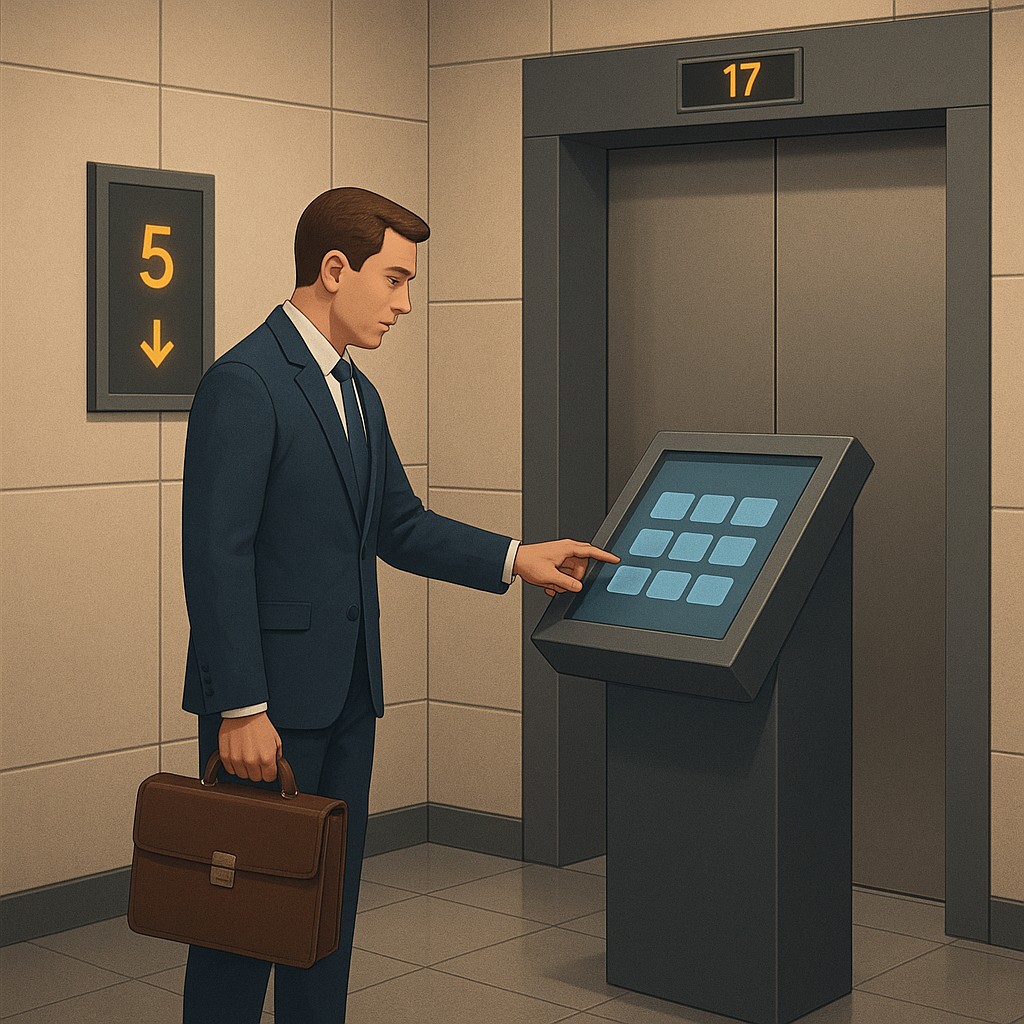
But in the world’s most advanced skyscrapers, this familiar frustration is quietly disappearing. If you walk into a modern high-rise in New York, Dubai, or Singapore, you might notice something strange: there are no buttons inside the elevator car. There is no "Door Open" button to mash, and there is certainly no way to change your mind once you are moving. Instead, you must select your floor at a kiosk in the lobby before you ever set foot in the lift. This shift from a "taxi" model to a "coordinated shuttle" model is known as Destination Dispatch. It represents one of the biggest leaps in urban logistics since the invention of the safety brake.
The Mathematical Mess of the Traditional Lift
To understand why we had to remove the buttons, we first have to look at the flaws of the traditional design. In a standard system, the elevator has no idea where you are going until you are already on board. It simply knows that someone on the 10th floor wants to go "up." When the car arrives, it might already be carrying people headed to the 15th, 20th, and 25th floors. By picking you up, the elevator adds another stop to its itinerary. If three different people on three different floors all press "up" at the same time, the elevator stops three times, regardless of whether they are all going to the same place or opposite ends of the building.
This creates "stop-and-go" inefficiency. Much like a car driving through a city with a red light on every block, the elevator spends most of its energy and time speeding up and slowing down rather than actually moving. The mechanical wear and tear is significant, but the real cost is in "handling capacity," or the total number of people a system can move in a set period. In a traditional system during the morning rush, a single elevator might stop at five different floors to drop off five different people, even if those floors are right next to each other. This keeps the car tied up for minutes, leaving a massive queue of frustrated employees growing in the lobby.
Turning Chaos Into Coordinated Groups
Destination Dispatch solves this by using a basic math formula to group people together. When you tap "Floor 42" on a lobby kiosk, the building's central computer doesn't just call a random elevator. It looks at every car in the system and asks, "Who is already headed near the 40s?" If Elevator B is already assigned to take three people to floors 40 and 45, the system will tell you to go to Elevator B. By the time you step inside, the system has already bundled you with people sharing a similar destination.
This transforms the journey from a series of random interruptions into a programmed flight. Because everyone in Car B is going to the same general "zone" of the building, the lift can skip floors 1 through 39 entirely. It reaches full speed quickly, maintains it, and then completes its mission in one tight cluster of stops. Once those passengers are out, the car is immediately free to return to the lobby or move to another high-demand area. By reducing the stops per trip, the elevator spends more time doing what it was built for, moving at high speeds, and less time waiting for doors to cycle open and closed.
Measuring the Efficiency Gains
The impact of this shift is transformative for building design. Architects have long been limited by the "elevator core," the massive vertical hole in the center of a building that takes up valuable real estate. If you want to move more people in a traditional system, you usually have to add more elevator shafts, which eats into the floor space you can actually rent out. Destination Dispatch allows a building to increase its "throughput," or passenger flow, by 30 percent or more without adding a single extra shaft.
| Feature |
Traditional Elevator |
Destination Dispatch |
| Input Method |
Up/Down buttons in lobby; floor buttons in car |
Keypad or touchscreen in lobby only |
| Logic Type |
Reactive (First-come, first-served) |
Predictive (Grouping by destination) |
| Stops per Trip |
High (random stops at every floor) |
Low (grouped by floor zones) |
| Crowding |
High (people pack into the first car) |
Managed (system balances the load) |
| Wait Times |
Random and often long at peak hours |
Shorter and more predictable |
| Building Capacity |
Limited by the number of shafts |
Optimized by software performance |
Beyond speed, this system offers more psychological comfort, even if it doesn't feel like it at first. In a traditional lobby, there is a "scramble" mentality. When a bell rings, everyone rushes toward the door like they are in a race. With destination control, the scramble is gone. You are given a specific letter (Elevator A, B, or C) and you walk calmly to that station. The system manages the crowd for you, ensuring that one car doesn't get dangerously overcrowded while another sits empty.
The Psychological Barrier of Losing Control
Despite the clear mathematical advantages, the transition to these systems often faces resistance. This is due to a phenomenon called the "illusion of control." Humans generally like to feel like they are "driving" their experience. When you walk into a traditional elevator and press the light-up button for floor 12, you get immediate feedback. You have told the machine what to do, and you can see your request registered.
In a destination-powered building, that control is taken away. You press a button in the lobby, and then you enter a box that has no buttons at all. If you suddenly realize you forgot your lunch on floor 4, you can't just press a different button. You are a passenger on a pre-set path. This can feel claustrophobic to some people. Some buildings have even installed decorative "indicator lights" inside the cars just to reassure people that the elevator knows where it is going, because the lack of a control panel feels like a lack of power.
There is also the "stranger danger" of grouped travel. In a traditional system, you might get lucky and be the only person in the car. In a destination system, the computer is actively trying to pair you with others. While this is better for the building's energy use and wait times, some users feel the system "forced" them into a crowded car. However, modern software is getting smarter, taking into account things like VIP priority, freight needs, and even social distancing to ensure that efficiency doesn't come at the cost of basic comfort.
The Future of Vertical Logistics
The logic of destination dispatch is already evolving. Some buildings are now using "multi-car" shafts, where two separate elevator cabins share the same vertical track, passing each other or moving together like a vertical railway. This would be impossible with traditional buttons because the risk of a "traffic jam" or a collision would be too high. Only a centralized "brain" that knows exactly where every passenger is going can manage the movement of multiple cars in a single shaft.
As our cities grow upward rather than outward, the "elevator problem" becomes the primary bottleneck of urban life. We are essentially building vertical dead-end streets, and destination dispatch is the traffic light system that keeps them from getting gridlocked. By treating passengers as data points to be sorted rather than random inputs, we have turned one of the oldest forms of motorized transport into a masterpiece of engineering.
The next time you stand in a lobby and a sleek touchscreen tells you to head to "Group D," take a moment to appreciate the invisible math at work. You aren't just taking an elevator ride; you are part of a coordinated dance. While it might feel strange to step into a buttonless box, remember that the system has done the hard work of thinking for you. It has spared you from three extra stops, saved a few kilowatts of energy, and ensured that the person standing next to you isn't just a random stranger, but a partner on the same vertical path. Losing a little individual control is a small price to pay for a world that moves just a little bit faster.