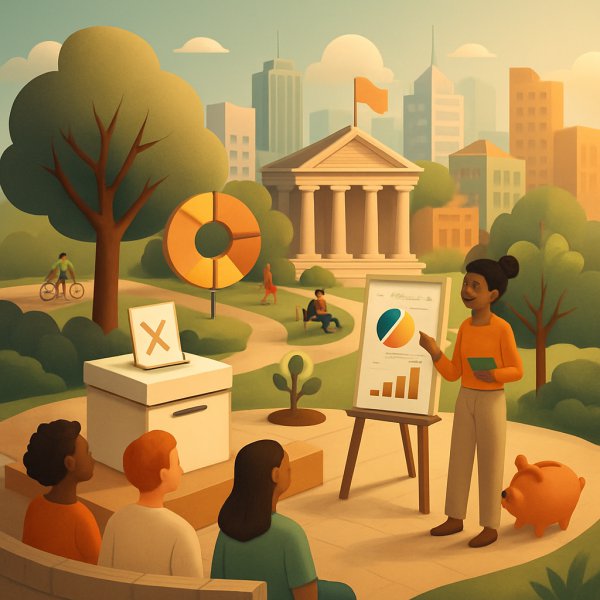
Imagine stepping into a city where the air smells faintly of baking bread, people greet one another with calm curiosity, and no child is counting the cost of dinner
Picture this: you walk down a pedestrian avenue shaded by trees, and you notice a public library that is always full because kids, teenagers, and grandparents all find things there they love. Buses arrive frequently and on time, food markets sell fresh produce at prices people can afford, and a community noticeboard posts invitations to a neighborhood council meeting where neighbors decide how to spend a small local budget. That scene is not a fairy tale, it is a practical sketch of features that many thinkers and experiments suggest produce thriving societies. The question we will explore together is not only what a perfect society might look like, but how to recognize the building blocks, test them in real life, and make incremental progress toward them.
This guide is a map rather than a manifesto. We will move from simple observations you can picture, to theories scholars use to think about justice and wellbeing, to practical examples and small experiments you can try. Along the way you will get short challenges, a few cases from real places, and concrete metrics to measure progress, so you leave not just inspired, but with tools.
Why "perfect" is a tricky word and what better really means in practice
Perfection implies a fixed end point where nothing more could be improved, which makes it a poor target for social design because societies are dynamic and human preferences change. Instead of chasing perfection, social theorists ask what societies make people better off in ways that are fair, sustainable, and free. Thinkers like John Rawls asked how to design just institutions using thought experiments such as the veil of ignorance, while Amartya Sen and Martha Nussbaum reframed progress as widening people's capabilities - what people are actually able to do and be. Utilitarians focus on aggregate happiness, libertarians emphasize individual liberty and property, and deliberative democrats emphasize inclusive, reasoned public discussion.
The practical upshot is to replace the single word perfect with a few measurable and morally guided goals: durable wellbeing, fair opportunity, robust freedoms, ecological sustainability, and lively democratic participation. These goals sometimes compete, which is why good social design is about balancing trade-offs rather than idolizing a single metric. When you learn to see which values are being promoted by a policy, you gain the power to shape choices rather than be surprised by consequences.
The things you would notice first in a near-perfect society - everyday features that matter
Walkability, reliable public services, and a sense of mutual aid are not glamorous, but they make life easier and more humane. A near-perfect society meets basic needs reliably - food, healthcare, education, shelter - and makes space for meaningful work, creative pursuits, and relationships. You would notice people having time, not because they are lazy, but because systems reward productivity that includes care and community, not only market output. Community institutions would be strong: schools that are hubs of learning for all ages, public spaces designed for conversation and play, and civic forums where decisions are transparent and inclusive.
You would also notice institutions that cushion shocks, such as unemployment insurance, universal health coverage, and disaster-prepared infrastructure. Culture would be diverse and free, with arts well supported because culture binds people and sparks innovation. Technology would be harnessed to expand access and reduce drudgery, with clear guardrails against surveillance and misuse. The sensory detail helps: fewer sirens at night, more laughter in parks, fewer empty storefronts, and a higher ratio of people who feel their voices matter.
The engines that make a society resilient - systems, incentives, and feedback loops
A thriving society relies on institutions that combine incentives with accountability. Markets are good at allocating many resources efficiently, but left alone they often produce inequality and short-term thinking. Public goods and regulation correct for those market failures, while social insurance provides stability so people can take risks like starting a business or switching careers. Democratic institutions that invite deliberation and feedback - town halls, participatory budgeting, independent courts, free press - help systems learn and self-correct.
Effective governance also uses feedback loops similar to those in engineering: monitor outcomes, compare them to goals, and adjust. This is what successful social programs do when they iterate based on data and citizen input. For example, Porto Alegre in Brazil introduced participatory budgeting so citizens decide parts of municipal spending, and over decades the city documented improved public services and transparency. The key difference between a utopia and a robust society is not the absence of flaws, but the presence of mechanisms to detect and repair them.
Case studies that teach more than theories - what real places have tried, and what we learned
The Nordic countries are often cited for combining generous safety nets with high innovation and productivity. Their mix of universal healthcare, progressive taxation, and strong public education correlates with high scores on the World Happiness Report, though context matters and these models are adapted to cultural and historical conditions. Finland ran a basic income experiment in 2017-2018 showing improvements in wellbeing indicators for recipients, though long-term fiscal and labor-market effects remain debated. Porto Alegre, Brazil provides a long-running example of direct citizen participation in budgeting that improved infrastructure in poorer neighborhoods and increased civic engagement.
Bhutan's Gross National Happiness offers a reminder to measure wellbeing beyond GDP, structuring policy around psychological wellbeing, cultural preservation, and environmental stewardship. These case studies show that there is no single path, but reproducible principles - invest in human capabilities, create inclusive decision-making, pilot changes, measure outcomes, and scale what works.
Practical design principles you can test in your community - small experiments with big learning value
Start small and treat every intervention as an experiment. A local community can test ideas such as a time bank where people exchange skills, a neighborhood repair cafe to reduce waste and build social ties, or a participatory budget for a small municipal fund. Schools can pilot project-based learning that connects students to local environmental or social projects, demonstrating how education can foster civic agency. Employers can trial reduced workweeks with no loss in pay to study effects on productivity and wellbeing, and cities can run pop-up pedestrian zones during certain days to test transport shifts.
Use the scientific method: define a clear goal, design a pilot, set measurable indicators, collect data, and involve stakeholders in evaluation before scaling. Encourage partnerships across public, private, and civic sectors, and be transparent about costs and outcomes. Small pilots reduce political friction and generate proof-of-concept evidence that can change minds more effectively than abstract arguments.
Common myths and worries people have when imagining a better society - and how to answer them honestly
People often fear that more equality means less freedom, or that universal programs will destroy incentives. These concerns are legitimate and deserve empirical answers rather than slogans. Evidence shows that basic safety nets can increase economic mobility by allowing people to invest in education and entrepreneurial ventures, and that progressive taxation does not necessarily stifle growth when designed intelligently. Another misconception is that harmony requires cultural uniformity; in truth, vibrant societies manage pluralism through rights, civic rituals, and spaces for contestation.
It is also mistaken to think that design can remove conflict entirely. Conflict is inevitable in diverse societies and can be productive if institutions channel it into deliberation and fair dispute resolution. Realistic design recognizes trade-offs: higher public spending may require higher taxes, and prioritizing environmental sustainability may limit some growth models. The goal is not to eliminate trade-offs, but to make them transparent and subject to democratic choice.
Short challenges and thought exercises to sharpen your thinking - try these to test your intuitions
Try the veil of ignorance exercise: imagine you must design society without knowing your future gender, race, class, or abilities. Which safety nets and freedoms would you demand? Writing your answers helps you identify principles you value. Try a "city design challenge": pick a street in your town and redesign it to maximize safety, social connection, and economic opportunity while minimizing carbon impact. What changes would you make and why?
Here are quick reflective prompts to try over a week:
- Attend one local civic meeting and note who is present and who is missing, then brainstorm ways to include absent voices.
- Track one public service - transit, waste collection, or library usage - and propose one low-cost improvement that could increase access or fairness.
Small exercises reveal complexity and opportunities, and they help you move from abstract ideals to concrete steps.
How to measure whether a society is actually improving - practical indicators you can follow
Good measurement blends objective and subjective indicators. Objective measures include life expectancy, infant mortality, income inequality (Gini coefficient), educational attainment, and ecological footprint. Subjective measures matter too: self-reported life satisfaction, sense of social trust, and perceived fairness. The World Happiness Report, the United Nations Sustainable Development Goals (SDGs), and Amartya Sen's capabilities framework are useful reference points that combine these types of indicators.
Table: What to measure and what it tells you
| Indicator |
What it reveals |
| Life expectancy, infant mortality |
Basic health outcomes and access to care |
| Gini coefficient, income shares |
Economic inequality and distributional effects |
| Employment rate, underemployment |
Economic inclusion and meaningful work |
| Voter turnout, civic participation |
Democratic health and legitimacy |
| Life satisfaction, trust surveys |
Subjective wellbeing and social capital |
| Ecological footprint, emissions per capita |
Sustainability and intergenerational equity |
Using a basket of indicators reduces the risk of tunnel vision, and comparing trends over time highlights whether reforms are moving society toward the goals you value.
A short story that makes the abstract concrete - a day in a well-tuned town
In the early morning, a municipal bakery run by a cooperative opens its ovens, and bakers exchange shifts with parents dropping children off at a school that doubles as a community learning hub. A teacher, who also coordinates an after-school robotics club, exchanges repair advice with a retired engineer at the local repair cafe. Commuters board affordable, electric buses while cyclists share widened lanes. At noon, a farmer from nearby sells seasonal vegetables at a market that accepts public food vouchers, ensuring nobody goes hungry. In the evening, a neighborhood council gathers at the library to discuss a small grant for an inclusive playground, and youth representatives present a plan they co-created.
This town still has debates - about how to fund affordable housing and how to balance tourist demand with resident needs - but these debates happen openly and with structures that absorb new voices. People report high life satisfaction not because everything is perfect, but because public systems work reliably, personal agency is respected, and social ties are strong. That mix of reliability, freedom, and belonging is what makes the difference.
Practical roadmap you can follow right now - five directions that move the needle
- Educate and reflect: Read foundational texts such as Rawls' A Theory of Justice or Amartya Sen's Development as Freedom, and follow applied reports like the World Happiness Report to ground your values in evidence. Learning clears confusion and builds persuasive power when you advocate for change.
- Start locally and experiment: Join or launch a pilot project - a community garden, time bank, or participatory budget - and treat it as an experiment with measurable outcomes. Local wins create models for larger change.
- Build coalitions: Work with diverse stakeholders - nonprofits, small businesses, local government, and universities - to combine expertise, legitimacy, and resources. Broader coalitions survive political cycles better than single-issue campaigns.
- Push for institutional changes: Advocate for policies that create durable public goods - universal healthcare, good public education, progressive taxation tied to transparency, and independent oversight mechanisms. Institutional design matters more than individual leaders.
- Vote and shape culture: Participate in elections, support civic education, and make culture that values empathy, curiosity, and critical thinking. Long-term change is cultural as much as it is institutional.
These moves are interconnected. Small local experiments teach what scales, public education changes what people demand at the ballot box, and institutional reforms lock in gains so experimentation is not erased by short political cycles.
Closing: optimism with a realistic toolkit - a better society is a craft, not a miracle
Imagining a better society is an act of both courage and humility. Courage, because you must propose alternatives to existing systems; humility, because social change requires iteration, mistakes, and listening. The image of perfect society is useful as a lighthouse to guide incremental steps, not as a rigid blueprint. By learning design principles, experimenting locally, measuring outcomes, and building broad coalitions, you can help turn hopeful images into durable improvements.
Quote to keep in mind:
"The best way to predict the future is to invent it" - a reminder that social design is an active craft. Start small, measure honestly, and scale what improves real people's lives.