Anyone who has tried to learn a second language knows the struggle of word endings and sentence structure. In English, we depend on word order to tell the difference between "the dog chased the cat" and "the cat chased the dog." Other languages, like German or Latin, use suffixes - specific endings tacked onto nouns - to show who is the hero of the story and who is being chased. We often think of communication as a single thread of information unspooling in a straight line. However, sign languages offer a sophisticated, three-dimensional alternative to this linear way of thinking.
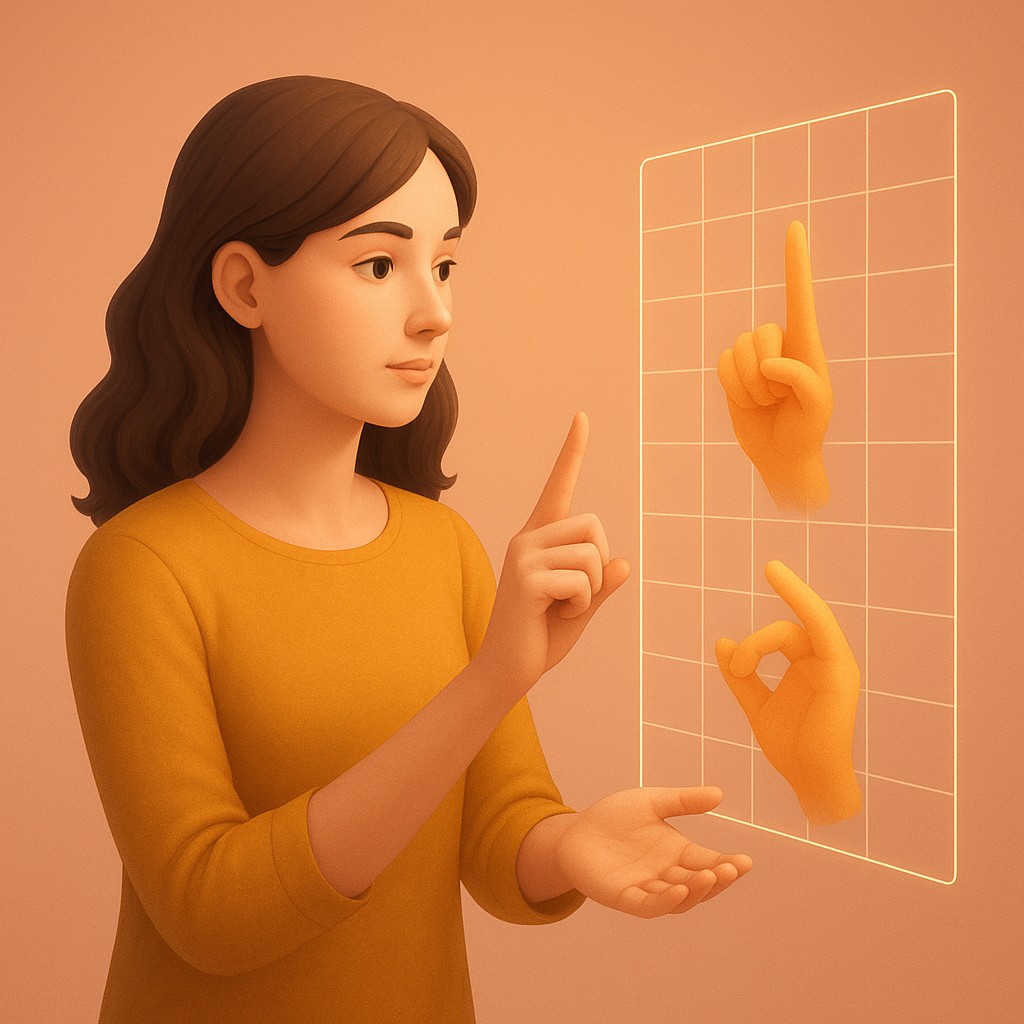
Hearing people often mistake sign languages for simple visual codes, like a hand-signed version of Morse code. In reality, American Sign Language (ASL), British Sign Language (BSL), and hundreds of others worldwide are independent languages with their own complex rules. One of their most elegant features is "spatial agreement." Instead of relying on a string of sounds, signers use the physical space around their bodies to map out relationships. This creates a visual mental map that allows them to communicate who did what to whom with incredible speed and clarity.
Mapping the Mental Stage
To understand spatial agreement, we first have to look at how a signer "sets the stage." Imagine you are telling a story about your friend Sarah and your cousin Mike. In a spoken language, you have to keep repeating their names or using pronouns like "he" or "she." If there are several men in the story, the listener might lose track of which "he" you mean. Sign languages solve this by "parking" Sarah and Mike in the air.
When a signer introduces someone, they usually sign the person’s name and then point to a specific spot in the empty space in front of them. From that moment on, that coordinate in the air belongs to that person. This point is called a "locus." If Sarah is parked on the right and Mike is parked on the left, the signer no longer needs to use their names. By simply gesturing toward the right, the signer is effectively saying "Sarah." This efficient indexing system turns the air into a temporary database of characters.
This spatial mapping creates a visual logic that speech cannot easily match. Because characters have fixed locations, a signer can track a dozen different people without the "pronoun confusion" that often mucks up spoken English. We have all been in conversations where someone says, "Then he told him that he didn't like what he did," leaving everyone wondering who was actually mad. In sign language, having a unique physical location for every person in the story eliminates that guesswork.
The Verb as a Bridge
Once the "actors" are in their spots, the magic of spatial agreement shows up in the verbs. In English, many verbs are static; the word "give" sounds the same regardless of who is giving or receiving. We have to add extra words for context: "I give the book to you." In sign languages, many verbs are "directional." They aren't just signs; they are vectors.
Take the ASL sign for "give." Instead of a fixed motion, the sign starts at the giver's location and moves through the air to the receiver's spot. If I am giving something to you, the sign moves from my body toward you. If Sarah (on my right) is giving something to Mike (on my left), I move the sign from the right-hand locus over to the left-hand locus. In one fluid, half-second motion, I have named the subject (Sarah), the action (giving), and the object (Mike).
This is the heart of spatial agreement. The verb literally "agrees" with the locations of the people involved. It transforms grammar from a flat line of words into a 3D interaction. This allows for a density of information that spoken languages struggle to hit. The movement, speed, and starting point of the sign all carry grammatical data that would take an entire spoken sentence to explain.
Comparing Linear and Spatial Frameworks
It helps to see how this compares to the languages most of us know. Spoken languages are "one-dimensional" because we can only make one sound at a time. We are essentially communicating through a narrow pipe. Sign languages use three-dimensional space, allowing several layers of information to happen at once.
| Feature |
Spoken English |
American Sign Language (ASL) |
| Primary Tool |
Word order and helping words |
Spatial points (loci) and movement |
| Identifying Subjects |
Naming them before the verb |
Pointing to a designated spot in the air |
| Verb Structure |
Stays the same or uses suffixes |
Moves between spots to show relationships |
| Clarity |
Pronouns like "he/she" can be vague |
Physical placement makes it specific |
| Data Density |
Linear (one word at a time) |
Simultaneous (hand shape, move, and face) |
As the table shows, "agreement" means the verb must align its path with the established points in space. If you put Mike on the left but move the verb for "tell" toward the right to say you told Mike something, you have made a grammatical mistake. It would be like saying "She tell he" in English. It sounds wrong to a native signer because the spatial logic is broken.
The Role of Body Language
While the hands move between spots in the air, the signer’s entire upper body supports the grammar. This includes "non-manual markers" - facial expressions, head tilts, and shoulder shifts that add layers of meaning. A signer might tilt their head toward the spot of the person who is the subject of the sentence to clarify the story's perspective.
For example, if a signer is describing a talk between a boss and an employee, they might "become" those characters for a moment. They might shift their shoulders toward the right when signing the boss’s words and then shift left for the employee’s reply. This is called "role shifting," and it works perfectly with spatial agreement. By combining the path of the verb with the tilt of the body, the signer creates a cinematic experience.
These markers aren't just for emotion; they are required parts of the language. A raised eyebrow or a specific mouth shape can turn a statement into a question or show that an action happens repeatedly. When combined with spatial verbs, the result is a system that is both fast and deeply expressive. It captures the "who, what, and how" in a way that feels more like a 3D simulation than a simple list of facts.
Correcting Common Myths
One of the most persistent myths is that sign languages are universal or based on the local spoken language. Many people assume ASL is just "English on the hands" and that BSL would be the same since both countries speak English. In reality, ASL and BSL are completely different languages. They have different vocabularies and different ways of handling space.
This misunderstanding comes from the idea that signs are just "pictures" or pantomime. While some signs are "iconic" (meaning they look like the object they represent, like the sign for "book"), most are "arbitrary." The spatial agreement system proves this. It is a strict, rule-governed framework that must be learned, just like French verb endings. You can't just wave your hands around and expect to be understood; you have to follow specific spatial rules.
Another myth is that sign languages are too simple for abstract or technical topics. Because spatial agreement tracks people and ideas so precisely, it is actually perfect for complex fields like law, medicine, or philosophy. Signers can use space to represent abstract ideas - for example, placing "Justice" on the left and "Mercy" on the right - and move verbs between those spots to discuss the fine details of a legal case.
The Mental Gym of Spatial Thinking
Learning spatial agreement requires a total shift in how the brain handles language. For a hearing person, the hardest part is letting go of the "linear" habits of speech. Beginners often struggle to remember where they "placed" people. They might put Sarah on the right and then, a minute later, accidentally point to the left to talk about her. To a native signer, this is nonsensical because the person on the left is Mike.
This spatial memory is a unique mental skill. Research shows that native signers often have better spatial awareness and visual memory than non-signers. Their brains are trained to treat the world as a canvas for data. They aren't just listening for words; they are tracking coordinates, watching for body shifts, and interpreting the geometry of the signs.
The beauty of this system is that it makes "invisible" connections visible. In a spoken sentence, the link between the person doing the action and the one receiving it is a concept we build in our minds. In sign language, that link is physically drawn in the air. You can see the connection traveling from one point to another. It reminds us that there are many ways for the human brain to organize information, and our reliance on sound is only one path to communication.
The mechanics of sign language reveal a world where grammar is a sophisticated ballet of movement. It challenges our assumptions about what a language "should" look like and reminds us that human communication is endlessly adaptable. The next time you see someone signing, you won't just see hands moving; you will see an architect building a complex, invisible structure in the air, one point at a time.