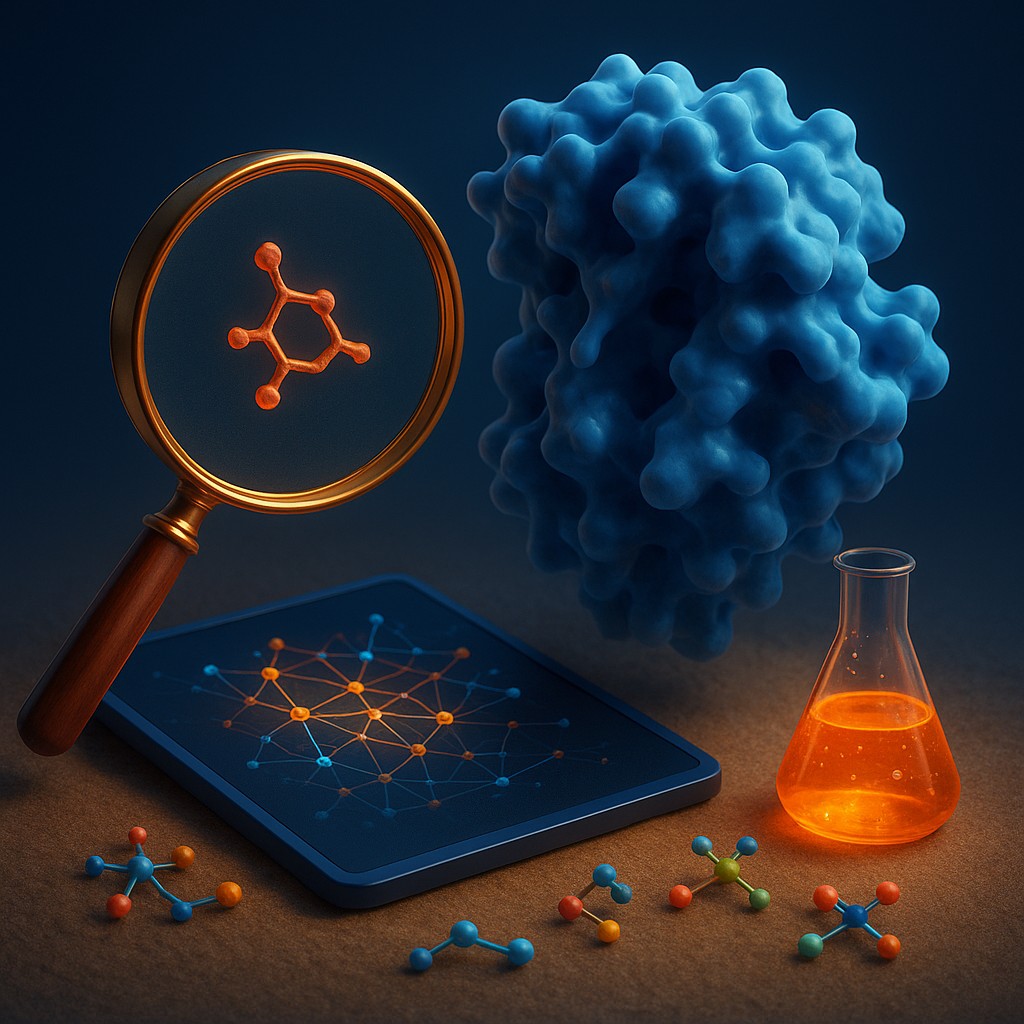
For decades, the search for a cure has felt like wearing a blindfold while trying to find a specific grain of sand on a vast beach. Scientists would start with a known biological target, such as a protein that causes inflammation or a receptor on a cancer cell, and then test thousands of existing chemicals against it. This process, known as high-throughput screening, is essentially a high-stakes game of trial and error. Researchers take a library of known chemicals and hope that one of them, by sheer luck, happens to stick to the target perfectly enough to stop the disease.
However, the traditional way of making medicine is notoriously slow and incredibly expensive. It takes an average of ten years and billions of dollars to bring a single drug from the lab to the pharmacy shelf, and that is only if everything goes perfectly. Most of the time, it does not. About nine out of ten drug candidates fail during human trials because they turn out to be toxic or simply do not work. We have been limited by the "chemical space" we already know, fishing in the same small pond while the vast ocean of potential molecular structures remains unexplored.
The Architecture of Invisible Keys
To understand how generative chemistry is changing the game, imagine a biological target in your body as a complex, three-dimensional lock. In the past, we had a giant ring of keys we had already found in nature or built by hand. We would try every single one, hoping one would turn the lock. Generative chemistry, powered by artificial intelligence, does not bother with the old key ring. Instead, it looks at the internal shape of the lock and uses advanced math to design a brand-new key from scratch, one that has never existed before.
This shift from "discovery" to "design" is a major breakthrough. By using computer programs like Generative Adversarial Networks (GANs) or Variational Autoencoders, computers can analyze the atomic structure of a disease-related protein. The AI acts like a creative architect that understands the laws of physics and chemistry. It explores a nearly infinite digital playground of molecular options, moving atoms around and testing bonds in a virtual world. It doesn't just find a molecule; it imagines one that is perfectly tuned to be powerful, stable, and safe, often creating structures that human chemists might never have thought to try.
From Digital Dreams to Real Remedies
When the AI identifies a "winner," the process moves from the computer screen into the real world. This is where lab work meets the precision of the computer. Because the AI has already filtered out billions of bad options that would have failed due to basic chemical flaws, researchers only need to make a handful of the most promising candidates. This stage, called the "hit to lead" phase, is where the timeline begins to shrink. What used to take three to five years of physical lab work can now sometimes be done in a few months.
Once these custom molecules are created, they undergo the same strict safety testing as any other drug. They are tested in cells and animal models to make sure they do not cause unintended harm. The goal of generative chemistry is not to skip safety steps, but to ensure that the molecules we choose to test are much more likely to succeed. By the time a drug enters human trials, it has already passed a digital test that traditional drugs never face. We are moving the intelligence to the front of the process so that human trials are a confirmation rather than a gamble.
Comparing the Old Guard and the New Wave
The transition from traditional methods to AI-driven chemistry can be summarized by looking at the changes in efficiency and creativity. While the traditional method relies on history and physical repetition, the generative approach relies on predictive models and new structures.
| Feature |
Traditional Drug Discovery |
Generative Chemistry (AI) |
| Starting Point |
Libraries of known chemicals |
A blank canvas based on the target's shape |
| Timeline |
4 to 6 years for early discovery |
12 to 18 months for early discovery |
| Molecular Origin |
Found in nature or existing databases |
Designed from scratch; brand-new structures |
| Success Rate |
High failure rate due to "brute force" |
Higher precision; fewer physical failures |
| Cost |
Billions of dollars per drug |
Potential for much lower costs |
| Complexity |
Limited by human intuition and past maps |
Limited only by computer power |
Navigating the Human Element of Clinical Trials
Despite the incredible power of modern supercomputers, we are not yet at the point where a machine can guarantee a drug will work in a human. Biology is messy, unpredictable, and far more complex than any current computer model can fully simulate. This is why human clinical trials remain the gold standard. AI-generated drugs, such as those currently in Phase 2 trials for lung diseases like idiopathic pulmonary fibrosis, must still prove they work in real patients over months and years.
The human element is also vital for ethics. We must ensure that the data used to train these AI models is diverse and represents people from all over the world. If an AI is trained only on one specific group, the "perfect" molecules it designs might only work for that group. Furthermore, doctors and researchers are responsible for watching for side effects a computer might not have predicted. The AI provides the blueprint and the chemistry provides the tool, but human empathy and scientific doubt provide the guardrails that keep patients safe.
Busting the Myths of the Robot Chemist
One common fear is that AI is "replacing" chemists. In reality, it is more like giving a master craftsman a high-powered tool. Chemists are now spending less time on the "grunt work" of mixing thousands of unsuccessful samples and more time analyzing high-level data. Another myth is that AI-discovered drugs are "synthetic" in a way that makes them more dangerous. Chemistry is chemistry; whether a molecule was inspired by a fungus or designed by a computer, its safety depends on its structure and how it interacts with our bodies, not where it came from.
There is also a fear that we are losing the "happy accidents" of science, like the discovery of penicillin. While generative chemistry is very intentional, the AI often comes up with strange, unexpected molecular shapes that a human would never have guessed. In a way, AI has created a new kind of digital luck, where "accidents" happen at the speed of light inside a processor. This allows us to find the wonders of the molecular world without waiting for a lucky mold growth in a petri dish.
The Future of Living Longer and Better
The true promise of this technology lies in rare diseases and "undruggable" targets that have been ignored for decades. For many rare conditions, the patient population is so small that a ten-year, multi-billion dollar development cycle is financially impossible. Generative chemistry lowers the bar, making it possible to design treatments for diseases that affect only a few thousand people. It flips the economics of medicine, moving us toward a future of personalized, precise healthcare.
As you look toward the next decade of medical breakthroughs, remember that we are witnessing a fundamental shift in how we interact with the building blocks of life. We are no longer just scavengers looking for cures in the woods; we have become architects of our own molecular destiny. The journey from a digital idea to a life-saving pill is becoming shorter, smarter, and more hopeful every day. We are living in an era where the next great cure might not be found in a forest, but dreamed up in a line of code and proven true by the steady hand of human science.