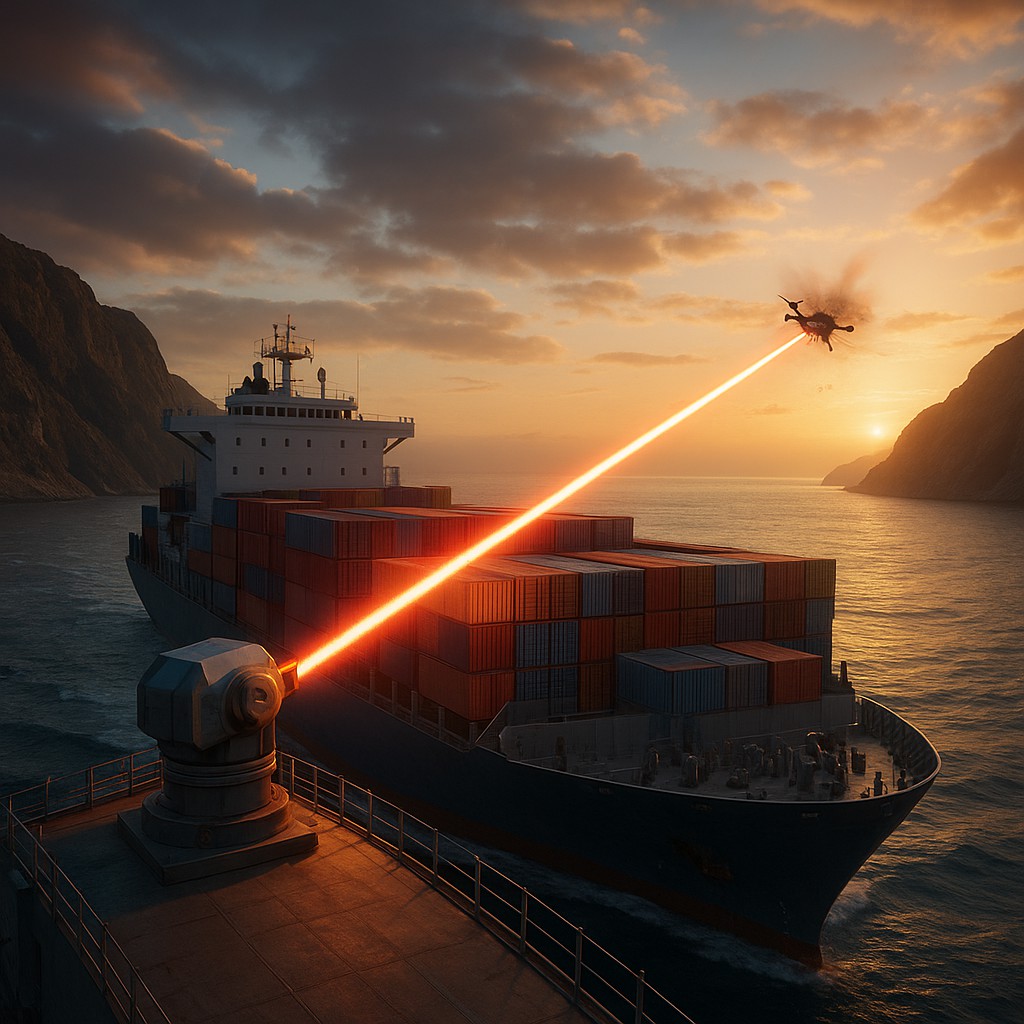
Imagine standing on the deck of a massive container ship as it glides through a narrow strait. For decades, the primary threats to these giants were predictable: heavy weather, engine failure, or perhaps a rare run-in with pirates in speedboats. Today, however, the dangers have shrunk in size but grown in complexity. Tiny, inexpensive drones - some no larger than a hobbyist’s toy - can now be launched from miles away to swarm a vessel. Carrying enough explosives to disable vital systems or ignite cargo, these "mosquito fleets" are a nightmare for traditional maritime security. They are too small for standard radar to track easily and far too cheap to justify firing a million-dollar missile in response.
The maritime world is currently undergoing a quiet but profound shift in how it protects these vital trade routes. Instead of relying solely on physical weapons like heavy machine guns or interceptors, international protocols are beginning to integrate high-power laser systems into the hulls of both commercial and naval escorts. This isn’t the stuff of deep-space science fiction, but a practical application of physics used to solve a modern economic problem. We are moving toward an era where a ship’s primary ammunition isn't stored in a heavy magazine downstairs, but is instead generated in the engine room as pure electrical energy.
The Mathematical Imbalance of Modern Piracy
To understand why lasers are becoming the preferred tool for maritime defense, one must look at the brutal math of modern conflict. Historically, defending a ship required a "like for like" exchange: if an attacker fired a shell, the defender used armor or a counter-shell. However, the rise of cheap, off-the-shelf aerial drones has broken this symmetry. A group of insurgents or pirates can build a swarm of twenty drones for the price of a high-end used car. To shoot them down using traditional anti-ship missiles, a defender might spend fifty times that amount per shot. This creates an "attrition trap," where the defender runs out of money or ammunition long before the attacker runs out of drones.
Directed energy weapons, specifically High Energy Lasers (HEL), flip this script entirely. When a ship fires a laser, the cost of the "shot" is essentially just the price of the fuel required to generate the electricity for that specific burst of light. Current estimates suggest that a high-power laser engagement costs less than ten dollars per firing. This allows a vessel to maintain a nearly infinite magazine. As long as the ship’s generators are humming and the cooling systems are working, the ship can keep firing. This shift moves the focus of naval architecture away from how many missiles a hull can carry and toward how much sustained electrical wattage it can produce.
How a Beam of Light Disables a Flying Robot
A common misconception about combat lasers is that they work like "blasters" in movies, creating a visible bolt of light that makes things instantly explode. In reality, a maritime laser system is more like a silent, invisible, and incredibly precise blowtorch. The system works through a process called thermal loading. The laser focuses a massive amount of light energy onto a tiny spot on the target - usually the drone’s engine housing, its guidance sensors, or its fuel reserves. Within seconds, the intense heat melts through plastic or carbon fiber, fries the delicate internal circuitry, or causes the battery to overheat and catch fire, effectively turning the drone into a falling brick.
The speed of this engagement is another massive advantage. Since light travels at 300,000 kilometers per second, there is no need to "lead" the target or calculate wind resistance and gravity as one would with a bullet or a missile. If the sensors can see it and the mirrors can point at it, the hit is instantaneous. This is particularly crucial when dealing with swarms that move in erratic patterns. A laser system can cycle between targets with millisecond precision, neutralizing one drone and immediately pivoting to the next. This "detect, track, and engage" cycle is managed by high-speed computers that can track hundreds of objects at once, picking out the most dangerous threats to neutralize first.
The Invisible Infrastructure of Directed Energy
The hardware required to fire a weaponized beam of light is a masterpiece of precision engineering, generally divided into three main components: the power source, the beam generator, and the beam director. The power source is usually the ship’s existing electrical grid, often backed by large capacitor banks - devices that store and discharge a massive "gulp" of energy quickly. The generator then converts this electricity into light. Modern systems often use fiber lasers, where many individual laser modules are combined into a single, high-power beam, much like a thick rope is woven from many small threads. This makes the system modular and more reliable than older gas-powered lasers.
The most visible part of the system is the beam director, often a polished dome or turret located on the ship’s upper decks. Inside this dome sits a series of mirrors and lenses that must remain perfectly still even as the ship tosses and turns in heavy seas. Using advanced gyroscopes and fast-steering mirrors, the system compensates for the ship’s motion to keep the beam focused on a spot the size of a coin several kilometers away. It is this combination of brute energy and surgical precision that makes the technology effective.
| Feature |
Traditional Missiles |
High-Power Laser Systems |
| Cost per Engagement |
$100,000 to $2,000,000 |
Roughly $1 to $15 |
| Ammunition Capacity |
Limited by physical storage |
Unlimited (as long as power exists) |
| Speed of Delivery |
Supersonic or Subsonic |
Speed of Light |
| Environmental Impact |
High (explosive debris and smoke) |
Low (precision heating) |
| Weather Reliability |
High (works in all weather) |
Low to Medium (vulnerable to fog) |
Navigating the Fog of War and Water
Despite their impressive capabilities, lasers are not magic. They face a formidable enemy in the maritime environment: the weather. Because a laser is made of light, it follows the laws of optics. In a clear, blue-sky environment, a laser can travel for miles with minimal loss of strength. However, the ocean is rarely a vacuum. Water vapor, salt spray, rain, and heavy fog all act as physical barriers to the beam. Each tiny droplet of water in a fog bank reflects and scatters the light, causing the beam to "bloom" or spread out. When a beam spreads, its energy density drops, meaning it can no longer generate the heat required to melt a target.
This limitation means that lasers are currently viewed as a "layered" defense rather than a total replacement for traditional weapons. In heavy rain or thick North Atlantic fog, a ship might still need to rely on its guns or missiles. Furthermore, there is the challenge of "dwell time." A missile destroys its target the moment it impacts. A laser, however, must "dwell" on a target for a few seconds to build up enough heat to cause a failure. If a drone is coated in a highly reflective or heat-resistant material, that dwell time increases, potentially allowing other drones in the swarm to close the distance. Engineers are currently working on adaptive optics - mirrors that can slightly change their shape in real-time to compensate for atmospheric distortion - to effectively "punch" a path through the mist.
The Ethical and Regulatory Horizon
As these systems move from experimental naval vessels to the wider world of commercial shipping, they bring a host of new regulatory questions. International maritime protocols are currently being updated to ensure that these lasers are used safely and responsibly. One of the primary concerns is eye safety. While a laser might be aimed at a drone, the beam can travel for miles into the sky or across the horizon. If that beam were to accidentally strike a passing aircraft or another ship’s bridge, it could cause permanent blindness to anyone looking in its direction. This has led to the development of sophisticated "backstop" software that automatically shuts the laser off if a non-target object enters the beam's path.
There is also the question of who gets to use this technology. Currently, high-power lasers are largely the province of well-funded national navies, such as the UK’s DragonFire system or the US Navy’s various prototypes. However, as the technology becomes more compact and affordable, we may see private security companies on commercial tankers requesting the same capabilities. This creates a delicate balance for international regulators: how do you allow ships to defend themselves against modern threats without turning the world’s shipping lanes into a high-stakes, high-energy arms race? The coming decade will likely see the establishment of strict "no-fire zones" and specific certification for laser operators to keep the seas safe for both commerce and crews.
Stepping Into a Bright Defensive Future
The transition from physical projectiles to directed energy is more than just a technological upgrade; it is a fundamental shift in how humanity secures its global lifelines. By harnessing the power of the electromagnetic spectrum, we are finding ways to neutralize threats that were previously too numerous or too cheap to stop. We are learning to defend not with larger walls or bigger explosions, but with a deeper understanding of energy, precision, and light.
As you look toward the horizon, remember that the future of security is often invisible. The most effective defenses of tomorrow will not be marked by the roar of cannons, but by the silent, steady hum of electrical generators and the focused power of light particles. It is an exciting time to study technology, as we watch the ancient art of seafaring embrace the cutting edge of physics to ensure the world remains connected and secure. Whether it is through adaptive optics or better electrical storage, the journey to a safer ocean is being paved with light.