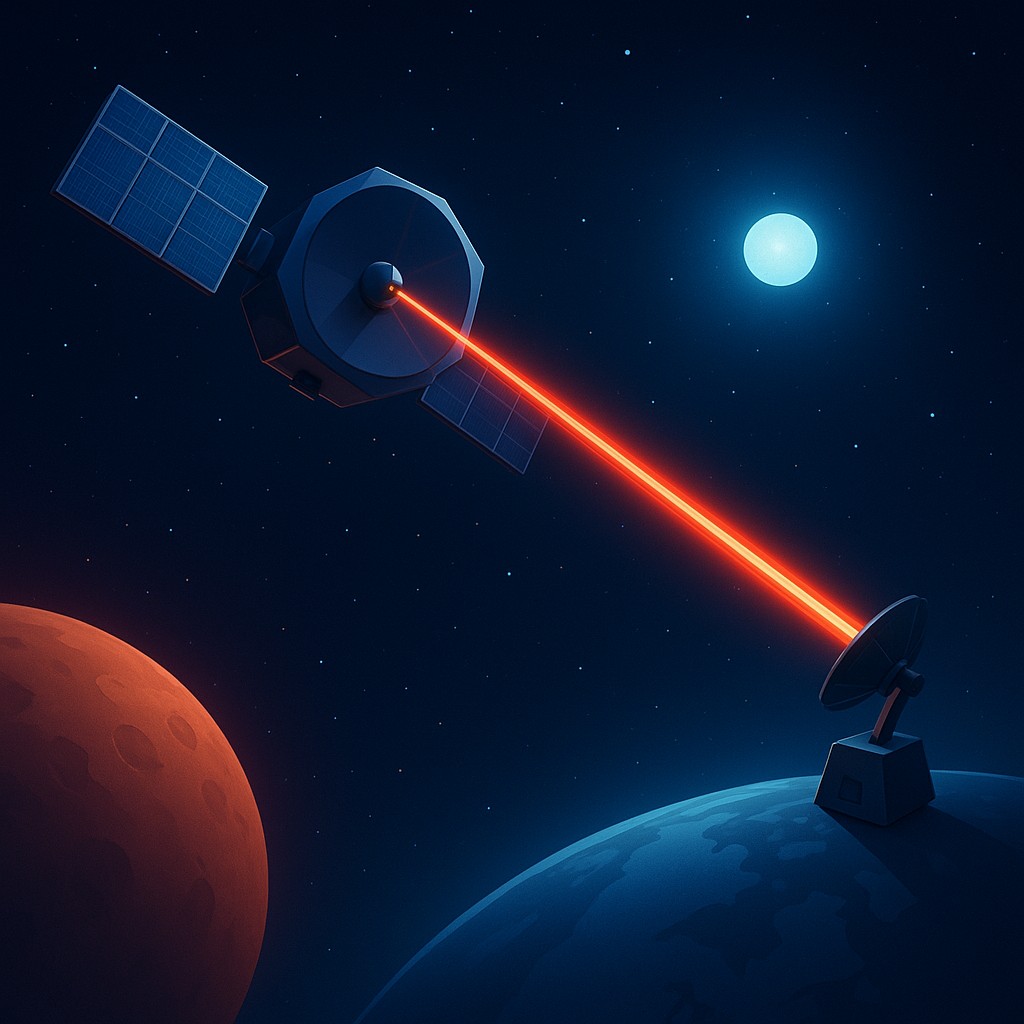
Imagine trying to download a high-definition movie using an old dial-up modem while someone else in the house is trying to make a phone call. For decades, this has been the reality of deep-space exploration. While our rovers and probes have become more sophisticated, equipped with 4K cameras and complex chemical sensors, the "pipe" used to send that data back to Earth has remained stubbornly narrow. We are currently living in a golden age of space discovery, yet we are viewing it through the digital equivalent of a drinking straw. The culprit is the radio wave, a reliable but increasingly crowded and low-capacity method of communication that has reached its physical limits.
To break through this bottleneck, scientists and engineers are turning away from invisible radio pulses and toward the concentrated power of light. By using infrared lasers, space agencies are beginning to build a "galactic fiber-optic network" that promises to increase data transfer speeds ten or even a hundred times over. This shift is not just about getting prettier pictures of Martian sunsets; it is about making it possible to send humans to other planets. A crewed mission to Mars will generate as much data in a single day as a robotic rover might in a year. Without laser communications, that data would sit trapped on a hard drive millions of miles away, waiting weeks or months to trickle back to mission control.
The Physics of the Frequency Bottleneck
The move from radio waves to lasers is essentially a move toward higher frequencies. In physics, the amount of data a wave can carry is directly related to its frequency: the number of times the wave vibrates every second. Think of a wave like a physical train. If each car on the train carries a piece of data, a radio wave is like a slow-moving freight train with very long cars. It gets the job done, but it takes a long time for the whole train to pass the station. A laser, which operates in the optical or infrared spectrum, is like a high-speed maglev train with thousands of tiny, rapid-fire cars passing by every second. Because the frequency of light is hundreds of terahertz higher than radio, it can pack significantly more information into the same amount of time.
Beyond speed, radio waves have a frustrating tendency to spread out. When a spacecraft at Jupiter beams a radio signal toward Earth, that signal fans out like light from a wide-angle flashlight. By the time it reaches our planet, the signal "spot" can be wider than the Earth itself. This means only a tiny fraction of the signal actually hits our receiving antennas, while the rest vanishes into the void. This "beam divergence" is a massive waste of energy. Lasers, on the other hand, produce a highly stable, narrow beam where the light stays tightly packed together. A laser fired from deep space might only be a few miles wide by the time it reaches Earth, ensuring that the receiver captures a much higher percentage of the energy and the data.
Pointing a Needle at a Speck of Dust
The primary reason we haven't used lasers for the last 50 years is that they are almost impossibly difficult to aim. Because the beam is so narrow, there is zero margin for error. NASA often describes this challenge as trying to hit a moving dime with a laser pointer from the top of a skyscraper, while the skyscraper sits on a rotating planet and the dime is on a moving car. If the spacecraft’s aim is off by even a fraction of a degree, the data beam will miss the ground station entirely, and the connection will be lost. This requires a level of precision in "pointing, acquisition, and tracking" (PAT) that pushes the limits of modern mechanical engineering.
To solve this, engineers use a multi-stage aiming system. The spacecraft first uses its primary thrusters and reaction wheels to point its body generally toward Earth. Then, highly sensitive mirrors inside the optical terminal make micro-adjustments to the laser beam, compensating for vibrations from the spacecraft’s own electronics. On the Earth side, ground stations often fire an "uplink beacon" - a laser aimed back at the spacecraft - to act as a guidepost. The spacecraft sees this beacon and uses it to lock its sights on the target. This high-wire balancing act must happen across millions of miles of vacuum. Because of the delay caused by the speed of light, the spacecraft must aim where Earth will be minutes into the future, rather than where it is right map.
| Feature |
Traditional Radio (RF) |
Laser Communication (Optical) |
| Data Rate |
Low to Moderate (Kbps to Mbps) |
High to Ultra-High (Gbps+) |
| Weight/Size |
Heavy antennas and bulky hardware |
Smaller, lightweight optical terminals |
| Power Efficiency |
Low (signal spreads out too much) |
High (concentrated energy beam) |
| Precision Required |
Moderate (wide beam is easy to catch) |
Extreme (tight beam requires high accuracy) |
| Atmospheric Interference |
Low (passes through clouds and rain) |
High (blocked by clouds and turbulence) |
Piercing the Atmospheric Veil
While the vacuum of space is a perfect medium for light, Earth's atmosphere is a chaotic, swirling mess of gas and moisture. For a laser communication system, the atmosphere is the final boss. Not only do clouds and rain physically block infrared light, but even clear air causes "atmospheric turbulence." This is the same phenomenon that makes stars appear to twinkle. Small pockets of air with different temperatures and densities act like tiny, shifting lenses, bending the laser beam and causing the signal to flicker. To a high-speed data receiver, this "twinkling" looks like a corrupted file.
To combat this, engineers use a two-pronged strategy. First, they use "site diversity," which involves building ground stations in different locations - usually high-altitude deserts like those in California, Arizona, or Australia. Since it is unlikely to be cloudy in all these places at once, mission control can switch the download to whichever station has the clearest skies. Second, researchers are developing "adaptive optics." This technology uses flexible, computer-controlled mirrors that can change their shape hundreds of times per second to cancel out atmospheric distortion in real time. By warping the mirror in the exact opposite way the atmosphere warps the light, the system "un-blurs" the signal and protects the data.
The End of the Silent Deep Space
The shift to laser communication represents a fundamental change in how we explore the cosmos. Historically, space missions have been slow-motion endeavors. We get a few dozen photos from a flyby, or a short video clip that takes days to process and transmit. With optical links, we are entering the era of the "live-streamed" solar system. The NASA Deep Space Optical Communications (DSOC) experiment, recently tested on the Psyche mission, proved that we can transmit high-definition video from deep space at speeds that rival home internet. This isn't just for public relations; it is a scientific game-changer. It means a rover on Mars could send back massive, multi-gigabyte maps of the terrain, or a probe in the icy plumes of Europa could transmit high-resolution video of potential signs of life.
This technology also allows us to shrink the hardware on the spacecraft. Because lasers are so efficient at concentrating energy, the "antennas" (which are actually telescopes) can be much smaller than the massive radio dishes we use today. Reducing the weight and size of the communication system frees up room for more scientific instruments or fuel, extending the life and capability of the mission. We are essentially swapping a 100-pound radio dish for a 15-pound optical terminal that performs 100 times better. In the weight-sensitive world of aerospace engineering, that is a miracle.
Navigating the Myths of the Laser Age
There are several misconceptions about this transition that often lead to confusion. A common myth is that lasers will completely replace radio waves in space. In reality, radio is not going anywhere. Radio waves are incredibly tough; they can penetrate thick cloud cover and even some planetary atmospheres (like that of Titan) that would completely stop a laser. Radio will likely remain the "emergency channel" or the primary way we send simple commands to a spacecraft. Laser communication will serve as the "high-speed broadband" for massive data transfers, creating a hybrid system where radio provides reliability and light provides speed.
Another misconception is that these lasers are like the weapons seen in science fiction. In truth, the lasers used for communication are relatively low-power. They are designed to carry information, not heat, and they operate in the infrared spectrum, which is invisible to the human eye. You couldn't use a communication laser to blast an asteroid, and you couldn't even see the beam if you were standing right next to it. It is a subtle, invisible thread of light, carrying the collective knowledge of our species across the silent ocean of space.
The transition from the roar of radio to the precision of the laser is more than a technical upgrade; it is an invitation to a closer relationship with the universe. As we perfect the art of aiming light across the void and taming the turbulence of our own air, we are building the foundation for a future where the distance between Earth and Mars feels a little shorter. We are moving toward a time when a child in a classroom can watch a live, high-definition feed of an astronaut stepping onto the red dust of another world, sent via a shimmering beam of light. This is the dawn of a truly connected solar system, where the speed of discovery is no longer limited by the frequency of our waves, but only by the reach of our imagination.