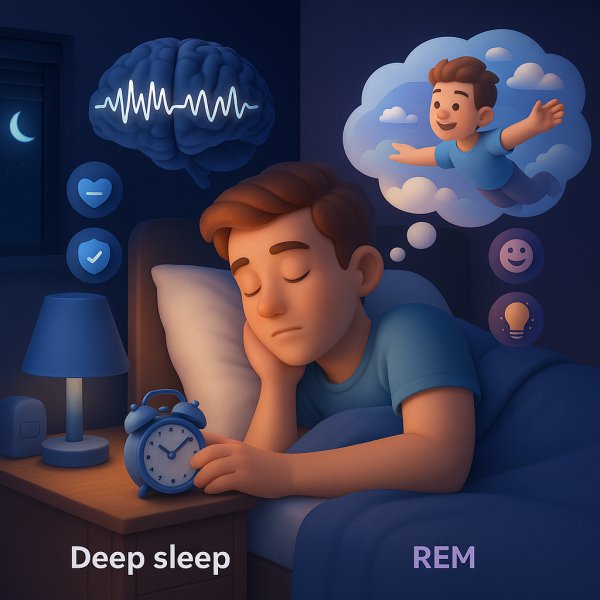
Where your brain goes when you sleep - a surprising nightly double act
Have you ever woken up after a weird, vivid dream and wondered whether your bed had secretly been running a movie studio, a gym, and a repair shop all night? It turns out your brain is exactly that busy, and it shifts between two main modes that look and feel very different: deep sleep, and REM sleep. Both are essential, but they are not the same job, and mixing them up is like confusing a mechanic with a novelist - both are helpful, but they do very different things.
Think of your night as a sequence of shifts. Over roughly 7 to 9 hours most people cycle through light sleep, deep sleep, and REM sleep every 90 to 120 minutes, repeating this loop like a factory assembly line. Deep sleep handles heavy maintenance and cleaning, while REM sleep stages set the stage for storytelling and emotional processing. Getting to know what each stage does helps you understand why a poor night affects memory, mood, creativity, and even long-term health.
Meet the two main actors: Deep sleep and REM sleep in plain English
Deep sleep, technically called slow-wave sleep or Stage N3, is the slow, restorative phase of the night when your brain waves slow down into large, regular oscillations. During deep sleep your breathing and heart rate slow, your muscles relax, and your body ramps up repair processes, such as releasing growth hormone and washing away metabolic waste. If sleep were a night at the theater, deep sleep would be the stage crew, quietly fixing things and resetting the set for tomorrow.
REM sleep, short for rapid eye movement sleep, looks like high-energy activity when you peek at brain scans. The brain during REM is more active, almost similar to wakefulness, while the body is mostly paralyzed to stop you from acting out dreams. REM is the dream factory and the emotional lab, busy blending memories, emotions, and creative recombinations into something new. If deep sleep is the maintenance crew, REM sleep is the screenwriter, editing your day into stories that help you learn and adapt.
Behind the scenes - how deep sleep and REM sleep show up on brain, body, and behavior
On an electroencephalogram, or EEG, deep sleep displays slow, high-amplitude delta waves that reflect synchronized firing across large groups of neurons. Breathing and heart rate are steady and low, blood pressure dips, and the body focuses on physical restoration. Scientists link deep sleep to immune function, tissue repair, hormone regulation, and the glymphatic system that clears brain waste, potentially lowering dementia risk later in life.
REM sleep shows fast, low-amplitude EEG patterns similar to wakefulness, but with bursts of rapid eye movements and irregular breathing. The body is largely paralyzed, a safe mechanism called REM atonia that prevents physical acting out of dreams. REM sleep is strongly associated with emotional memory consolidation, problem-solving, and the generation of vivid dreams. Studies show REM helps integrate emotional experiences and can dampen the emotional intensity of difficult memories so they become easier to handle.
| Feature |
Deep sleep (N3) |
REM sleep |
| EEG pattern |
Slow, high-amplitude delta waves |
Fast, low-amplitude, wake-like waves |
| Heart rate / breathing |
Slow, steady |
Variable, irregular |
| Body movement |
Minimal, muscles relaxed |
Muscles atonia, eye movements present |
| Primary functions |
Physical restoration, glymphatic clearance, growth hormone release |
Emotional processing, procedural learning, dreaming, creativity |
| Typical time proportion in adults |
13-23% (decreases with age) |
20-25% (increases across the night) |
What each stage does for memory, mood, and body - the science made simple
Deep sleep consolidates declarative memory, which is memory for facts and events, like the vocabulary list you studied for a test. During slow-wave sleep, the brain seems to replay newly learned information in a coordinated way that helps move memories from short-term storage in the hippocampus into long-term storage in the cortex. This stage also supports immune function and physical recovery, with research showing that growth hormone secretion peaks during deep sleep, and the glymphatic system - the brain's waste clearance mechanism - is especially active during slow-wave sleep.
REM sleep, on the other hand, is crucial for emotional memory and procedural learning, which is how you learn skills and habits. REM appears to help the brain integrate emotional experiences, reduce the emotional charge of negative memories, and make remote associations that support creativity. Studies indicate that after intense skill learning, people show more REM sleep, and dream content sometimes reflects the learning material in metaphorical ways. REM is also strongly linked to mood regulation; lack of REM correlates with increased emotional reactivity and poor stress coping.
Researchers such as Matthew Walker and neuroscientists Giulio Tononi and Chiara Cirelli have outlined these complementary roles, showing that sleep is not a uniform state, but a coordinated set of processes that together support cognition, health, and well-being (see Why We Sleep, Walker, 2017, and the synaptic homeostasis hypothesis by Tononi and Cirelli).
Common myths that get in the way of better sleep - short corrections with real reasons
A common myth is that only REM sleep involves dreaming, while deep sleep is dreamless. In reality, dreams can and do occur across sleep stages, but REM dreams are often longer and more vivid, while deep-sleep dreams are shorter and less story-like. Another misconception is that you can "catch up" on specific stages selectively; while recovery sleep can increase some features of deep sleep or REM, the architecture of recovery is complex and not a perfect substitute for regular, balanced sleep over weeks and months.
Many people also believe that the more deep sleep the better, uniformly. While deep sleep is vital for repair, an abnormal excess or deficit can be a sign of underlying issues, and different ages need different amounts. For example, young people naturally have more deep sleep than older adults. Alcohol is sometimes used as a sleep crutch, but it suppresses REM sleep and fragments deep sleep, producing the illusion of sleeping well while degrading the restorative quality of the night.
Two short real-life stories that show the difference in action
Tom is a university student who pulls an all-nighter cramming for an exam, then sleeps only five hours before the test. He wakes up groggy, can't recall facts he reviewed, and feels emotionally thin during the exam. Tom's short sleep likely cut deep sleep cycles and REM consolidation, compromising both declarative memory and emotional balance. When he later improves his sleep schedule to get full nights, he notices he remembers facts easier and is less anxious in class, showing how both deep sleep and REM contributed to learning and emotional resilience.
Maria is a new parent who is waking frequently at night to feed her infant. She notices daytime forgetfulness and that tasks requiring creativity feel harder. Her fragmented sleep reduces continuous blocks of deep sleep and REM, so her brain doesn't get full maintenance cycles or the emotional processing it needs. Over months, chronic disruption increases her feelings of stress and reduces her ability to solve complex problems at work. These stories are not dramatized exceptions; they are typical examples of how different kinds of sleep loss produce distinct deficits.
"Sleep is the single most effective thing we can do to reset our brain and body health each day" - paraphrase of insights from sleep research leaders.
Practical steps to increase the type of sleep you need - evidence-based routines
Improving sleep quality is about creating conditions that allow your brain to cycle naturally through deep sleep and REM. Here are practical strategies that favor balanced sleep architecture:
- Keep a consistent sleep schedule, even on weekends, to stabilize your circadian rhythm, which helps time the distribution of deep sleep and REM across the night. Regularity is one of the strongest predictors of good sleep quality.
- Create a cool, dark, quiet bedroom. Cooler temperatures promote deep sleep, while light exposure at night can suppress melatonin and shift your REM timing.
- Time caffeine and alcohol wisely. Avoid caffeine within 6-8 hours of bedtime; even late-afternoon caffeine can reduce deep sleep. Avoid alcohol as a sleep aid, because it fragments REM sleep and impairs memory consolidation.
- Exercise regularly, but not right before bed. Physical activity promotes deep sleep when performed earlier in the day, but vigorous exercise immediately before bedtime can make falling asleep harder.
- Limit screen time before bed and get morning light. Blue light in the evening delays melatonin release and affects the timing of REM. Morning light helps anchor the circadian rhythm, improving sleep architecture at night.
- Consider a routine for emotional processing, such as journaling or a short worry list before bed to offload concerns. This can reduce fragmented REM related to anxiety and promote better emotional consolidation during sleep.
- If you nap, keep naps short (20-30 minutes) and before mid-afternoon to avoid interfering with nighttime deep sleep. Strategic naps can improve alertness without sabotaging core restorative sleep.
Try a simple 7-step pre-sleep routine: dim lights 90 minutes before bed, put phone on do-not-disturb, take a warm shower or bath 60 minutes before bed, do gentle stretching or breathing exercises 30 minutes before bed, write a short "brain dump" of worries, lie down at your scheduled bedtime, practice 10 minutes of relaxed breathing to drift off. Following such a routine helps your brain move smoothly into deep sleep early on, and then into restorative REM cycles later in the night.
Small experiments to try this week - track, tweak, and notice
Experiment 1: Track your sleep for 7 nights with a diary or a reliable tracker and note how you feel each morning. Compare nights with late caffeine or alcohol to baseline nights. You will likely notice mood and memory differences that reflect disrupted REM or deep sleep.
Experiment 2: Choose one variable to change for a week, such as consistent bedtime, no screens after 9 pm, or a 30-minute morning walk. Observe differences in vivid dreaming, daytime alertness, memory, and emotional reactivity. Journaling these observations helps you see patterns and makes sleep changes stick.
Experiment 3: Try a short nap experiment. On three different days, test a 20-minute nap, a 60-90 minute nap that includes deep sleep, and skipping a nap. Notice which best helps your afternoon focus and whether it affects your night sleep. Use these small trials to discover what your body prefers.
Quick comparison - the one-page cheat sheet to remember
- Deep sleep: slow brain waves, physical repair, memory consolidation for facts, immune and metabolic benefits, prominent earlier in the night, declines with age.
- REM sleep: active brain, vivid dreams, emotional processing, procedural and creative learning, more abundant toward morning, vulnerable to alcohol and antidepressants.
Remember, both types are complementary and essential. Sacrificing one to get more of the other is a false economy.
Final thoughts you can act on tonight
If you take one thing away, remember this: sleep is not a single activity, it is a choreography of states, each with its own job. Deep sleep does the heavy lifting for your body and fact memory. REM sleep composes the emotional, creative, and procedural tunes your life needs. Prioritizing consistent sleep, smart timing of light and substances, and gentle pre-sleep rituals gives both stages the time they need to do their work.
So tonight, try one small thing - dim the lights and go to bed 20 minutes earlier than usual with your phone out of reach. It is a tiny act of faith in the process that the brain will repay by clearing, repairing, and making sense of your day. Over a few weeks, you should notice clearer thinking, better mood, and perhaps some memorable dreams that tell you your REM sleep is back on the job.