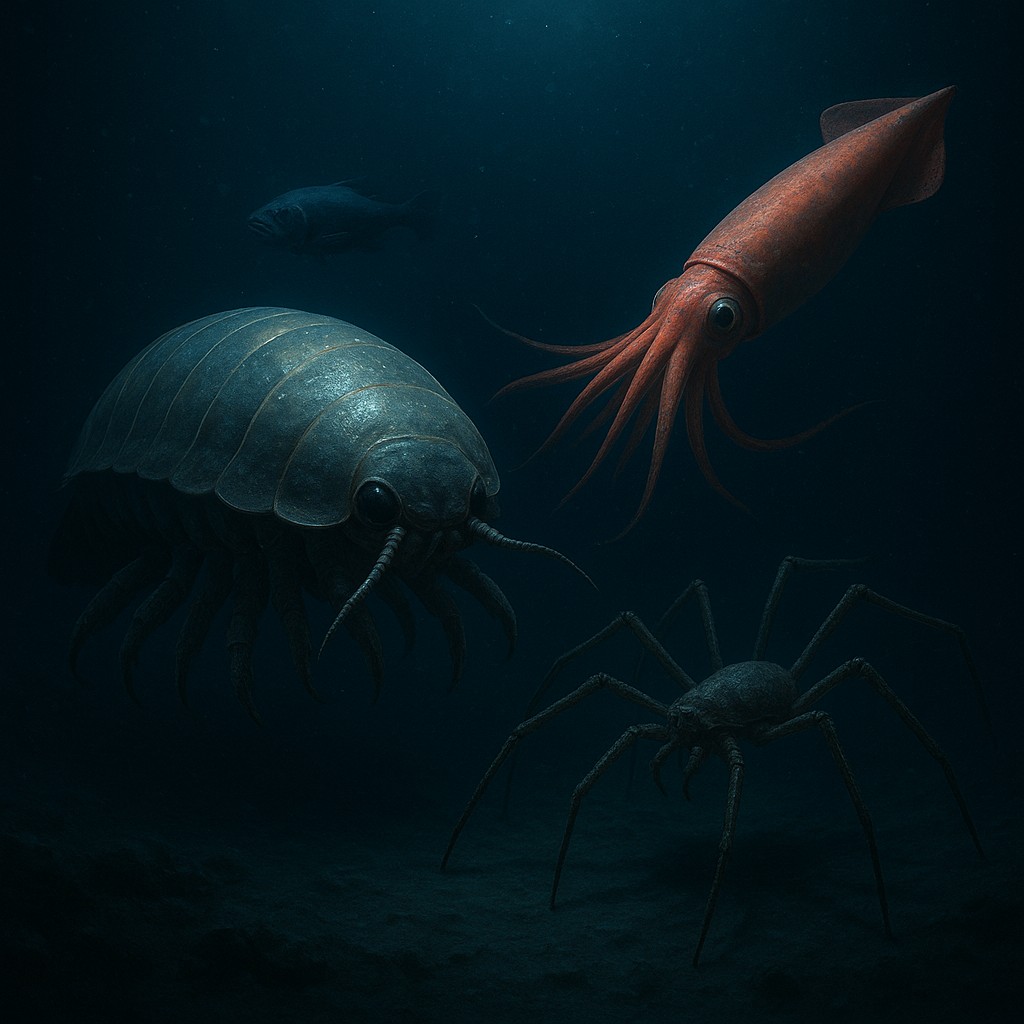
Imagine diving into the open ocean, leaving behind the sun-drenched waves where colorful coral reefs teem with life. As you sink deeper, the water shifts from turquoise to a bruised, heavy navy before finally fading into a pitch-black void. The temperature plummets to just a few degrees above freezing, and the weight of the ocean overhead creates a crushing pressure that would flatten a modern submarine. In this alien world, you might expect to find only tiny, withered creatures struggling to survive on the meager crumbs drifting down from above. Instead, you encounter a nightmare turned into a wonder: a pillbug the size of a football, a squid as long as a bus, and sea spiders with legs as wide as a dining table.
This phenomenon is known as abyssal gigantism, a biological "rule" that seems to defy our surface-level logic. On land or in shallow water, being small is often an advantage because it requires less energy and allows for quick reproduction. However, the deep sea turns the normal rules of biology upside down. Here, the "monsters" of the deep are not the result of freak mutations or a surplus of food; rather, they are the most efficient, logical solutions to a high-pressure, low-calorie existence. By understanding why these invertebrates grow to such staggering proportions, we can begin to appreciate how life adapts when pushed to its absolute limits.
The Chilly Secret to an Endless Childhood
To understand why a deep-sea creature becomes a giant, we first have to look at its internal thermometer. The deep sea acts like a massive refrigerator, kept at a constant, bone-chilling temperature. Since cold-blooded invertebrates like crabs and clams cannot regulate their own body heat, their metabolism is dictated by their environment. In freezing water, the chemical reactions inside their bodies slow to a crawl. This means that instead of burning through energy quickly, these animals operate in slow motion. While a shallow-water crab might live a fast-paced life of just a few years, its deep-sea cousin might take decades to reach adulthood.
This sluggish metabolism leads to a concept known as delayed sexual maturity. Because the animal grows so slowly and its internal processes are so chilled, it doesn't hit "puberty" at the usual time. Instead of spending energy to produce eggs or find a mate early in life, the animal simply keeps adding cells and building a larger frame. It is essentially trapped in a prolonged childhood where all available resources go toward physical growth. By the time it is finally ready to reproduce, it has already reached a massive scale that its shallow-water relatives could never achieve.
Furthermore, being large in a cold environment is a clever physics trick. Larger bodies have a smaller surface-area-to-volume ratio, which means they are much better at holding onto whatever heat or energy they generate. In the abyss, every unit of energy is a precious currency. By growing large, these animals become more efficient at maintaining their internal balance. They aren't big just to be scary; they are big because, in the freezing dark, size acts as a protective buffer against the elements.
Turning the Abyss into a Long-Distance Buffet
If you think your local grocery store is far away, imagine living two miles beneath the surface where the nearest meal might be fifty miles to the west and sinking from above. The deep sea is often described as a biological desert. There are no plants because there is no sunlight for photosynthesis. Most life depends on "marine snow," a polite term for the constant drizzle of waste, mucus, and decaying organic matter drifting down from the surface. Occasionally, a "food fall" occurs, such as when a whale dies and its massive carcass sinks to the seafloor. This is a lottery win for deep-sea scavengers, providing enough food to power an entire ecosystem for years.
To take advantage of these rare windfalls, an animal must be able to travel. A tiny shrimp might spend its whole life within a ten-foot radius, but a giant isopod can cover vast stretches of the seafloor to find the next whale carcass. Being larger means having more muscle and a more efficient stride or swimming stroke. It also means having the internal "fuel tank" necessary to survive months or even years between meals. Large animals can store significant amounts of fat, allowing them to enter a state of semi-hibernation until the scent of a meal drifts through the water.
When food finally appears, the giants are the ones who can feast most effectively. A giant isopod, for instance, can eat so much in one sitting that its body becomes visibly bloated like a balloon. It then uses that massive intake of calories to sustain its large frame during the lean times. In this context, gigantism is an insurance policy. It is the biological equivalent of buying in bulk; if you don't know when the next shipment is coming, you need a massive pantry to store as much as possible.
Comparing the Small and the Submerged
While the concept of gigantism is fascinating, it helps to look at how specific groups of animals change as they move from the sunlit waves to the midnight zone. Not every animal follows this rule, and the differences between shallow and deep versions of similar creatures are startling.
| Animal Type |
Shallow-Water Relative |
Deep-Sea Giant Version |
Key Difference in the Deep |
| Crustacean |
Common Woodlouse (tiny) |
Giant Isopod (1.5 feet) |
Massive energy storage and thick armor. |
| Cephalopod |
Common Squid (under 1 foot) |
Colossal Squid (up to 46 feet) |
Delayed maturity and massive eyes for low light. |
| Pycnogonid |
Typical Sea Spider (nearly invisible) |
Giant Sea Spider (2-foot leg span) |
High oxygen in cold water supports larger limbs. |
| Amphipod |
Sand hoppers (tiny) |
Alicella gigantea (nearly 1 foot) |
Longer lifespan allows for continuous growth. |
As the table shows, the jump in size isn't just a small increase; it is often ten times larger or more. These invertebrates use essentially the same "blueprints" as the ones we find in tide pools, but the extreme environment has stretched those designs to their limit. It is also worth noting that while we see this in creatures without backbones, deep-sea fish (with rare exceptions like the oarfish) don't always follow this trend. Fish have different skeletons and metabolic needs that often favor smaller, more streamlined bodies to save the high energy costs of maintaining a complex nervous system.
The Role of Oxygen and Pressure
While temperature and food are the primary drivers, the chemistry of the water also plays a part. Cold water holds much more dissolved oxygen than warm water. In the shallow tropics, the water can be "thin" on oxygen, which limits how large an animal can grow before it runs out of breath. In the deep sea, the water is often rich in oxygen carried down from the poles by deep-ocean currents. This oxygen surplus acts like high-octane fuel for animals that are already growing slowly, allowing them to support larger bodies without their tissues suffocating.
High pressure also plays a fascinating role, though scientists are still studying exactly how. At the bottom of the Mariana Trench, the pressure is over 1,000 times higher than at the surface. To survive, deep-sea creatures have developed "piezolytes," which are small molecules that act like internal reinforcements to keep their proteins and cell membranes from being crushed. Some evidence suggests these adaptations to high pressure also lead to larger cell sizes. When cells are built to withstand the weight of an entire ocean, they tend to be robust, providing a sturdy foundation for a giant body.
We should also clear up a common myth: these creatures are not "monsters" hunting for humans. In reality, most deep-sea giants are quite sluggish. They aren't the fast-moving predators seen in movies. A giant squid is certainly powerful, but it spends much of its time drifting and waiting rather than chasing. The "gigantism" we see is a strategy of patience and endurance, not aggression. These animals are perfectly tuned to a world where speed is a death sentence because it requires too much energy.
The Evolutionary Logic of the Abyss
When we look at the giant isopod or the colossal squid, we aren't looking at "mistakes" or "freaks of nature." We are looking at the winners of a very long, very cold game of survival. Evolution does not care about looking scary; it only cares about what works. In the deep sea, being big works. It allows you to live longer, travel further, and survive long droughts between meals. It is a testament to the flexibility of life that the same basic plan for a crab or a squid can be scaled up so massively just by changing the temperature and pressure of the environment.
This perspective helps us see the deep ocean not as a wasteland, but as a unique laboratory of adaptation. We often think of "extreme" environments as places where life is diminished, but the abyss shows us that "extreme" can also mean "magnified." The deep-sea giants remind us that our idea of "normal" size depends entirely on our own comfortable, sunlit world. If we were born at the bottom of the ocean, we would likely look at the tiny, frantic creatures of the surface and wonder how they manage to survive while being so disadvantageously small.
The vast, dark plains of the seafloor show us the persistence of life. Even in a place with no light, freezing temperatures, and almost nothing to eat, nature has found a way to grow into something magnificent. The deep-sea giants are a reminder that there is always a strategy for survival, no matter how harsh the conditions. They teach us that sometimes, the best way to handle a difficult world is to slow down, grow strong, and stay patient until the next opportunity drifts your way. Under the weight of the world, life doesn't just endure; it expands.