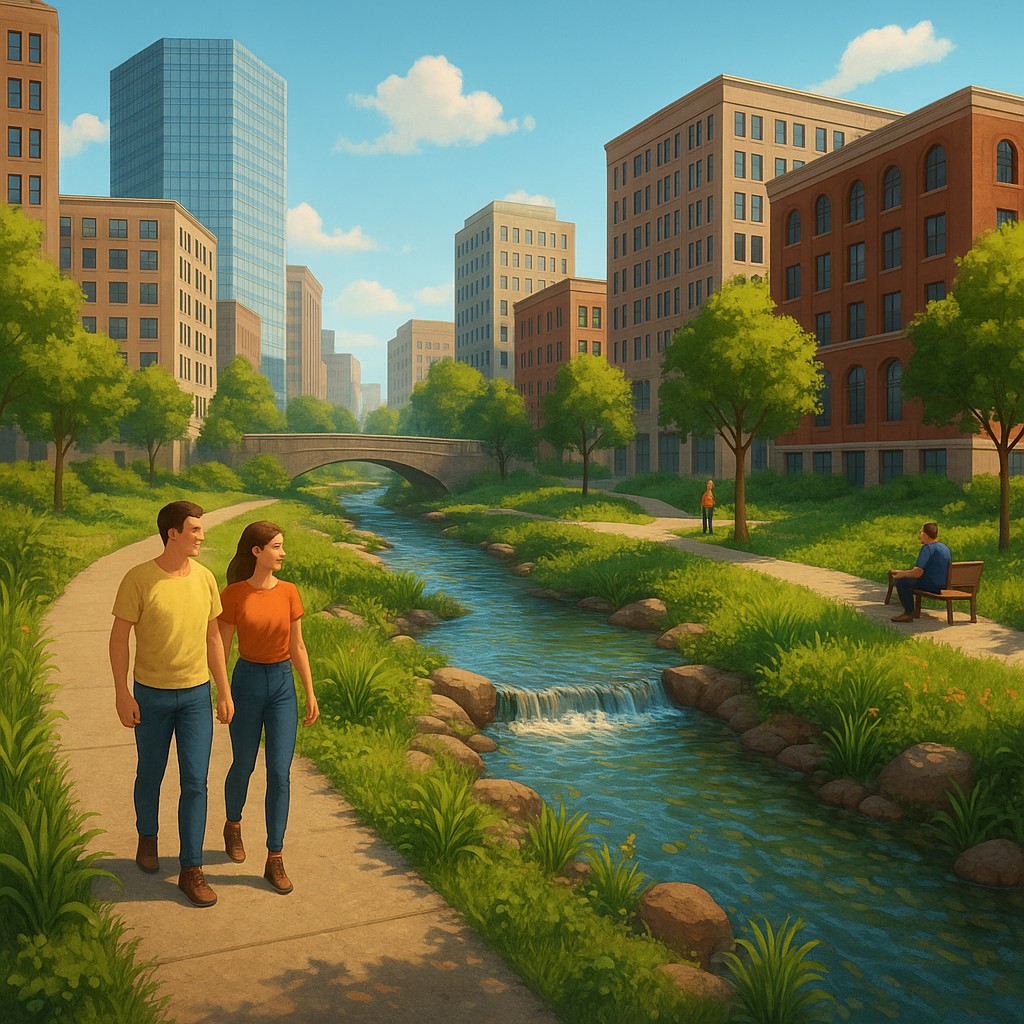
Walk through almost any major city today, and you are likely standing on top of a ghost. Beneath the asphalt of your favorite coffee shop or the concrete of a busy intersection, there is a high probability that a stream once flowed. During the industrial boom of the nineteenth and twentieth centuries, urban planners viewed these natural waterways as nuisances. They were seen as obstacles to straight roads, breeding grounds for mosquitoes, or convenient places to dump industrial waste. To "solve" the problem, engineers forced these streams into cramped, underground concrete pipes, buried them under tons of dirt, and built the modern world right on top of them.
We are now discovering that nature does not appreciate being put in a box, especially a circular concrete one. By hiding our rivers, we inadvertently turned our cities into massive heat traps that do not let water soak into the ground. During heavy rain, these areas become dangerous funnels. The tide, however, is finally turning. A bold movement known as "daylighting" is gaining momentum across the globe, as urban designers literally rip up the pavement to bring these buried treasures back to the light of day. It is a radical reimagining of the city, where we stop treating water as an enemy to be imprisoned and start treating it as a vital partner in our survival.
The Concrete Straightjacket and the Physics of Flooding
To understand why we are digging up streets to find water, we first have to understand why we hid it in the first place. Old-school engineering followed a philosophy often called "gray infrastructure." This approach relied on hard, unyielding materials like concrete and steel to move water away from buildings as fast as possible. The logic seemed sound at the time: if rain falls on a city, get it into a pipe and shoot it out to the nearest lake or ocean before it can pool on the streets. This created a rigid system that worked well enough under normal conditions but failed spectacularly during extreme weather.
When a stream is allowed to wind through a natural meadow, it hits obstacles like rocks, bends, and plants. This resistance slows the water down, allowing it to soak into the ground. When you shove 그 same volume of water into a smooth concrete pipe, you remove all friction. The water speeds up, gaining incredible power. During a heavy storm, these pipes often fill up and act like pressurized cannons. Because the ground above is paved over, the rain has nowhere to sink in. This leads to "flash floods" where water rises so quickly that the local drainage system simply chokes and backfires.
Turning Cities into Sponges through Blue-Green Logic
Daylighting represents a shift toward "blue-green infrastructure," a strategy that uses water (blue) and plants (green) to manage the environment. When a stream is brought back to the surface, designers don't just dig a ditch; they recreate a floodplain. They surround the water with native grasses, shrubs, and wetlands. This creates what ecologists call a "natural sponge." Instead of water racing through a pipe, it spills over the banks of the new stream into the surrounding soil. This soil acts as a massive reservoir, holding millions of gallons of water and releasing it slowly over several days rather than several minutes.
This approach transforms the basic layout of a city. In places like Seoul, South Korea, the daylighting of the Cheonggyecheon stream involved removing a massive elevated highway that had covered the water for decades. Once the water was freed, the surrounding area became much better at handling the monsoon rains that used to cause chaos in the district. By giving the water room to breathe, the city reduced the pressure on its aging sewer systems and provided a safety net that hard concrete could never offer.
The Invisible Air Conditioner in the Sky
Beyond flood control, bringing streams back to the surface solves another pressing urban crisis: the "Urban Heat Island" effect. Cities are famously hotter than the surrounding countryside because materials like asphalt and concrete soak up sun during the day and release that heat at night. This creates a dome of trapped heat that can make cities feel like ovens. Daylighting offers a beautiful, low-tech solution to this problem through the power of thermodynamics, specifically a process called evaporative cooling.
When water is exposed to the air, it evaporates. This change from liquid to gas requires energy, which it pulls from the surrounding area in the form of heat. A flowing stream acts as a continuous, natural air conditioner for a city block. Furthermore, the thick plants that grow along the banks provide shade, preventing the ground from heating up in the first place. Studies in cities that have embraced daylighting show that the area right next to a restored stream can be several degrees cooler than the nearby paved streets, providing a literal breath of fresh air for residents.
| Feature |
Gray Infrastructure (Pipes and Concrete) |
Blue-Green Infrastructure (Daylighting) |
| Water Speed |
Fast moving; increases flood risk downstream |
Slow moving; naturally calmed by curves |
| Filtration |
None; moves pollution directly to the ocean |
Natural; plants and soil scrub out toxins |
| Temperature |
Holds and releases heat (Heat Island) |
Cools the air through evaporation and shade |
| Maintenance |
Costly underground repairs and pipe cleaning |
Self-regulating systems with easy surface access |
| Biodiversity |
Zero; pipes are biological dead zones |
High; creates homes for birds, fish, and insects |
Biological Kidneys and the Cost of Clean Water
One of the most expensive things a city does is treat its water. In many older cities, storm drains are connected to the same pipes that carry sewage. When it rains too much, these "combined sewer systems" overflow, dumping raw sewage directly into local rivers or the sea. Daylighting helps break this cycle by introducing natural filtration. As water moves through the plants and soil of a restored stream, it goes through a chemical change. Plants like reeds and cattails, along with the bacteria living in their roots, act as biological kidneys.
These organisms "scrub" the water, breaking down pollutants like nitrogen, phosphorus, and even heavy metals from car exhaust that wash off the streets. By the time the water reaches the end of the daylighted stretch, it is often much cleaner than when it entered. This reduces the work for city water treatment plants, saving taxpayers millions of dollars in the long run. Instead of building bigger, more expensive chemical treatment tanks, cities are realizing that a well-designed wetland can do much of the heavy lifting for free, all while looking much more attractive.
The High Price of Parking and the Geometry of Choice
If daylighting is so beneficial, why isn't every city ripping up its streets tomorrow? The answer lies in the intense competition for urban space. Cities are crowded, and every square foot has a price tag. Reclaiming a stream often means removing a parking lot, narrowing a road, or even tearing down buildings. These are not easy decisions. In many cases, the "ghost stream" runs directly under a valuable business district where every inch of real estate is already being used.
Urban designers have to perform a delicate balancing act. They must convince local businesses that the loss of a few parking spots is worth the gain in foot traffic and property value that usually follows a waterfront restoration. There is also the matter of moving things around in the underground world. Our cities are packed with fiber optic cables, gas lines, and subway tunnels. Moving a stream back to the surface is an engineering puzzle that requires navigating a 3D maze of modern technology. It is a trade-off: do we prioritize the speed of a straight road, or the long-term health and safety of a natural ecosystem?
Reweaving the Fabric of the Modern Metropolis
The process of daylighting is more than just a plumbing fix; it is a psychological one. For over a century, we have lived in cities that felt separate from the natural world, as if humanity were a layer of plastic wrap over the earth. When we bring a stream back to the surface, we reconnect with the rhythm of the seasons. We see the water rise in the spring and fall in the late summer. We notice the arrival of migratory birds that haven't been seen in the city center for a generation.
This movement marks a transition from a "command and control" style of engineering to one based on humility and partnership. We are admitting that our ancestors' attempts to conquer the landscape were short-sighted. By inviting nature back into our neighborhoods, we aren't just protecting ourselves from floods or cooling our streets. We are creating spaces where people want to gather, where children can see a dragonfly for the first time, and where the city feels like a living, breathing place rather than a paved-over grid. The streams are still down there, waiting; all we have to do is give them the room to rise.
As you look around your own neighborhood, try to spot the subtle clues of a hidden history. Perhaps there is a slight dip in the road that doesn't quite make sense, or a line of trees that follows a winding path through a park. We are the architects of the next century, and we have the chance to decide what our legacy will be. Will we continue to hide the world beneath us, or will we have the courage to dig deep, peel back the concrete, and let the water flow once again? The future of the city is not just in the heights of our skyscrapers, but in the health of the waters running beneath our feet.