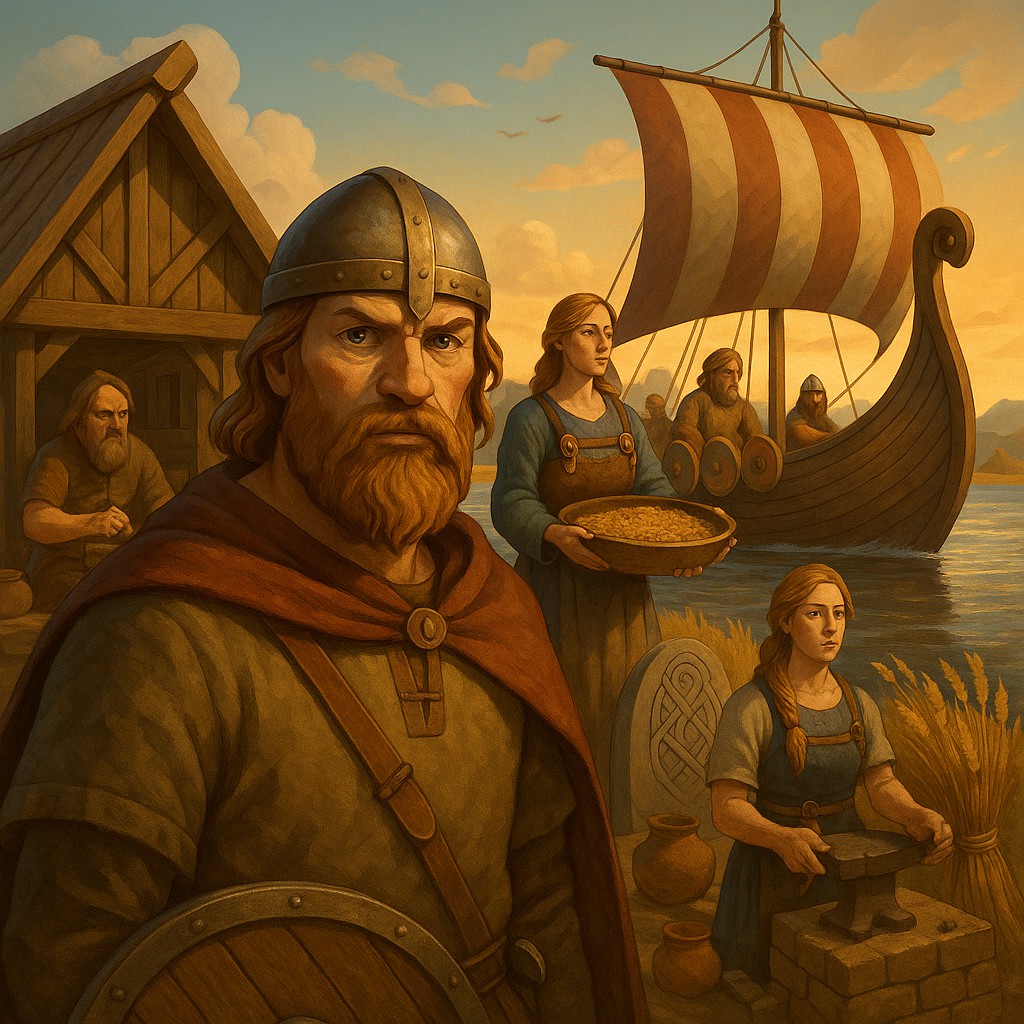
Why the Vikings still speak to us, more than a thousand years later
Picture a people who built swift ships, navigated under unpredictable stars, and sparked both fear and wonder along Europe’s coasts. Vikings are often painted as horned-helmeted barbarians at the door, but the reality is richer, more human, and often surprising. Understanding their daily life means placing men and women back in their settings - farms, markets, workshops, and assemblies - and seeing how work, faith, and adventure were woven together.
What fascinates us is that mix of daring seafaring and rooted local life. They explored unknown seas, but they also sowed fields, spun wool, and settled disputes to the rhythm of a chieftain’s hammer. Revealing everyday Viking life shows pragmatic, inventive people with rituals and laws that ordered collective life. Far from the nonstop raiding cliché, their existence was guided by seasons, farm work, family duties, and communal celebrations.
Reading about the Vikings also explains why so many Norse stories survived, and how collective memory amplified certain images. We will move step by step, starting with their multiple identities, then diving into daily life: housing, work, family, beliefs, food and crafts. By the end, you will see Vikings as neighbors who were both unruly and very human.
Who the Vikings really were - peoples, traders, sailors
The terms "Viking" and "vikings" refer to people mainly from the Scandinavian regions - Norway, Sweden, Denmark - between the late 8th and 11th centuries. But they were not a single homogeneous people. The word "viking" describes the activity of sea expeditions rather than a fixed ethnicity: people went on a viking, they practiced viking activities, much like we speak of going on a mission today. Some were farmers most of the year, others were merchants, artisans, or local leaders.
Their world was connected. Archaeologists find Viking objects in Kiev, Dublin, Anatolia, and even traces of contact with North America. Those commercial and military networks moved slaves, metal, furs, honey, and ideas. Vikings were therefore skilled navigators, entrepreneurs, and local political actors, pursuing a logic that mixed profit, prestige, and necessity.
The pillager reputation comes from spectacular raids - the attack on Lindisfarne in 793 is often cited as the opening of the Viking Age. But those attacks were part of a broader set of activities: colonization, trade, diplomacy, and mercenary work. Chiefs used violence when it served their interests, but they also negotiated, accepted danegeld, and integrated through marriage. The most accurate portrait is of people with varied motives, working and sailing according to seasons and opportunities.
Housing and navigation: houses, villages and boats that changed everything
Viking houses were not cold caves. Households lived in longhouses of wood or stone, roofed with turf or planks, warmed by central hearths. Families kept animals inside when space allowed, which explains the smells and closeness, but also provided warmth and security. Everyday objects - knives, wooden cups, loom weights - testify to a domestic life that was organized and rich in craft knowledge.
The Viking ship was the game-changer. Clinker-built longships, with light hulls and shallow drafts, allowed fast passages at sea, upstream river travel, and lightning landings on poorly defended coasts. These vessels were more than war machines, they were used for trade, communication, and colonization. Building a ship required collective skills - carpenters, smiths, sailmakers - and these shipyards brought communities together.
Villages were often clustered around arable land and water access. Isolated farms, sometimes dispersed, managed their own food needs, while larger centers acted as seasonal trading hubs. Assemblies called thing met outdoors to resolve conflicts and make major decisions. Domestic and public spaces constantly interacted, showing a society where daily life and politics were intertwined.
Work and subsistence: fields, workshops and markets
Most Vikings were farmers. They grew barley, oats, rye and wheat where the climate allowed, raised sheep, pigs, cattle, and tended kitchen gardens. Agricultural work followed the seasons: sowing, harvesting, haymaking, seed preparation, and winter storage. Productivity was often limited by the northern climate, which made reserves and trade vital.
Craftsmanship was another backbone of the economy: blacksmiths, weavers, carpenters, potters, and goldsmiths made tools and useful goods as well as jewelry and prestige items. Ironwork was crucial - sickles, axes, boat nails - and a local forge could determine a farm’s prosperity. Artisans sold at local markets or traded more widely along maritime routes.
Trade linked farms to emerging urban centers. Vikings exchanged furs, amber, slaves, and agricultural products for silk, wine, coins and exotic goods. Viking traders acted as diplomats of a sort, negotiating treaties and payments. Commercial activity reinforced the idea of a mobile, entrepreneurial society tuned to distant opportunities.
Family, status and gender: social divisions with nuance
Viking society was hierarchical but flexible. At the top, jarls or chieftains controlled land and warbands; most people were karls, free farmers and artisans; and at the bottom were thralls, slaves taken in war or born into bondage. This division brought different responsibilities and levels of economic security, but social mobility existed. A karl could become renowned through warfare or trade.
Viking women enjoyed surprisingly broad rights for the time. They often managed the household and estate in a husband’s absence, could inherit, seek divorce, and enter contracts. Some women ran estates, and the sagas show women with influence in politics and commerce. This does not mean full equality, but daily life offered women important public and private roles.
Children learned by imitation and tasks. Boys learned to handle tools or weapons depending on the family trade, while girls learned spinning, cooking and household management. Formal schooling was rare, but oral tradition was powerful - songs, stories, and laws circulated through skalds and leaders. The whole community took part in passing on practical and moral knowledge.
Beliefs, rituals and justice: between gods and assemblies
Norse religion was not a unified faith with a central clergy. Beliefs mixed a pantheon of gods - Odin, Thor, Freyja - with local practices and seasonal sacrifices. Rituals could be private, family-based, or public, and included offerings of animals, food, and sometimes deposits of objects at sacred sites. Myths were more than stories, they explained social order, war, and death.
Justice was practiced at the thing, the local assembly where free men argued, testified, and pronounced judgments. Sanctions ranged from fines to exile, and financial compensation was a common way to settle disputes. Chiefs guaranteed order but relied on the consent of others to rule - creating a balance between authority and community agreement.
Magic and superstition had their place. Runes were used to write inscriptions, bless objects, and sometimes for magical purposes. Healers, seers, and folk practitioners intervened in daily life to treat ailments, predict weather, or ensure a good catch. The world was seen as full of spirits - the sacred and the ordinary mixed in every action.
What they ate, how they dressed, and everyday health
Viking food was hearty and seasonal. Meals included thick pottage, barley bread, salted fish, roasted meat, cheese and dairy products. Honey and butter were valued sweeteners and fats, and fermentation - beer, kvas - produced nutritious drinks that kept. Preservation - salting, smoking, drying - was essential to survive the long winter months.
Clothing was wool, linen, and sometimes leather. Fabrics were dyed, embroidered, and adapted to the climate: layered garments, cloaks, and hose for the cold. Jewelry and brooches fastened clothes and also signaled social status. Personal grooming was not neglected; Vikings used bone combs, ointments, and bathed relatively often compared with some contemporary societies, contradicting the notion that they were dirty.
Health depended on diet, physical work, and folk medicine. Combat wounds were common, as were illnesses linked to a limited diet. Remedies combined herbs, bloodletting, prayers, and rudimentary surgery. High infant mortality and occupational hazards explain the importance of strong family solidarity.
Summary table - Seasons and daily tasks among the Vikings
| Season |
Main tasks |
Social life and rituals |
Examples of daily activities |
| Spring |
Field preparation, boat repairs |
Markets, sowing ceremonies |
Repair nets, milk animals, sow barley |
| Summer |
Crop work, fishing, building |
Festivals, local assemblies |
Harvest, weaving, build a new roof |
| Autumn |
Harvesting, storage, hunting |
Meetings to allocate reserves |
Salt fish, haymaking, market exchanges |
| Winter |
Indoor crafts, repairs, limited travel |
Feasts, arbitrations at the thing |
Spinning, indoor forging, storytelling by the fire |
Demystifying popular images: horned helmets and barbaric Vikings
The horned helmet is one of the most persistent false ideas. Modern depictions added horns for drama and aesthetics, but archaeological evidence shows plain helmets, usually without fanciful decorations. The horns appear to be a 19th century romantic invention, not a battlefield reality.
Another misconception is that all Vikings were violent raiders. The truth is more subtle: violence existed, but it was instrumental. Many spent long periods working the land, trading, and maintaining stable family networks. Raids were often seasonal, targeted, and embedded in specific political and economic logics.
Finally, they were not radically different from other medieval societies in daily habits or social organization. What set them apart was the intensity of their maritime mobility and their ability to turn that mobility into trade, colonies and alliances. Seeing Vikings as wholly separate loses the chance to learn how ordinary people adapt to demanding environments.
How to remember the essentials and apply them to your curiosity today
To keep what you have read, imagine a year in the life of a Viking family: sow in spring, build in summer, harvest in autumn, and tell sagas in winter. The seasonal rhythm structures both economy and culture. Also think of shared roles - the smith, the weaver, the chieftain, the mother - and how each person helped collective survival.
If you want to explore more, visit a museum with Viking objects, read translated sagas, or attend historical reenactments. Ask concrete questions: how is a light ship built? What does a burial deposit tell us about a group’s beliefs? Those inquiries will help connect archaeology to human stories.
Vikings offer lessons on human resilience, adapting to the tides of history, and the importance of social networks. Observing their daily life helps us see how culture and environment weave ordinary lives together - a lesson useful in any era.
One last word - go curious and humble
Vikings were noisy, inventive neighbors, able to build new worlds while staying rooted in shared daily practices. By taking an interest in their everyday life, you discover more than raids and voyages, you meet humans who worked, loved, negotiated and told stories. Stay curious, question easy images, and remember that the richest history often hides in ordinary gestures.