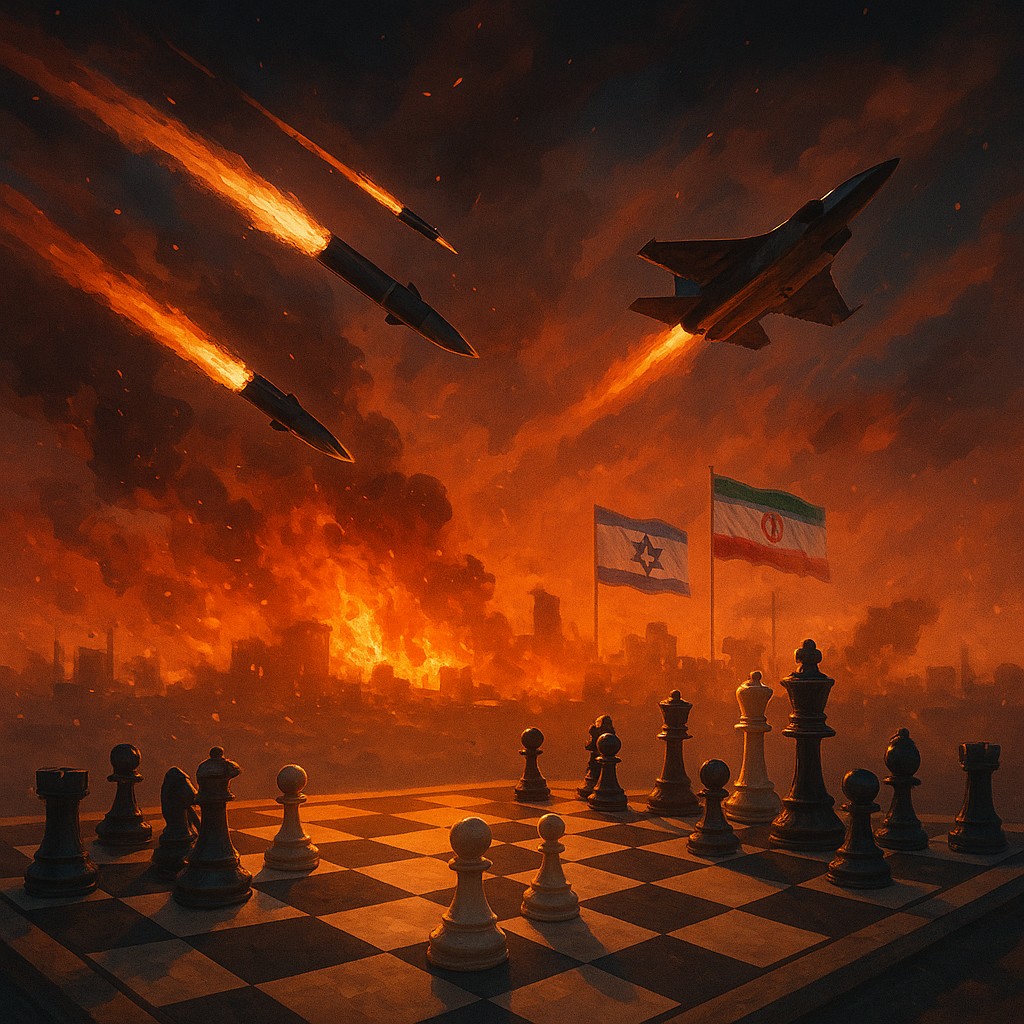
To understand the Middle East as of March 4, you have to move past the idea of a traditional, clearly defined battlefield. Instead, imagine a high-stakes chess match where the board is on fire, the players are using live ammunition, and the spectators are all holding their breath. We are currently in a period of "kinetic friction." This means long-standing shadow wars have finally burst into the open, turning the region into a tangled web of direct military fights involving Iran, Israel, and the United States.
What makes this moment so different from past decades is that the old rules of engagement have collapsed. For years, these powers avoided hitting each other directly on their own soil. They preferred to settle scores through third parties or in remote border areas. Today, those boundaries have vanished. The skies over major capitals like Tehran, Jerusalem, and Beirut have become theaters for intercepting missiles and drones. This "new normal" is as volatile as it is historic. To understand this conflict, you have to look past the headlines and into the machinery of modern warfare, regional alliances, and the pure logistical stamina required to keep up a high-intensity fight.
Breaking the Taboo: Direct Attacks on Sovereign Soil
The biggest shift in the current landscape is how direct the strikes have become. Until recently, the idea of Israel bombing targets deep inside Iran, or Iran launching massive salvos at Israeli cities, was considered a "red line." Neither side was willing to cross it for fear of a total regional collapse. As of March 4, that line has been crossed several times. This is no longer a proxy war fought by stand-ins; it is a direct, state-on-state confrontation. This change has forced every nearby country to rethink its national security, as the "deterrence" that kept the peace for so long has clearly failed to prevent open combat.
In the past week, we have seen waves of precision-guided weapons exchanged. Iranian defense systems are being tested by high-tech Israeli and American equipment, while Israel’s famous Iron Dome and Arrow systems are facing the most grueling endurance test in their history. Because of the sheer volume of incoming fire, a "perfect" defense is no longer possible. It is now a game of percentages. Every missile that slips through changes the political calculations for the next day. This makes diplomacy feel like a distant memory while the military takes center stage.
The Grimy Logistics of Modern Air Defense
People often talk about war in terms of courage and strategy, but right now, the conflict in the region is increasingly decided by math and manufacturing. Interceptor missiles, the high-tech tubes used to shoot down incoming threats, do not grow on trees. They are incredibly expensive and take a long time to build. As of early March, observers are seeing a staggering "burn rate" for these weapons. The United States and its allies are using these interceptors faster than they can replace them, creating a silent crisis behind the scenes of the flashy explosions.
When Iran launches a swarm of relatively cheap drones, they are using a "cost imposition" strategy. It might cost Iran a few thousand dollars to build a drone, but it costs the U.S. or Israel hundreds of thousands, or even millions, of dollars to shoot it down with a sophisticated interceptor. This economic imbalance is a core part of the fighting. If one side runs out of interceptors first, the other side gains "air superiority," which simply means they can hit whatever they want without being stopped. This logistical race is just as important as the bravery of the pilots in the air.
The Players: Who is Doing What?
To keep track of the chaos, it helps to look at the main actors currently involved. This is not just a fight between two countries; it is a regional ecosystem of military force. Each participant has a specific goal, whether it is survival, regional dominance, or protecting trade routes that keep the global economy moving.
| Actor |
Primary Objective |
Current Military Activity |
| Iran |
Government survival and regional influence |
Direct missile and drone launches; coordinating allied groups. |
| Israel |
Neutralizing long-range threats |
Air strikes in Tehran, Beirut, and surrounding areas. |
| United States |
Keeping the region stable and sea lanes open |
Active air defense and precision strikes on launch sites. |
| Hezbollah |
Pressure from the North |
Regular artillery and rocket exchanges along the border. |
| Gulf States |
Staying out of the crossfire |
Balancing airspace defense with quiet, intense diplomacy. |
The Domino Effect and the Gulf States
While the world watches Tehran and Jerusalem, the smaller nations in the Persian Gulf are walking a terrifying tightrope. Countries like the UAE, Qatar, and Saudi Arabia are literally caught in the middle. When a missile flies from Iran toward Israel, it often crosses the airspace of these countries. This puts them in a difficult spot: did they just watch it go by, or did they help stop it? If they allow the U.S. to use their bases to intercept Iranian drones, they risk being seen as enemies by Iran. If they do not, they risk losing the security protection they get from the West.
This has led to a tense diplomatic dance. These nations are currently serving as the world’s primary "switchboard," passing messages between Washington and Tehran to prevent a total catastrophe. They are essentially trying to lower the temperature while the house is on fire. Their goal is to ensure that even if the fighting continues, it stays "limited." They want to avoid a war that shuts down the Strait of Hormuz, a narrow waterway essential for oil. If that happened, global oil prices would skyrocket, likely triggering a worldwide recession.
Debunking the Myths of Modern War
One common mistake in thinking about modern war is the idea that "better technology always wins." While it is true that the U.S. and Israel have some of the most advanced hardware on earth, this conflict proves that quantity has a quality of its own. Iran has spent decades perfecting "asymmetric" warfare, which means using unconventional methods to fight a stronger foe. They know they cannot win a traditional one-on-one dogfight against an F-35 stealth fighter. Instead, they use swarms of drones and missiles to overwhelm a defender's sensors. It is like the difference between trying to catch one fast baseball versus trying to catch a hundred tennis balls thrown at you all at once.
Another myth is that these wars end quickly once "big targets" are hit. In reality, modern military infrastructure is often buried deep underground or designed to move around. A strike on a capital city is a massive political blow, but it rarely wipes out a nation's ability to keep fighting. This creates an "escalation ladder" where each side feels they must hit back slightly harder to show they are not losing. This cycle is very difficult to stop without outside help or both sides realizing the cost of continuing is simply too high.
The Human Cost of the Map
Beyond the talk of "assets," "interceptors," and "theaters of operation," the reality on the ground in cities like Tehran and Beirut is one of deep uncertainty. For the average person, the war isn't a map with arrows on it. It is the sound of sirens at 3:00 AM and the rising price of bread. Conflict on this scale disrupts supply chains instantly. In Iran, the economy was already struggling under sanctions, and the current fighting has put even more pressure on the local currency.
Daily life has been upended across the region. When air defenses are active, businesses close, schools move online or shut down, and people hunker down at home. This "invisible" cost of war is what creates long-term instability. Even if the missiles stop flying tomorrow, the psychological and economic impact of this March escalation will be felt for a generation. The region is exhausted and on high alert, with everyone waiting to see if the next wave of attacks will be the one that finally pushes things past the point of no return.
The world is watching a historic turning point in real time. While the technical details of missile stocks and geopolitical maneuvering are complex, the heart of the story is about a region trying to find a new balance in a very dangerous world. Staying informed about these shifts doesn't just make you smarter; it helps you understand how interconnected our world is, where a drone launch in one desert can change the price of gas on the other side of the planet. As we move forward from March 4, keep your eyes on the logistics and the diplomacy. Those are the quiet forces that will ultimately decide when the sirens finally go silent.