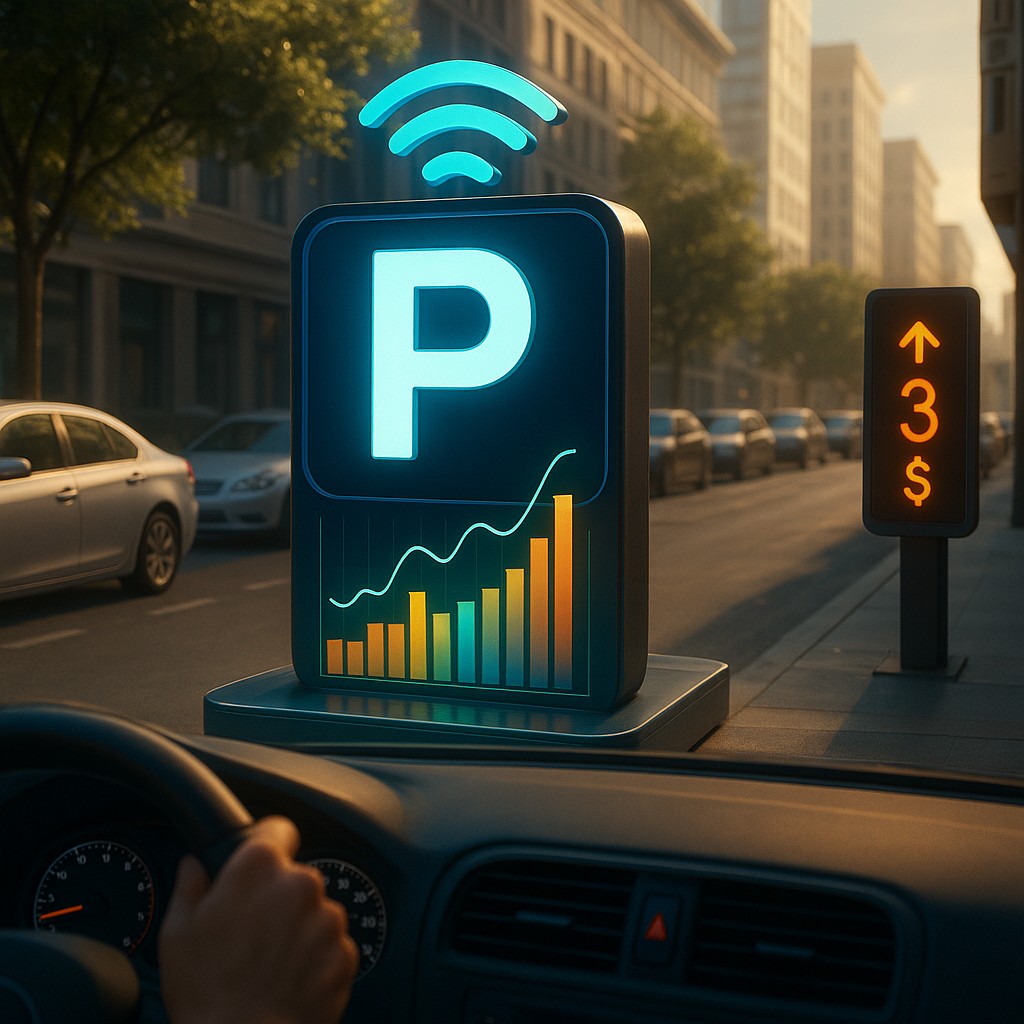
Every driver in a major city knows the "shiver of the hunt." It is that specific, low-grade anxiety that kicks in as you approach your destination and realize the street is lined with a solid wall of parked cars. You begin to circle the block like a shark, eyes scanning for the telltale glow of a reverse light or a pedestrian walking toward their vehicle. This ritual, known to urban planners as "cruising," feels like a personal nuisance, but on a global scale, it is an ecological and logistical disaster. Studies show that in some dense city centers, up to 30 percent of traffic at any given moment is made up of people who have already arrived but simply cannot find a place to put their car.
Imagine if city streets functioned more like a high-speed internet connection or a modern power grid, where resources are handed out based on real-time demand rather than outdated, static rules. For decades, the price of a parking meter was set by a city council meeting once every few years, based on little more than a guess. Whether it was a rainy Tuesday morning or the peak of a holiday weekend, the price stayed the same. This lack of flexibility is why we often see ten cars fighting for one spot on a popular street while a block away, several spots sit empty just because they lack the same prestige. By treating the curb as a living, data-driven utility, cities are finally beginning to solve the mystery of the empty space.
The Mathematical Ghost of the Empty Block
To understand why our current parking systems fail, we have to look at the ideal goal for a city street. Urban planners generally agree that the "sweet spot" for a block is about 85 percent occupancy. This means that out of every eight parking spaces, one should almost always be vacant. If occupancy is lower than that, the city is wasting valuable real estate that could be used for bike lanes, wider sidewalks, or outdoor dining. If occupancy is 100 percent, the "cruising" cycle begins. New arrivals find nowhere to stop and start circling, which slows down buses, blocks emergency vehicles, and fills the air with unnecessary exhaust.
Dynamic curbside management uses the concept of "price as a signal" to reach that 85 percent golden ratio. When a city installs sensors in the pavement or uses camera-based AI to track headcounts, they can see exactly how many spots are filled in real time. If a block is consistently full, the system automatically nudges the price upward. This does not happen because the city is "greedy," but because it needs to encourage a few people to make a different choice. Perhaps someone who planned to park for four hours decides to use a nearby garage instead, or someone running a quick errand finishes five minutes faster to save a few cents.
This logic is essentially the same as "surge pricing" used by ride-sharing apps, but with a much more civic-minded goal. Instead of maximizing profit for a company, the goal is to make the street work better for everyone. When the price is exactly right, the "parking ghost" disappears. A spot opens up just as someone arrives, the circling stops, and the street breathes a sigh of relief. It turns a chaotic system based on luck into a predictable one based on the market. The prize is no longer a lucky find, but an available space for whoever needs it most.
From Pavement Sensors to Invisible Orchestration
The magic behind these trials lives in a sophisticated layer of technology that most citizens will never actually see. In the early days of smart parking, cities like San Francisco experimented with physical sensors buried in the asphalt. These hockey-puck-shaped devices detected the presence of a large metal object (your car) and beamed that data to a central server. While effective, these sensors were expensive to maintain and often suffered from electronic interference. Today, the technology has evolved into a mix of high-definition cameras with "computer vision" (software that can see and identify objects) and the location data already being generated by your smartphone.
When you drive through a pilot zone for dynamic pricing, a central "brain" is crunching the numbers for thousands of blocks at once. This data is not just used to change the numbers on a digital meter; it is also fed into navigation apps that can tell a driver, "Don't bother turning down 5th Street; there are no spots. Try 6th Street instead, where it is cheaper and 20 percent of the spots are open." This coordination reduces the mental load on the driver and keeps traffic moving at a steady pace. By the time you arrive, you aren't just looking for a spot; you are responding to a digital invitation.
The following table shows how dynamic pricing reacts to different urban scenarios compared to the traditional "fixed rate" model we have used for a century.
| Scenario |
Traditional Fixed Pricing |
Dynamic Curbside Management |
Resulting Impact |
| Early Morning Commute |
$2.00 / hour (underpriced) |
$0.50 / hour (low demand) |
Encourages early birds to use street spots. |
| Mid-Day Shopping Peak |
$2.00 / hour (overcrowded) |
$4.50 / hour (high demand) |
Encourages high turnover and use of garages. |
| Major Sporting Event |
$2.00 / hour (impossible) |
$8.00 / hour (peak demand) |
Reduces "cruising" traffic around the stadium. |
| Rainy or Slow Tuesday |
$2.00 / hour (empty street) |
$0.25 / hour (stimulus) |
Attracts visitors to local businesses during lulls. |
Debunking the High-Tech Tax Myth
One of the loudest objections to dynamic pricing is the fear that it is simply a "hidden tax" designed to squeeze more money out of drivers. It is a reasonable concern, but data from real-world trials tells a different story. In many cases, dynamic pricing actually lowers the average price paid across the city. while the most popular street downtown might see a price hike during lunch hour, the streets just two blocks away often see their prices drop significantly to pull drivers away from the center.
The goal is not to make parking expensive; it is to make it efficient. Think of it like a game of musical chairs where someone is constantly adding and removing chairs to make sure everyone has exactly one place to sit. When parking is too cheap or free in a high-demand area, it is "subsidized" by everyone else, including people who do not even own cars. Those people pay for road maintenance and the environmental costs of the traffic jams caused by parkers. Dynamic pricing shifts that cost onto the people actually using the resource, which is a fairer way to manage public land.
Furthermore, these systems often include "social equity" features. For example, some cities use the money made from high-demand parking zones to fund better public transit or to offer low-income residents discounted parking permits. By treating the curb as a valuable asset rather than a free-for-all, the city can reinvest that value back into the community. It is less about "taxing" and more about "balancing," ensuring that the curb serves delivery drivers, buses, and residents, rather than just the person who got there first and stayed all day.
The Ripple Effect on Urban Life
When we solve the parking puzzle, the benefits spread far beyond the individual driver. Consider the city bus. In a traditional parking environment, buses are constantly slowed down by cars double-parking out of desperation or by the "crawl" of drivers looking for spots. When dynamic pricing ensures that a spot is always available, double-parking nearly vanishes. This allows buses to stay on schedule, making public transit a better option for everyone. When buses move faster, more people take them, which further reduces the number of cars needing a place to park.
Emergency services also see a massive benefit. Every second counts when an ambulance or fire truck is trying to navigate a crowded neighborhood. A street at 100 percent capacity is prone to gridlock. By maintaining that 85 percent occupancy buffer, cities create a "safety margin" that allows emergency vehicles to pass through with fewer obstructions. It turns out that the price of a parking spot can actually be a life-saving tool when managed with precision.
Finally, there is the change to the atmosphere of the city. Imagine a street where the constant "white noise" of circling engines is replaced by the sound of people talking and birds chirping. Imagine sidewalks that feel wider because cars aren't idling inches away from pedestrians. By using data to manage the curb, we stop treating our streets as giant, inefficient storage lockers and start treating them as vibrant public spaces. We move away from the "concrete jungle" and toward a "responsive city" that understands and reacts to the needs of its people in real time.
Embracing the Responsive City of Tomorrow
The shift toward dynamic curbside management represents a fundamental change in how we think about urban space. We are moving away from the era of static, "dumb" infrastructure and into an age where the objects around us are as smart as the phones in our pockets. This transition might feel a bit strange at first, as checking an app to see the current price of a block is a new habit, but the rewards are far too great to ignore. We are trading the frustration of the hunt for the peace of a predictable journey.
As you go about your week, take a moment to look at the cars lined up along the sidewalk. Think about the invisible data flowing between the pavement, the cloud, and the dashboards of the vehicles around you. This isn't just about parking meters; it is about learning how to share a crowded planet with grace and efficiency. By supporting these "living" systems, we are helping to build cities that are not just smarter, but kinder to our time, our environment, and our sanity. The next time you see a spot open up exactly when you need it, you might just have an algorithm to thank for that little bit of urban magic.