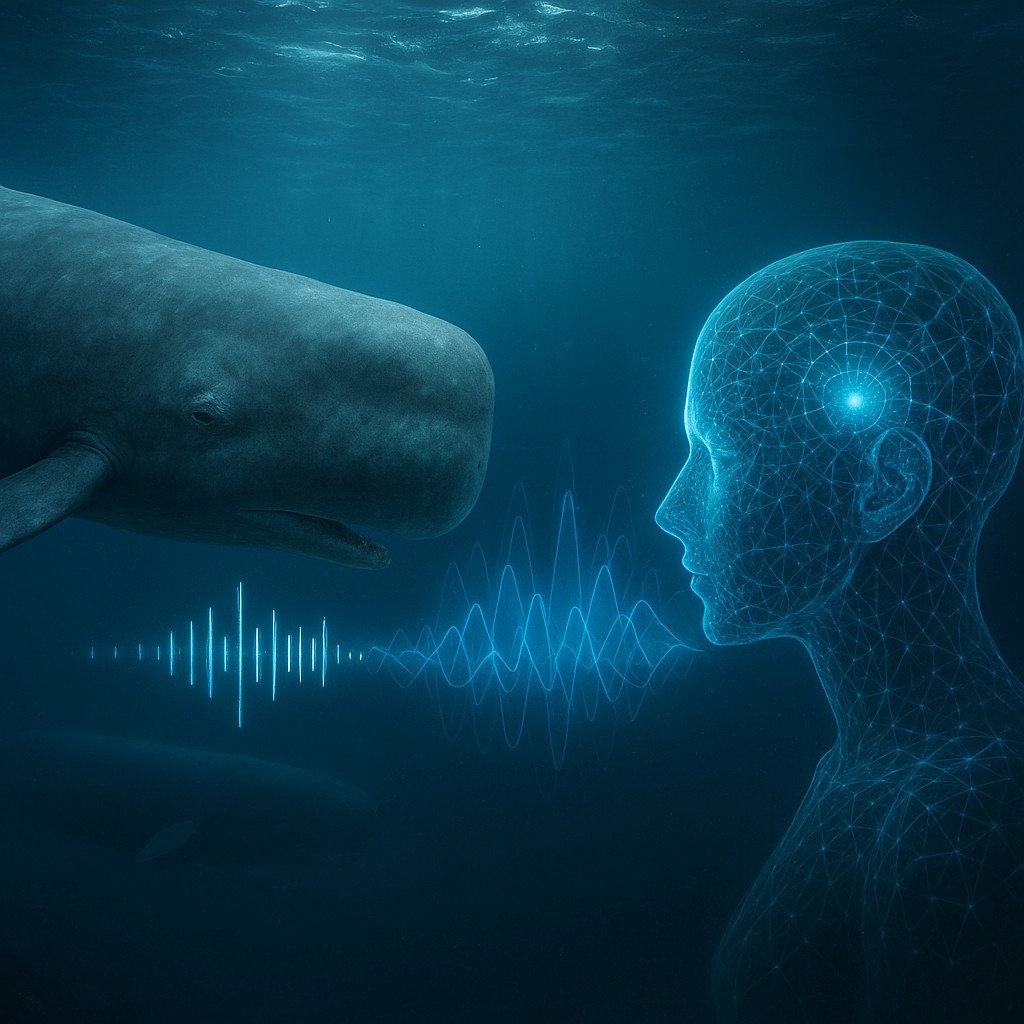
Deep beneath the rolling turquoise waves of the open ocean, a conversation is taking place that has lasted for millions of years. This is a world of shadows and crushing pressure where sight is nearly useless. Here, sound is the only reliable bridge between living things. Massive sperm whales, carrying the largest brains on Earth, glide through the abyss emitting rhythmic sequences of clicks known as codas. For decades, humans heard these sounds as beautiful but meaningless static, like Morse code without a key. We knew they were talking, but we were like tourists in a crowded foreign plaza, hearing the rhythm of speech without grasping a single syllable.
The stakes of this silence have grown dangerously high as industrial noise begins to drown out the ocean's natural symphony. From the low thrum of massive cargo ships to the sharp, piercing pings of military sonar, the seafloor is no longer a quiet refuge. Scientists have long suspected that this "acoustic smog" disrupts how whales find food and navigate their migratory paths. However, proving this requires more than just tracking where a whale swims; it requires understanding what the whale is saying about its environment. For the first time, a partnership between marine biology and advanced computing is allowing us to peek into the whale's mind. We are using the same technology that powers digital assistants to decode the ancient language of the deep.
Decoding the Grammar of the Deep
To understand how we might "talk" to a whale, we must first set aside our human ideas of language. Humans are visual creatures who rely on lips, tongues, and written symbols. Whales, however, communicate through pressure waves that can travel hundreds of miles. Research groups like Project CETI (the Cetacean Translation Initiative) are treating whale sounds not as random noises, but as data structures. By using thousands of specialized underwater microphones and high-tech tags that stick to a whale’s skin, researchers are gathering a library of millions of clicks. The challenge is no longer just hearing the whales; it is making sense of the massive amount of data they produce.
This is where Large Language Models (LLMs) come in. We usually think of LLMs as tools for writing emails, but at their core, they are pattern-recognition engines. They work by looking at a sequence of markers and predicting what comes next based on math and probability. When applied to sperm whale clicks, these models do not look for words. Instead, they look for "phonemes," which are the smallest units of sound that change a meaning. By analyzing the timing, rhythm, and speed of these clicks, AI has begun to identify a structure that looks a lot like a phonetic alphabet. This suggests that whales aren't just making "happy" or "sad" noises. They are likely combining sounds in specific ways to share complex information, much like we combine letters into words and words into sentences.
The Mechanical Symphony of Survival
A whale’s life is governed by its ears. A sperm whale may dive thousands of feet into the "midnight zone" to hunt giant squid, using sound as its primary tool to "see" its prey. This process, called echolocation, involves a constant stream of clicks that bounce off objects and return to the whale. This creates a high-resolution sound map of the darkness. Whales also use social calls to coordinate these hunts, acting like a team of tactical operators whispering to one another in the dark. This delicate balance of hunting clicks and social chatter is the heartbeat of the whale family, but it is incredibly sensitive to noise.
When a ship passes overhead or a sonar array turns on, the ocean doesn't just get louder; it becomes cluttered. Imagine trying to have a vital business meeting in the middle of a construction site while wearing a blindfold. That is the reality for a hunting whale. By using AI to tell the difference between "checking in" calls and "prey found" calls, conservationists can now see exactly when a whale gives up on a hunt. The AI acts as a filter. It shows us that a whale might stop hunting the moment a ship's engine noise reaches a certain volume. This is no longer a guess; it is a data-driven look at a sensory system being shut down by human activity.
Moving Toward Quiet Zones
In the past, whale conservation was mostly about maps. We looked at where whales were and tried to make sure ships didn't hit them. While avoiding crashes is important, it only fixes the most violent problems. The ability to "translate" whale distress allows for a much smarter approach: the creation of acoustic sanctuaries. If we can use AI to prove that certain sonar sounds cause a mother whale to lose her calf or leave a feeding ground, we can create seasonal "quiet zones." These are more than just lines on a map. They act as shields that protect the peace of the ocean during critical times like migration or birth.
Port authorities are beginning to use this data to ask ships to slow down. A slower ship is a quieter ship, and a quieter ship means a larger "sound window" for whales to talk. The table below shows how human activities impact the whale's world and how AI helps us understand those changes.
| Human Activity |
Impact on Sound |
Biological Result |
AI Detection Signal |
| Commercial Shipping |
Constant low-frequency thrum |
Blocks long-distance social calls |
Change in vocal pitch |
| Military Sonar |
High-intensity rhythmic pings |
Hearing loss or panic |
Rapid "distress" pulse patterns |
| Oil/Gas Exploration |
Loud airgun blasts |
Physical injury or fleeing the area |
Sudden stop in hunting clicks |
| Recreational Boating |
Erratic high-frequency noise |
Disturbs resting at the surface |
More "contact" calls to calves |
The Risk of the Human Mirror
As exciting as it is to imagine a "Google Translate" for whales, we must avoid a major trap. Humans tend to project our own feelings onto everything. We want to believe whales are talking about their day, discussing philosophy, or naming their children. However, whale communication is truly alien. They evolved in a world 800 times denser than air, where sound travels five times faster. Their reality is so different from ours that their "language" may not even have nouns or verbs as we understand them.
The danger of assuming whales think like humans is that we might miss what they are actually telling us. The AI identifies mathematical patterns, not emotions. If we assume a specific sound means "I am hungry" when it actually means "The water is getting denser," we might make the wrong conservation choices. The goal of using AI in the ocean should not be to force whales into a human box. Instead, we should respect their unique way of living. We want to understand their patterns so we can stop interrupting them, not necessarily so we can invite them for a chat.
A Future Built on Listening
Using AI in the deep sea represents a major shift in how we treat nature. For centuries, we have been a loud, distracted species, treating the ocean as a silent void or a highway. By using our best tools to listen to the sea, we are finally admitting that we are not the only ones with a story to tell. We are learning that the "void" is actually a busy community held together by sound. This technology gives us a rare chance to be better neighbors by learning when to be quiet and when to listen.
As we improve these models, the ocean will become less of a mystery and more of a shared home. We may never know what it feels like to be a sperm whale in the deep, but we can at least recognize their right to be heard. The true success of this AI revolution will not be a dictionary of whale words. It will be the silence we provide so their ancient conversations can continue. By listening with humility and technology, we ensure that the symphony of the deep does not fade into a lonely, industrial hum.