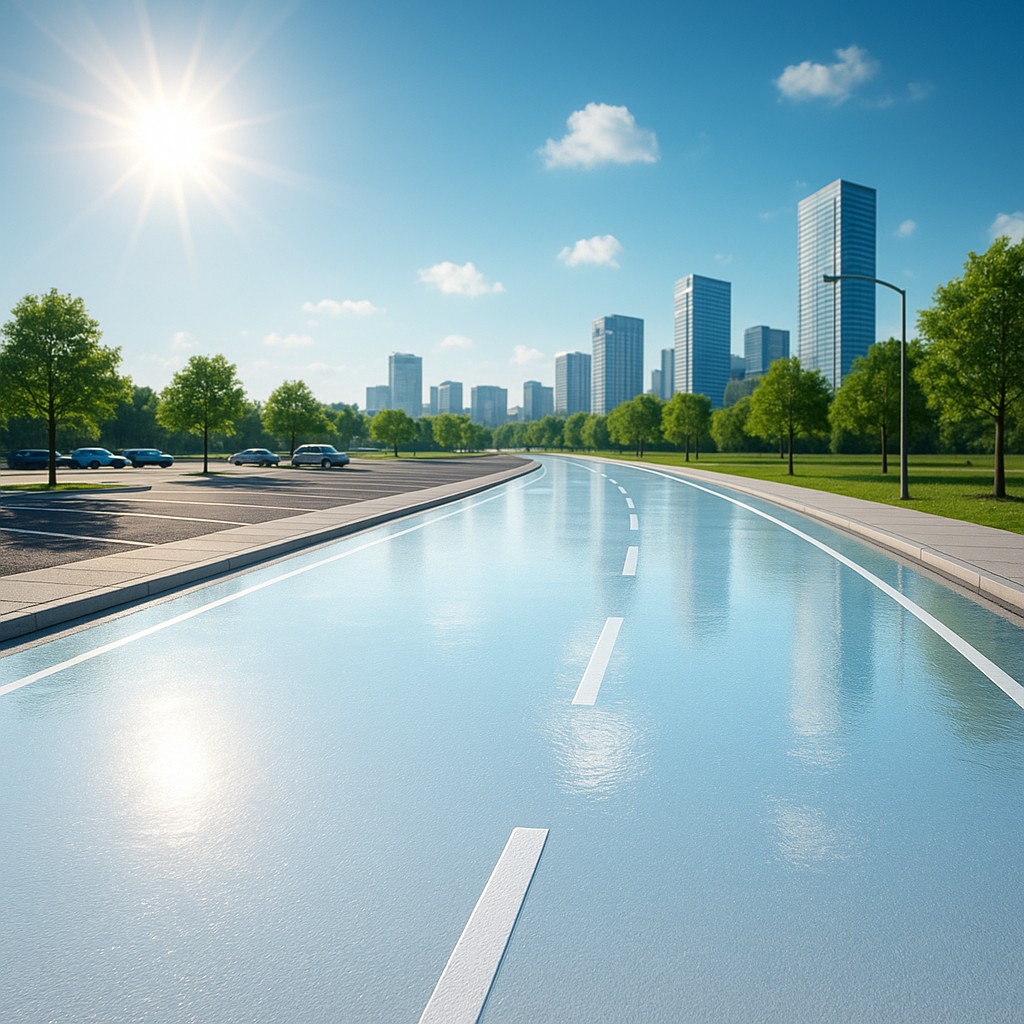
Think about the last time you walked across a massive parking lot in the middle of July. You could practically see the heat shimmering off the black surface, creating a wavy, distorted view of the horizon. This isn't just your imagination playing tricks on you; it is the result of millions of tons of dark asphalt acting like a giant thermal sponge. Traditional roads are designed to be durable and cheap, but they have a hidden habit of absorbing up to 95 percent of the solar energy that hits them. This energy doesn't just disappear. It turns into heat that radiates back into our neighborhoods long after the sun has gone down, turning our cities into "heat islands" where the air stays stiflingly hot all night.
Now, imagine if we could flip a switch and turn those miles of blacktop into a giant mirror. Engineers and urban planners are currently experimenting with "cool pavement" technologies. This approach treats the city street not just as a path for cars, but as a sophisticated tool for climate control. By applying specialized, light-colored coatings to existing roads, we are essentially "sunscreening" our infrastructure. This represents a fundamental shift in civil engineering: we are moving from a passive approach, where we simply endure the weather, to an active one, where we design our environment to reject unwanted heat. It is a simple concept with surprisingly complex physics and even more surprising benefits for our electricity bills.
The Physics of the Urban Heat Island Effect
Most of our modern cities are built with materials that seem almost perfectly designed to trap heat. Asphalt and concrete are dense, dark, and highly effective at soaking up shortwave radiation from the sun. Once absorbed, this energy is stored as "sensible heat" within the material's mass. As the sun sets, the city doesn't actually cool down immediately. Instead, the buildings and roads begin "re-radiating" that stored energy back into the surrounding air as longwave infrared radiation. This process is the primary driver of the Urban Heat Island (UHI) effect, which can make a metropolitan area significantly warmer than the surrounding countryside.
To understand how to fight this, we have to look at a concept called albedo. Albedo is a measure of how much light a surface reflects without absorbing it. A perfect mirror would have an albedo of 1.0, while a perfectly black object would have an albedo of 0.0. Standard, fresh asphalt usually sits at a dismal 0.05, meaning it converts almost all the light that hits it into heat. Cool pavements aim to raise this number significantly, often reaching an albedo of 0.30 or higher. While 0.30 might not sound like much, in the world of thermodynamics, it is the difference between a surface that burns your hand and one that feels merely warm to the touch.
When we increase the albedo of a city's footprint, we are practicing "preventative cooling." Instead of letting heat enter the urban environment and then paying a fortune to pump it out of our offices with air conditioning, we stop the heat from ever getting in. This has a massive ripple effect on the local climate. Lower surface temperatures lead to lower air temperatures, which in turn reduces the "convective heating" of the air right above the ground. It is a rare example of a solution that works passively, around the clock, without needing a single moving part once it is applied.
Reflective Coatings as an Infrastructure Shield
The actual "cool" part of cool pavement is usually a water-based, asphalt-emulsion coating infused with specialized pigments and minerals. These aren't just cans of white house paint dumped onto a street. These coatings are engineered to be durable enough to withstand thousands of cars daily while maintaining their reflective properties. They often contain small ceramic particles or light-colored aggregates that scatter incoming solar radiation in all directions, sending a significant portion of it right back through the atmosphere and out into space.
Pilot programs in cities like Phoenix and Los Angeles have provided eye-opening data on how these coatings perform in the real world. During the peak of a summer afternoon, researchers have measured surface temperatures on treated streets that are more than 10 degrees Fahrenheit cooler than the untreated black asphalt right next to them. This reduction is vital because it prevents "deep heating" in the roadbed. When the road stays cooler, the buildings lining the street benefit too. They don't have to fight against a constant wall of heat radiating from the ground, which can lead to a 3 to 5 percent reduction in cooling costs for nearby residents.
Beyond just the temperature, these coatings serve as a protective layer for the infrastructure underneath. Heat is a primary enemy of asphalt; it causes the bitumen binder to soften and break down, leading to cracks, ruts, and "alligatoring" (a pattern of cracks that look like reptile skin) over time. By keeping the road cooler, we are actually extending the life of the pavement. It is a win-win: the city saves money on road maintenance while making the neighborhood more livable during a heatwave.
Balancing Radiation and Reflection
While the benefits are impressive, nature rarely gives us a "free lunch." One of the most interesting challenges of this technology is the "glare and glow" factor. Because the pavement reflects more light, that light has to go somewhere. If the coating is too reflective or the wrong color, it can create a blinding glare for drivers, especially during the "golden hours" of sunrise and sunset. This is more than just an annoyance; it is a safety concern. Engineers have to carefully calibrate the shades, often choosing specific grays or off-whites that offer high thermal reflection without reflecting too much visible light into a driver’s eyes.
There is also the "pedestrian toast" phenomenon. In narrow "urban canyons" surrounded by tall glass buildings, reflecting the sun off the ground can sometimes mean reflecting it directly onto people walking on the sidewalk. While the air temperature might be lower, a person standing on a highly reflective surface might actually feel hotter because they are being hit by solar radiation from both above and below. This is why cool pavement isn't a one-size-fits-all solution. It works best on wide boulevards and open residential streets where the reflected energy can easily escape upward rather than bouncing back and forth between buildings.
| Feature |
Traditional Asphalt |
Cool Pavement Coating |
| Solar Reflectance (Albedo) |
Low (0.05 - 0.10) |
Moderate to High (0.30 - 0.45) |
| Surface Temperature |
High (can exceed 150°F / 65°C) |
Lower (typically 10-15°F cooler) |
| Energy Impact |
Increases A/C demand |
Reduces evening cooling load |
| Durability Factor |
High thermal stress/cracking |
Reduced thermal expansion |
| Visibility |
Harder on night vision |
Improves visibility at night |
| Initial Cost |
Standard / Lower |
Higher (due to specialty coating) |
Designing for the Human Experience
When we look at how city streets have evolved, we see a move toward "multi-functional" infrastructure. For over a century, a road had one job: move vehicles. Today, we are asking our streets to do much more. We want them to manage stormwater, provide space for e-bikes, and now, help regulate the planet's temperature. Adding a reflective coating turns a static piece of stone and oil into a dynamic climate shield. This change in perspective is vital as we move toward more sustainable urban design.
Another unexpected benefit of cool pavements is improved nighttime visibility. Because the roads are lighter in color, they require less artificial street lighting to reach the same level of safety. This can lead to further energy savings for a city’s lighting department and can even reduce light pollution, as more light from street lamps is reflected upward rather than being swallowed by a dark surface. It creates a cleaner look for the neighborhood, often making streets feel safer and more inviting for pedestrians after dark.
The challenge moving forward lies in the chemistry of the coatings. Researchers are currently working on "second-generation" cool pavements that are even more durable and less prone to getting dirty. Since the cooling effect depends entirely on the surface remaining light-colored, things like tire marks, oil spills, and general city dust can degrade performance over time. Developing "self-cleaning" or stain-resistant coatings is the next frontier. We are moving toward a future where our roads are "smart" not just because they have sensors, but because their physical makeup is optimized for their environment.
The Future of the Reflective City
Applying these standards on a massive scale requires a shift in how city budgets are managed. Often, the department that pays for road paving is not the same department that pays the electricity bills for city buildings or manages public health during heatwaves. Breaking down these "silos" is essential to seeing the true value of cool pavement. When we view the city as an interconnected system, the extra cost of a reflective coating looks like a bargain compared to long-term energy savings and better public health.
Every square mile of asphalt we treat is a step toward reclaiming our cities from the sweltering heat. It is a reminder that even the most mundane things, like the ground we walk and drive on, can be reimagined to solve global challenges. By layering science onto our streets, we aren't just paving a path to our destination; we are paving a way toward a cooler, more resilient world. As you look out at the grey-white streets of the future, you won't just see a road - you'll see a partner in the fight for a sustainable climate.