Most people imagine good cooks are born with a magic wrist flick, like they popped out of the womb knowing exactly how much salt a soup needs. The truth is simpler: good cooking comes from a few learnable habits you practice until they stick. The nice part is progress shows up fast: your eggs get fluffier, your vegetables stop tasting like wet homework, and before you know it friends start “casually” inviting themselves over.
Cooking matters because it pays you back every day. It saves money, improves your health, and turns random ingredients into real meals instead of sad snacks. It is also a quiet superpower - when you can feed yourself well you get more independent, more confident, and much harder to impress with overpriced restaurant pasta.
The fastest way to get better is to practice the right basics, repeat them, get feedback, and stay curious. Not by chasing endless complicated recipes, fancy tools, or slogging through bland chicken because someone online preached “clean eating.” You want a system that makes you better every week, even when you are tired and it is a Tuesday night.
Start with a small set of “forever skills” (not endless recipes)
Recipes are useful, but they do not make you a cook any more than reading sheet music makes you a musician. Great cooks rely on transferable skills that work across cuisines and ingredients. When you invest in these, dinner stops feeling like a new exam. You begin to see patterns: how heat behaves, how salt wakes up flavor, and why some foods turn golden while others go pale and sad.
Begin with a short list of core techniques and aim to get comfortably competent at each. The goal is reliability, not perfection. Once you can cook a few things well on repeat, you can branch out without panic. Building skills also makes cooking more fun because you are driving the car instead of being dragged behind it.
Here are the “forever skills” that give the biggest payoff:
- Knife basics: safe slicing, dicing, and chopping, plus how to keep a knife sharp enough to do its job.
- Heat control: knowing the difference between gentle simmering, active boiling, and high-heat searing.
- Seasoning: when to salt, tasting as you go, and balancing acidity (lemon, vinegar) with richness.
- Cooking proteins: not overcooking chicken, not turning fish into cotton, and knowing how to handle tofu.
- Vegetable cookery: roasting, sautéing, steaming, and how to avoid mush.
- Sauce instincts: pan sauces, vinaigrettes, and simple emulsions that make meals feel restaurant-quality.
A common misconception is that good cooks memorize everything. Most do not. They recognize patterns. They see “thin slices + high heat” and think “quick sauté,” or “tough cut + time” and think “braise.” That recognition comes from repeating a few fundamentals until they become second nature.
Taste like a scientist, cook like an artist
If there is a secret to getting better, it is this: taste early, taste often, and know what you are tasting for. People sometimes skip tasting because they think it is cheating, or they worry they will “mess it up.” Tasting is not messing it up. Tasting is how you avoid messing it up.
Train your palate with a simple checklist. When something tastes off, it is usually not mysterious. It is usually one of a few fixable problems:
- Too flat often means it needs salt, acidity, or both.
- Too harsh or too salty often needs dilution (water, stock, cream) or a touch of sweetness (a pinch, not dessert).
- Too heavy often needs acidity or fresh herbs to lift it.
- Too bitter can be softened with fat, a little sweetness, or gentler cooking.
- Too bland might need browning, not more seasoning, because flavor comes from cooking reactions too.
Here is the science-y part, in plain terms. Salt does more than make food salty - it boosts aroma and makes flavors pop. Acid does not just make food sour for fun - it adds brightness and stops rich dishes from feeling flat. Fat carries flavor and makes food feel satisfying. Heat creates new flavors through browning, which is why toasted bread tastes different from untoasted bread even though it is the same loaf.
When you taste, ask “What is missing?” not “Is this good?” That small shift turns you into a problem-solver instead of a judge. And yes, you are allowed to make small adjustments like a DJ tweaking the sound until the music lands.
Master heat and timing: the two levers that control everything
Many new cooks blame themselves when a dish goes wrong, but the real problem is often heat management. Too hot and you burn the outside while the inside stays raw. Too low and you steam things into sadness instead of browning them. Cooking is basically the art of applying heat on purpose.
Start by learning what different heat levels look and sound like. A proper sauté should sizzle, not whisper. A simmer is a gentle bubble, not a rolling boil that tosses pasta around like a theme park ride. Your pan should be hot before food goes in when you want browning, and cooler when you want gentleness, like cooking eggs or melting aromatics without burning them.
Timing is the second lever. Add garlic at the start of a long sauté on high heat and it will burn fast - burnt garlic tastes like regret. Toss delicate herbs in too early and they lose their fragrance. Cut vegetables into random sizes and some pieces will turn to mush while others stay crunchy and confused.
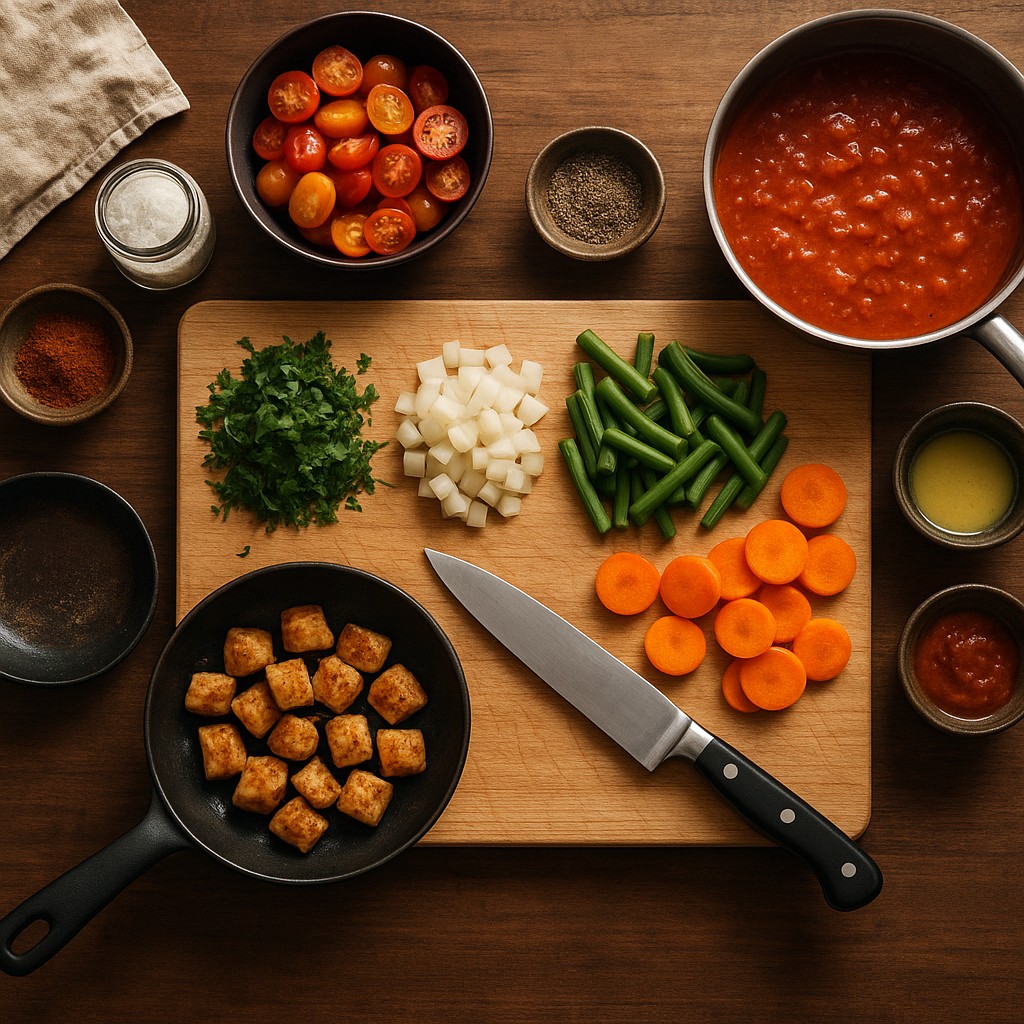
One practical habit improves both heat and timing: mise en place (get your stuff ready). Chop your onions, measure your sauce, preheat your pan, then cook. It is not about being precious, it is about not scrambling while your pan overheats and your onions turn into charcoal confetti.
Build a practice plan that actually makes you better
A quick way to stall is to cook something totally new every time and hope improvement happens by chance. Variety is fun, but skill grows faster with repetition. Think of cooking like learning a song on guitar: you do not play a different song every day and expect mastery. You repeat, refine, and slowly raise the difficulty.
Choose a “training menu” of 6 to 10 dishes you genuinely like and can rotate through. Each dish should teach one skill: roasting, pan-searing, simmering, sauce-making, or seasoning. Cook them several times over a month and change only one thing at a time, like switching the vegetable or trying a different spice blend. This helps your brain link cause and effect.
Here is a simple progression that works for many people:
- Pick one technique for the week (roasting, sautéing, simmering).
- Cook it 2 to 3 times with small variations.
- Take one note after each cook: what worked, what did not, what you would change.
- Repeat next week with a new technique.
This beats binge-watching cooking videos and then attempting a soufflé at midnight. You can still watch videos, but real improvement comes from doing, tasting, and adjusting.
A simple “skill ladder” you can climb
To keep practice on track, it helps to know what to learn first. The table below lays out a sensible order with examples and what you are trying to improve.
| Stage |
Focus skill |
What to practice |
What “good” looks like |
| 1 |
Knife and prep |
Dice onions, slice carrots, mince garlic |
Similar-sized pieces, safe grip, faster prep |
| 2 |
Heat basics |
Sauté vegetables, cook eggs, toast spices |
Controlled sizzling, no burning, consistent results |
| 3 |
Seasoning and balance |
Soups, dressings, sauces |
You adjust salt and acid intentionally, not randomly |
| 4 |
Protein confidence |
Chicken thighs, fish fillets, tofu, beans |
Juicy, not overcooked, flavorful crust or seasoning |
| 5 |
One-pan and one-pot meals |
Stir-fries, braises, curries, pasta |
Timing is smooth, flavors layer, leftovers taste better |
| 6 |
Improvisation |
“Fridge meals,” substitutions, cleanup meals |
You can cook without panic or perfect instructions |
Notice what is missing: “Buy an expensive pan.” Tools help, but skill is the multiplier. A confident cook with a cheap pan beats a nervous cook with luxury gear almost every time.
Learn flavor building: the story behind delicious food
A meal tastes complex when flavors are layered, not when it has 47 ingredients. Most great dishes follow a simple story: build a base, add depth, then brighten at the end. Once you see this, you can make food taste intentional even on a busy night.
A common flavor-building pattern looks like this:
- Start with aromatics (onion, garlic, ginger, scallions) in oil or butter.
- Develop deeper flavor by browning, toasting spices, or cooking tomato paste until it darkens a bit.
- Simmer to blend flavors (stock, beans, sauce, grains).
- Finish with brightness and freshness (lemon, vinegar, herbs, yogurt, chili oil).
This is why so many recipes begin with “cook onion until soft.” It is not tradition for its own sake. It is the base note. And it is also why a squeeze of lemon at the end can make a dish suddenly taste like you knew what you were doing.
A note on spice: spicy is not the same as flavorful. Heat is one dimension. Flavor is a whole room. If something tastes dull, dumping chili flakes on it may only give you dull food with pain. Balance first, then add heat if you want it.
Use recipes wisely: training wheels, not handcuffs
Recipes are great teachers when you treat them like lessons, not laws. The problem is many beginners follow recipes mechanically and still do not understand why things happen. That is how you end up saying “I followed it exactly” and still feeling disappointed. (Also, some recipes are just bad. The internet contains multitudes.)
When you use a recipe, read it like a coach’s notes. Before you start, ask:
- What technique is this teaching (roast, sauté, braise)?
- Where does the flavor come from (browning, spices, herbs, acid)?
- What are the danger points (overcooking, burning aromatics, curdling dairy)?
While you cook, pay attention to sensory cues instead of only the clock. “Cook 5 minutes” is a rough guide, not a sacred vow. Your stove, pan, and ingredient sizes change the timeline. Look for “onions are translucent,” “edges are browning,” “sauce coats the spoon,” “chicken juices run clear,” and “it smells nutty, not sharp.”
After cooking, make one deliberate tweak next time. Maybe you salt earlier, sear longer, or finish with vinegar. Small experiments are how recipes turn into intuition.
Make your kitchen a place where good cooking is easy
Becoming a good cook is not just skill, it is about removing friction. If your spices are scattered, your knives are dull, and you are always missing a clean cutting board, you will cook less and stress more. You do not need a fancy kitchen, you need a friendly one.
Start with a short list of essentials that cover most tasks: a sharp chef’s knife, a cutting board, a skillet, a medium pot, a sheet pan, a wooden spoon, tongs, and a thermometer if you often cook meat. A thermometer is like a cheat code - it replaces guesswork with information. You stop wondering whether chicken is done and start knowing.
Also, set yourself up for weekday success. Wash greens when you bring them home. Cook extra rice or beans. Keep “flavor helpers” on hand, like lemons, vinegar, soy sauce, mustard, and a couple of spice blends you actually use. Great cooks are often just great planners who make it look effortless.
Common myths that keep people stuck (and the truth that frees you)
Some cooking myths sound inspiring but slow your progress. Let us retire a few.
“Good cooks never use shortcuts.”
Good cooks use smart shortcuts all the time. Store-bought broth, frozen vegetables, rotisserie chicken, and canned beans are not moral failures, they are time machines. The goal is delicious, nourishing food you can actually make, not culinary martyrdom.
“You need fancy gear to cook well.”
A nicer pan is pleasant, but sharper skills matter more. Learn to manage heat, season properly, and brown food well, and your results will improve even with basic equipment. Upgrade tools when they solve a problem you keep having.
“Baking is hard, cooking is easy.”
They are different. Baking rewards precision, cooking rewards attention. If you can read and measure, you can bake. If you can taste and adjust, you can cook. You do not have to pick a side.
“If I mess up, I am bad at cooking.”
Mistakes are part of the curriculum. You will oversalt something, overcook something, and once make a sauce that looks like it needs therapy. The point is to learn the fixes: dilute, add acid, add fat, lower heat, or call it “Version 2” and try again.
Bringing it all together: the best way, in one sentence
The best way to become a good cook is to practice core techniques repeatedly, taste and adjust with intention, and learn to control heat and timing, using recipes as guides while you build your own instincts. It is not glamorous, but it works. After a few months, cooking stops feeling like a performance and starts feeling like a conversation with your ingredients.
You do not need to wait for confidence to cook. Cook to build confidence. Pick a few dependable dishes, keep your knife sharp, taste like you mean it, and treat every meal as a low-stakes experiment you get to eat. Over time the kitchen becomes less of a test and more of a playground, and you become the kind of person who can open the fridge, shrug, and say, “Yeah, I can make something great from this.”