Imagine standing on the deck of a research ship in the middle of the Pacific Ocean. Directly beneath you, the water reaches down for nearly seven miles. At those depths, the pressure is like having an African elephant stand on your thumb, or more accurately, like trying to balance the weight of a Boeing 747 on your chest. For decades, the biggest hurdle in deep-sea exploration wasn't just getting a camera or a person into that abyss; it was making sure they didn't return to the surface as a pile of crushed metallic confetti. The ocean is a relentless destroyer of steel, and for a long time, the only way to fight it was with pure, heavy mass.
Traditional seafaring logic says that to go down, you must be heavy, and to come up, you must be light. In shallow waters, submarines manage this with ballast tanks filled with air. To dive, they vent the air and let in water; to surface, they use compressed air to blow the water out. But in the Hadal zone, the deepest trenches on Earth, air is a liability. At such extreme pressures, a hollow metal tank acts less like a float and more like a soda can waiting to be crushed. If the walls are thin enough to stay light, they implode. If they are thick enough to resist the pressure, the ship becomes so heavy it sinks like a stone and stays there forever. This is where a remarkable material called syntactic foam enters the story, changing the very chemistry of how we conquer the deep.
The Structural Magic of Tiny Glass Bubbles
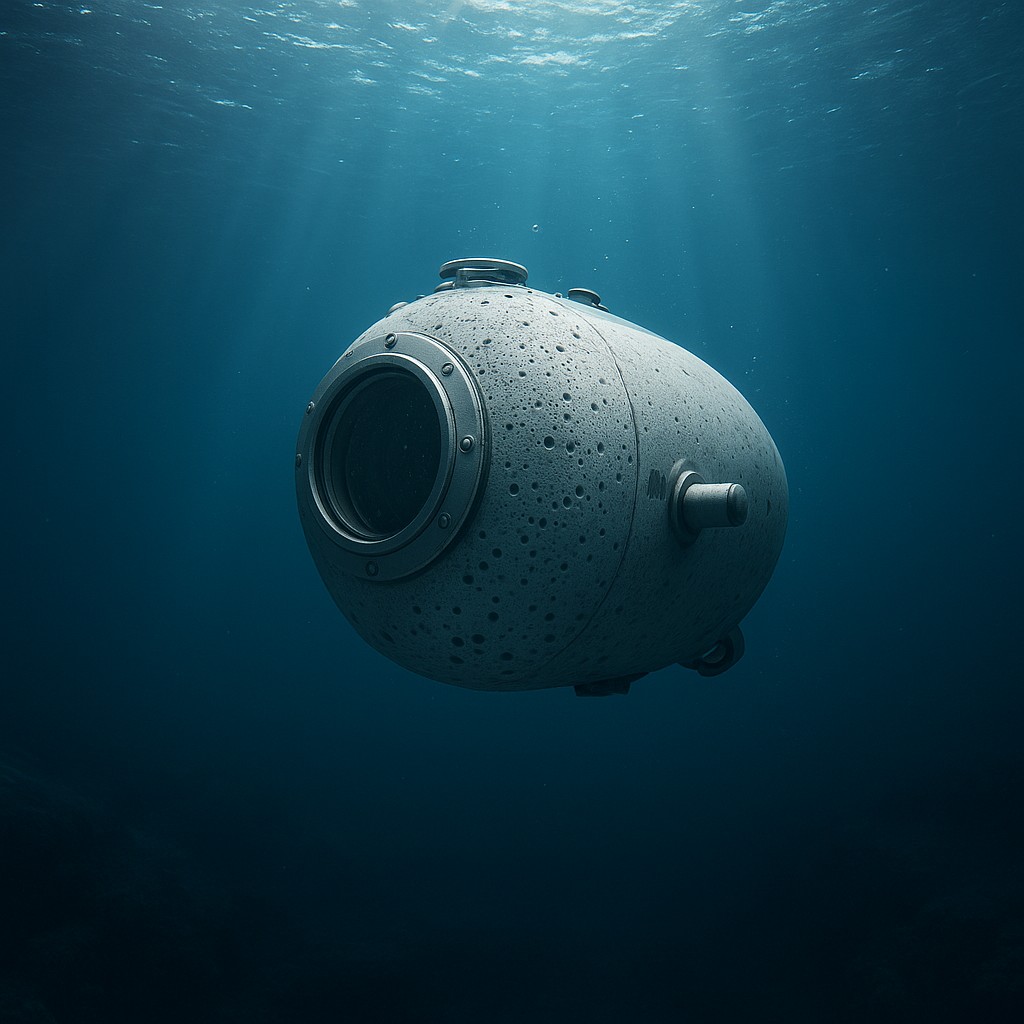
To understand why syntactic foam is the undisputed king of deep-sea materials, we have to look at how it is built. Unlike the squishy foam in a couch or the Styrofoam in a coffee cup, syntactic foam is incredibly hard. It feels more like a heavy billiard ball or a piece of polished granite. The word "syntactic" refers to the "ordered" way the material is put together. Instead of blowing gas into a liquid to create random, uneven bubbles, engineers carefully mix billions of microscopic, hollow glass spheres into a specialized epoxy resin. Imagine a giant tub of honey filled with billions of tiny, hollow Christmas ornaments the size of dust particles. Once that resin hardens, you are left with a solid block that is surprisingly light because it is mostly trapped air, yet structurally as tough as a brick.
These microscopic spheres, often called microballoons, are the secret to deep-sea survival. Because they are so small and numerous, they distribute the crushing weight of the ocean across a massive surface area. When the water tries to squeeze the foam, it isn't pushing against one large, weak pocket of air; it is pushing against billions of tiny, perfect spheres. Geometry tells us that a sphere is one of the strongest shapes for resisting external pressure because it distributes force evenly. By shrinking the air pockets down to the size of a grain of flour, engineers make it nearly impossible for the ocean to find a weak point.
This creates a material with a "superpower" in physics: it is both incompressible (it won't shrink) and buoyant (it floats). In the deep ocean, almost everything changes volume. Even water itself compresses slightly at the bottom of the Mariana Trench. But a high-quality block of syntactic foam keeps its shape. This means that while a steel beam might eventually buckle or a piece of wood might be squeezed until it no longer floats, the foam remains exactly as it was. It provides a constant, reliable upward force that acts as a life jacket for the entire submersible. This ensures that heavy cameras, batteries, and the pilot's cabin have a guaranteed ride back to the surface.
Separating Weight from Buoyancy
In classic naval engineering, weight and buoyancy are two sides of the same coin. If you want a ship to float higher, you remove weight. If you want a sub to dive, you add weight. However, deep-sea vessels like the famous Alvin or James Cameron’s Deepsea Challenger work on a different principle. They are designed to be "heavy" regarding their scientific gear but "light" in terms of their overall density. Syntactic foam allows engineers to separate these two ideas. They can build a massive, heavy titanium sphere to hold a pilot, and then simply bolt on enough blocks of foam to cancel out that weight.
This creates a "passive" buoyancy system. In a standard submarine, if the power fails and the pumps cannot clear the ballast tanks, the crew is in grave danger. But a vessel covered in syntactic foam is naturally buoyant; it effectively "wants" to float. To make it sink, pilots attach "drop weights," which are large chunks of iron held on by electromagnets. To go down, the pilot keeps the weights attached. To come up, they simply flip a switch (or wait for the power to fail, which releases the magnets). The weights fall to the seafloor, and the foam naturally carries the ship back to the surface like a cork. This fail-safe design is what turned deep-ocean exploration from a dangerous gamble into a predictable science.
| Feature |
Air-Based Ballast (Standard Subs) |
Syntactic Foam (Deep Explorers) |
| Material Density |
Low (Air) |
Medium (Glass + Resin) |
| Pressure Resistance |
Low (Compresses/Implodes) |
High (Incompressible) |
| Mechanism |
Active (Requires Pumps) |
Passive (Always Buoyant) |
| Failure Mode |
Mechanical failure leads to sinking |
Structural crack leads to loss of lift |
| Best Used At |
Shallow to Medium depths |
Extreme Deep/Hadal depths |
The Chain Reaction of the Abyss
Despite its strength, syntactic foam is not invincible. It exists in a world of "all or nothing" physics. The primary threat to this material is a phenomenon known as a "sympathetic implosion." Because the foam is made of billions of tiny bubbles held in a rigid resin frame, the resin acts as the primary shield. If the resin is perfectly cast and free of defects, the foam can withstand the pressure for years. However, if there is a tiny crack or a manufacturing flaw, the ocean will find it.
When one microballoon fails under pressure, it collapses inward with a tiny "pop." In a living room, this would be silent. But at the bottom of the ocean, that tiny collapse creates a shockwave. That shockwave can hit the neighboring glass spheres and shatter them, which in turn shatters the ones next to them. This can create a "zipper effect" where a small flaw causes a section of foam to disintegrate. This usually doesn't sink the whole ship, but it causes the foam to lose its buoyancy and become waterlogged. This is why deep-sea engineers treat the surface of the foam with obsessive care, often painting it with bright, protective coatings to prevent even the smallest scratch from letting the ocean in.
Additionally, not all syntactic foams are the same. Engineers must "tune" the foam for specific depths. If a mission only goes down 2,000 meters, they can use larger, thinner glass spheres to make the foam lighter and more buoyant. But for the 11,000-meter depths of the Challenger Deep, they must use much smaller spheres with thicker walls. This makes the foam denser and heavier, meaning they need more of it to lift the same amount of equipment. Balancing this lift-to-weight ratio is the main math problem for those building the next generation of robotic explorers.
From the Deep Sea to the Future
The lessons learned from syntactic foam are now moving into other industries, proving that extreme engineering often leads to everyday breakthroughs. By learning how to embed hollow structures into solids to create strength without weight, scientists are finding new ways to build airplanes, body armor, and lightweight car parts. The idea is simple: if a material can survive the weight of five miles of water, it can certainly handle the stress of a highway or a flight across the Atlantic.
Syntactic foam has effectively made the ocean floor accessible. By removing the fear of implosion and the complexity of high-pressure pumps, we have opened our planet to continuous study. It is a quiet hero of science, a block of high-tech plastic that serves as the backbone of our curiosity. It allows us to park a robot on the seabed for months or send a human to witness the strange life of the trenches, knowing with mathematical certainty that they will rise again.
The most revolutionary inventions often solve basic problems in elegant ways. We didn't solve the problem of deep-sea pressure by building stronger pumps; we solved it by rethinking what "floating" actually means. We replaced the fragile, empty space of a tank with the collective strength of billions of tiny glass worlds. In science, as in life, sometimes the best way to handle immense pressure is not to fight it alone, but to distribute the weight across a resilient community. Every time a submersible breaks the surface, it is a victory for the tiny glass bubbles that refused to give in.