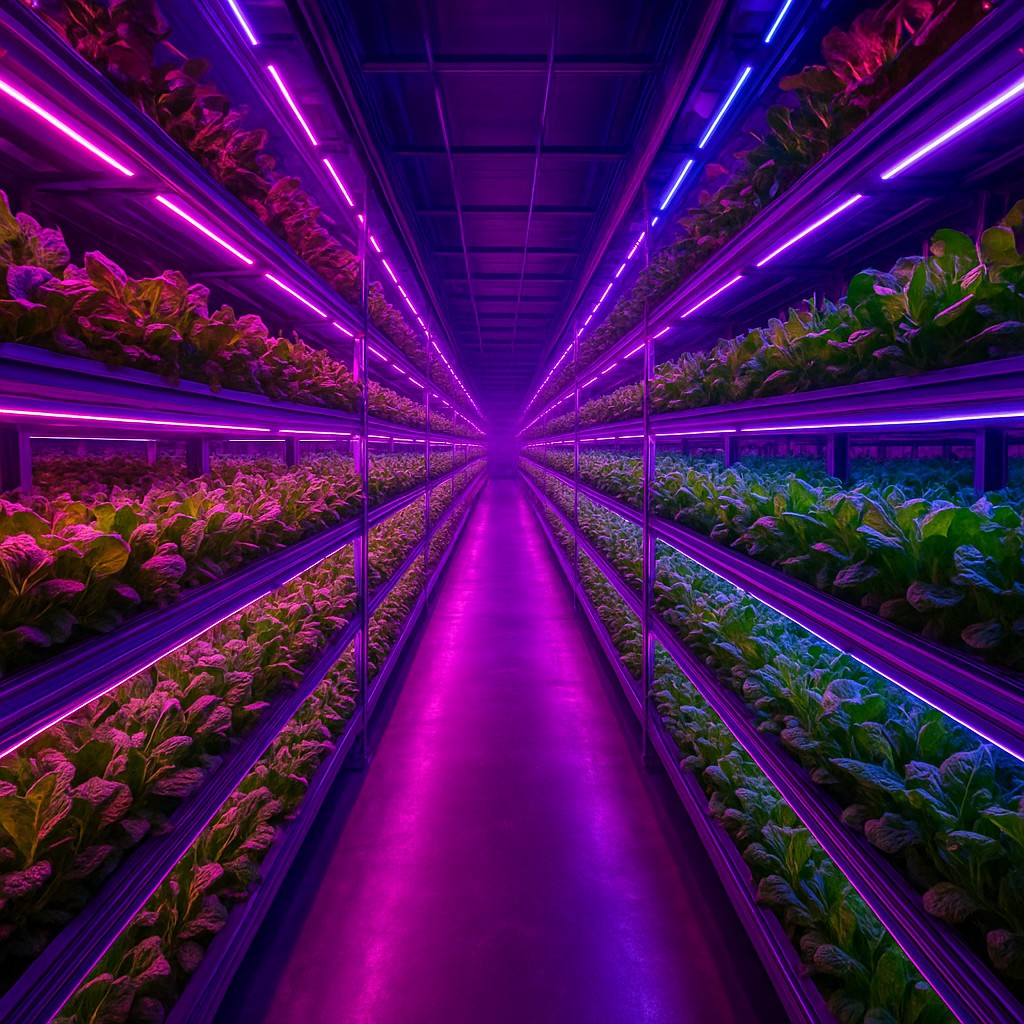
Imagine walking into a massive warehouse in the heart of a city, where the air is perfectly humid and vibrant greens stack up in rows from floor to ceiling. There is no sun, no smell of damp earth, and definitely no tractors. Instead, you are met by a soft, otherworldly glow of pinks, purples, and deep blues. This is the world of modern vertical farming. The industry has moved far beyond just "keeping plants alive" and into the realm of biological programming. We are no longer just growing food; we are orchestrating it, using light as our main tool to compose the flavor, texture, and nutrition of our dinner.
For decades, we believed that the secret to a great tomato or spicy arugula lived only in the soil of an Italian hillside or the coastal breezes of California. While "terroir" - the unique flavor profile given by a specific environment - still matters in traditional farming, vertical farms are proving we can recreate and even improve these conditions by hacking a plant’s internal software. Using "spectral tuning," farmers can now adjust light waves to convince a plant to produce more vitamin C, change its leaf shape, or develop a sharper peppery kick. This shift from "farming by nature" to "farming by design" is changing our relationship with food, turning the simple LED bulb into the most powerful tool in the kitchen.
The Secret Language of Photoreceptors
To understand how we can "program" a vegetable, we first have to realize that plants do not just use light to make food through photosynthesis. They also use it as a complex stream of data. Humans see a rainbow as a beautiful sight, but a plant sees it as a list of instructions. Deep inside plant cells are specialized proteins called photoreceptors, such as phytochromes and cryptochromes. These act like tiny organic sensors that constantly track the quality, strength, and timing of the light hitting them. When a specific color hits these sensors, it triggers a chain reaction of chemical signals that tells the plant exactly what to do next.
If a plant detects a high amount of blue light, for example, it might choose to keep its stems short and thick, focusing its energy on growing large, dark green leaves full of chlorophyll. If it senses plenty of "far-red" light - a color on the edge of what humans can see - it might panic and think a rival plant is shading it. In response, it will stretch its stems upward in a desperate race for the "sun." By understanding this "light language," vertical farmers can skip the guesswork of traditional farming. They do not just hope for a good harvest; they send a direct command to the plant’s DNA, telling it to grow exactly how they want it to.
Mastering the Spectral Dashboard
In the early days of indoor growing, most farms used "blurple" light, a mix of red and blue LEDs that looked like a neon disco. This was based on the simple fact that plants mostly absorb these two colors for growth. However, modern light tuning is much more subtle. It involves a precise light "recipe" that changes as the plant grows from a tiny seedling to a mature head of lettuce. By adjusting the balance of light particles across the spectrum, growers act like high-tech chefs, seasoning their crops with light instead of salt and pepper.
The real magic happens when we look at the specific roles of different colors. Blue light is often the "architect," shaping the plant's structure and boosting healthy compounds like antioxidants. Red light is the "engine" that drives fast growth and leaf expansion. Far-red light acts as a "signalman," helping the plant decide when to flower or how to set its internal clock. When combined in the right amounts, the results are incredible. A head of lettuce grown under a tuned light spectrum can contain significantly more healthy nutrients, like polyphenols or flavonoids, than one grown in a traditional field. It is literally "healthier" by design.
Programming Nutrition and Flavor
The most exciting part of light tuning is the ability to change a plant's chemistry without any genetic modification. This is purely an environmental hack. For example, if a grower wants red-leaf lettuce with a deep, dark burgundy color, they can hit the plant with intense blue light or a touch of UV-B toward the end of its growth. The plant treats this light as a "stressor" and produces anthocyanins - the same healthy pigments found in blueberries - as a form of biological sunscreen. This does not just make the lettuce look beautiful; it packs it with nutrients that are great for human health.
Flavor can be adjusted with the same precision. The sharp, peppery taste of arugula or radishes comes from specific sulfur compounds. By tweaking the light spectrum and the timing of "light shocks," farmers can turn these flavors up or down. Imagine a world where a chef can order a batch of basil tuned to be sweeter for a dessert, or extra spicy for a savory pesto. This level of customization is impossible in the wild, where the sun provides one broad, unchangeable spectrum that varies with the time of day and cloud cover.
| Light Spectrum Component |
Main Biological Function |
Resulting Crop Feature |
| Blue Light (400-500nm) |
Controls leaf pores and stops stems from stretching. |
Compact plants, thicker leaves, and more antioxidants. |
| Red Light (600-700nm) |
Main driver of growth and energy production. |
Faster growth, larger leaves, and more sugar. |
| Far-Red Light (700-800nm) |
Triggers "shade alarm" and controls flowering. |
Quicker flowering, taller stems, and larger fruit in some crops. |
| Green Light (500-600nm) |
Reaches deeper into the plant than other colors. |
Better growth in bottom leaves and better visibility for workers. |
The High Stakes of the Biological Clock
While the power to program plants is exciting, it comes with risks and a high energy bill. Plants, like humans, have a circadian rhythm - an internal clock that coordinates their health with the rising and setting of the sun. In a vertical farm, the farmer is the sun. If the lights are timed poorly or the light recipe is inconsistent, the plant can become "confused." This stress can lead to "tipburn," where the edges of the leaves die, or premature flowering, which makes the vegetable bitter and impossible to sell.
Furthermore, running thousands of high-intensity LEDs around the clock uses a massive amount of electricity. Even though LED technology is more efficient than ever, the cost of "manufacturing" sunlight is the biggest hurdle for the industry. This is why light tuning is so critical. It is not just about making plants "better," but about making them more efficient. If a farmer can use a specific pulse of far-red light to trick a plant into growing 20 percent faster, they can turn off the lights sooner, saving thousands of dollars. The goal is the "Goldilocks" spectrum: just enough light to maximize quality and speed without wasting a single drop of energy.
Moving Beyond the Limitations of Earth
The impact of this technology reaches far beyond city warehouses and high-end salads. By mastering the art of growing food without soil or natural sunlight, we are essentially building the "life support" systems needed for long-distance space travel and colonies on the Moon. On Mars, where sunlight is weak and the soil is toxic, the ability to program a crop's nutrition using only LEDs and a liquid nutrient solution is a necessity, not a luxury. We are learning how to take the best parts of Earth's biology and pack them into a portable, controllable system that can work anywhere in the universe.
Closer to home, this technology offers a solution to the chaos of climate change. As traditional farming regions face unpredictable droughts, floods, and temperature swings, the controlled environment of a vertical farm remains a safe haven of consistency. We can now produce the same high-quality strawberries in the middle of a desert or a frozen tundra, every single day of the year. The "terroir" of the future won't be defined by a map, but by the skill of the "light architect" who designed the recipe.
As we continue to learn how light interacts with life, the line between technology and biology will continue to blur. Food is no longer just a passive passenger of the seasons, but an active part of a high-tech symphony. By learning to "speak" to plants through light, we are gaining the power to feed a growing world with more precision, efficiency, and flavor than ever before. The next time you enjoy a crisp, perfectly flavorful piece of lettuce, think about the invisible light waves that "taught" it how to be so delicious. The future of food is looking exceptionally bright.