Imagine, for a moment, that the planet has a slow-acting antacid tablet hidden within its own crust. For billions of years, Earth has managed its thermostat through a quiet geological conversation between the atmosphere and the rocks beneath our feet. When volcanoes belch carbon dioxide into the sky, the rain becomes slightly acidic. This rain falls onto mountains and reacts with silicate minerals. This chemical dance turns the gas into a liquid form that eventually washes into the sea, where it settles as harmless sediment on the ocean floor. It is a perfect, elegant system, but it has one major flaw for our modern crisis: it moves at the speed of a tectonic plate, taking tens of thousands of years to clean up a mess we have made in just a few centuries.
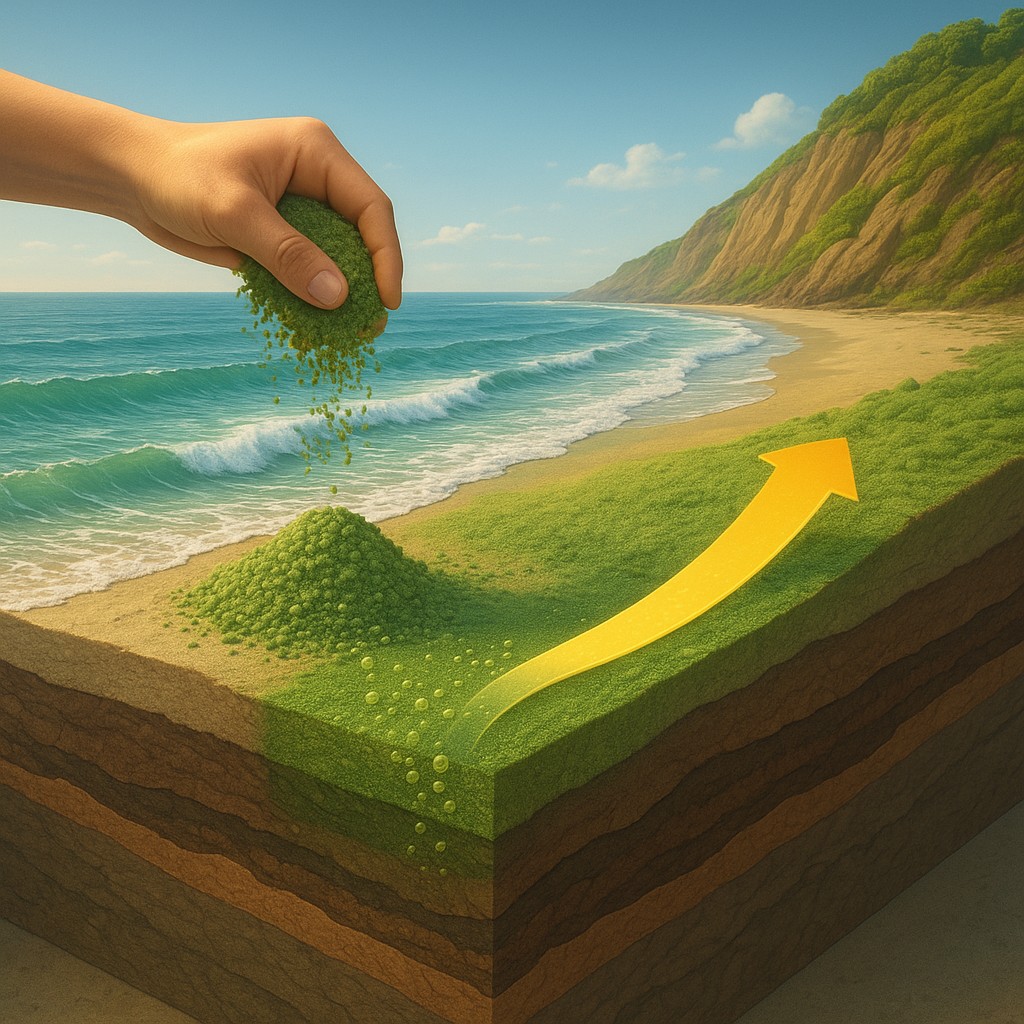
We are currently in a race to find a "fast-forward" button for this natural carbon cycle. While much of the climate conversation focuses on massive mechanical fans that suck carbon from the sky or vast forests that breathe it in, a group of scientists is looking toward the shoreline with a peculiar green mineral in hand. This mineral is olivine, a magnesium iron silicate that is abundant, relatively cheap, and chemically hungry for carbon. By grinding this rock into sand and spreading it along high-energy beaches, researchers are attempting to turn the world’s coastlines into giant, passive carbon scrubbers. It is a strategy known as enhanced weathering, and it represents a fascinating shift from high-tech mechanical solutions to a refined, nature-augmented chemical process.
The Chemistry of a Crumbling Rock
To understand why a green beach might save the sky, we have to look at the molecular level. Olivine is what geologists call a silicate mineral. In its natural state, it is quite unstable when exposed to water and air at the Earth's surface. When an olivine crystal meets water that has dissolved carbon dioxide in it (which characterizes most of our rainfall and seawater today), a chemical reaction begins. The olivine dissolves, releasing magnesium ions and silica. More importantly, this process pulls the carbon dioxide out of its gaseous or dissolved-acid state and converts it into bicarbonate ions.
Bicarbonate is the "hero" of this story. Unlike carbon dioxide, which traps heat in the atmosphere and acidifies the ocean, bicarbonate is stable, alkaline, and stays put. It is essentially the same stuff that makes up baking soda. When this reaction happens in the ocean, it doesn't just remove a greenhouse gas; it also helps fight ocean acidification by raising the pH of the water. This process happens naturally every time a mountain erodes, but by the time a boulder in the Himalayas turns into dust in the Ganges Delta, the Earth has already aged significantly. The goal of coastal enhanced weathering is to squeeze those thousands of years of geo-chemical processing into a single season.
Harnessing the Power of the Surf
If you simply piled olivine in a quiet field, the carbon removal would be painfully slow. The mineral would react with the top layer of rainwater, form a crust, and then sit there, effectively insulated from further reaction. This is where the "coastal" part of the strategy becomes a stroke of engineering genius. By placing the olivine sand in the "swash zone" - the area where waves constantly crash and retreat - we utilize the ocean as a massive, free, solar-powered blender. The waves provide the kinetic energy necessary to keep the process moving at peak efficiency.
As the waves tumble the green grains against one another, they physically grind the surface of the mineral. This constant friction strips away the weathered outer layer and exposes fresh, unreacted olivine to the seawater. It is a self-cleaning mechanism that ensures the chemical reaction never hits a stalemate. Furthermore, the ocean is a vast reservoir that is already in equilibrium with the atmosphere. As the olivine removes dissolved carbon from the water, the ocean "gulps" more carbon from the air to replace what was lost. In this sense, the beach acts as a vacuum nozzle, while the entire ocean acts as the collection bag.
Weighing the Benefits and the Tradeoffs
Every climate solution comes with a "price tag" that isn't always measured in dollars. To make a meaningful dent in global emissions, we would need to mine, grind, and transport billions of tons of olivine. This creates a bit of a paradox: we would be using fossil-fuel-powered ships and massive industrial crushers to move the very material intended to save the climate. Researchers must carefully calculate the "carbon payback time" for these projects. If it takes more carbon to move the rock than the rock can absorb in its first five years, the project might be a net loss in the short term. Fortunately, calculations suggest that for every ton of CO2 emitted during the mining and transport process, the olivine can eventually remove up to twenty tons from the atmosphere.
| Feature |
Natural Weathering |
Coastal Enhanced Weathering |
| Timescale |
Thousands to millions of years |
Years to decades |
| Energy Source |
Gravity and natural erosion |
Wave action and industrial grinding |
| Primary Location |
Mountain ranges and river basins |
High-energy tropical and temperate coasts |
| Main Byproduct |
Stable bicarbonate and silica |
Stable bicarbonate and silica |
| Human Intervention |
None (natural cycle) |
Mining, grinding, and distribution |
| Environmental Impact |
Baseline geological state |
Changes in beach color and local pH |
Beyond the logistics, there is the question of "trace metals." Olivine often contains small amounts of nickel and chromium. As the sand dissolves, these metals are released into the tide pools and coastal ecosystems. While these are naturally occurring elements, dumping them in high concentrations in one area could be disruptive to sensitive marine life, such as crabs or larvae. This is precisely why current pilot projects, like those being tested on small scales in the Caribbean or along the North Carolina coast, are so vital. Scientists aren't just measuring carbon; they are counting snails and checking the health of seagrass to ensure that in our rush to fix the sky, we aren't accidentally poisoning the sea.
Why High Energy Coasts Are the Secret Sauce
Not all beaches are created equal when it comes to carbon removal. A calm, sheltered bay with crystal clear water might be beautiful for a vacation, but it is a terrible place for an olivine project. Without the agitation of heavy surf, the olivine would simply sit on the bottom and get buried under silt. The ideal locations are high-energy environments where the waves are powerful and consistent. These are often places that are already experiencing significant coastal erosion. In a poetic twist of engineering, olivine sand could potentially serve two purposes: it can act as "beach nourishment" to replace sand lost to rising sea levels, while simultaneously scrubbing the carbon that is causing those sea levels to rise in the first place.
However, the "high energy" requirement also makes monitoring the success of the project notoriously difficult. It is easy to measure how much carbon a forest captures because you can literally hug the trees and measure their growth. Measuring the carbon captured by a disappearing pile of green sand in a turbulent ocean is a nightmare of fluid dynamics and chemical modeling. Scientists have to track "alkalinity plumes" through the water, using sophisticated sensors to prove that the bicarbonate is indeed being formed and that the carbon is staying locked away. This "Verification and Monitoring" phase is currently the biggest hurdle to scaling the technology, as investors and governments want proof of every gram of carbon removed before they sign the checks.
The Aesthetic and Cultural Shift
We must also consider the human element. For most people, the "perfect" beach is a sugary white expanse of quartz sand or coral fragments. Transitioning a local beach to a dark greenish-gray hue might not sit well with the tourism industry or local residents. While the olivine grains are safe to walk on and touch, the visual change is a stark reminder of human intervention in nature. It raises a philosophical question: are we comfortable with "re-engineering" our landscapes to survive the Anthropocene, the current era of human-driven global change?
Some proponents argue that the green sand could become a badge of honor for coastal communities, a tangible sign that a town is doing its part for the planet. In places like Papakolea Beach in Hawaii, natural olivine sand is already a world-famous tourist attraction. If we can shift the narrative from "dumping rocks" to "planting a chemical forest," public perception might follow. After all, a green beach is a small price to pay if it prevents the total loss of that beach to a rising tide. Education and transparency are the most effective tools here; when people understand that the "dirt" on their feet is actually a microscopic machine cleaning the air, the "yuck" factor tends to vanish.
A Balanced Tool in the Climate Toolbox
It is tempting to look for a "silver bullet" that solves climate change in one go, but the reality of our situation requires a broader approach. Coastal enhanced weathering is not intended to replace the urgent need to stop burning fossil fuels. Instead, it serves as a critical cleanup crew for the carbon that is already lingering in the air. One of the most attractive aspects of this method is its permanence. Unlike a forest that might burn down and release its stored carbon back into the air in a single afternoon, the bicarbonate created by olivine is effectively permanent on a human timescale. Once that carbon is in the ocean's "alkalinity bank," it stays there for thousands of years.
As we move forward, the success of olivine sand projects will depend on a delicate balance of geochemistry, marine biology, and global logistics. We are learning how to collaborate with the planet’s oldest systems, using the kinetic energy of the moon and the sun (which drive the tides and waves) to accelerate a chemical process that has kept Earth habitable since the dawn of time. It is a sophisticated way of "asking" the Earth for help, rather than trying to force a purely mechanical solution upon it.
While there is still much to learn about the long-term effects on marine ecosystems and the most efficient ways to transport these minerals, the potential is undeniable. We are standing at the edge of a new era of environmental stewardship, one where the very sand beneath our toes becomes a partner in our survival. Seeing the world's coastlines not just as recreational zones, but as active participants in the restoration of our atmosphere, offers a radical and hopeful vision for the future. By leaning into the natural wisdom of the rocks and the relentless energy of the sea, we may find that the solution to our most modern problem has been sitting on the beach all along.