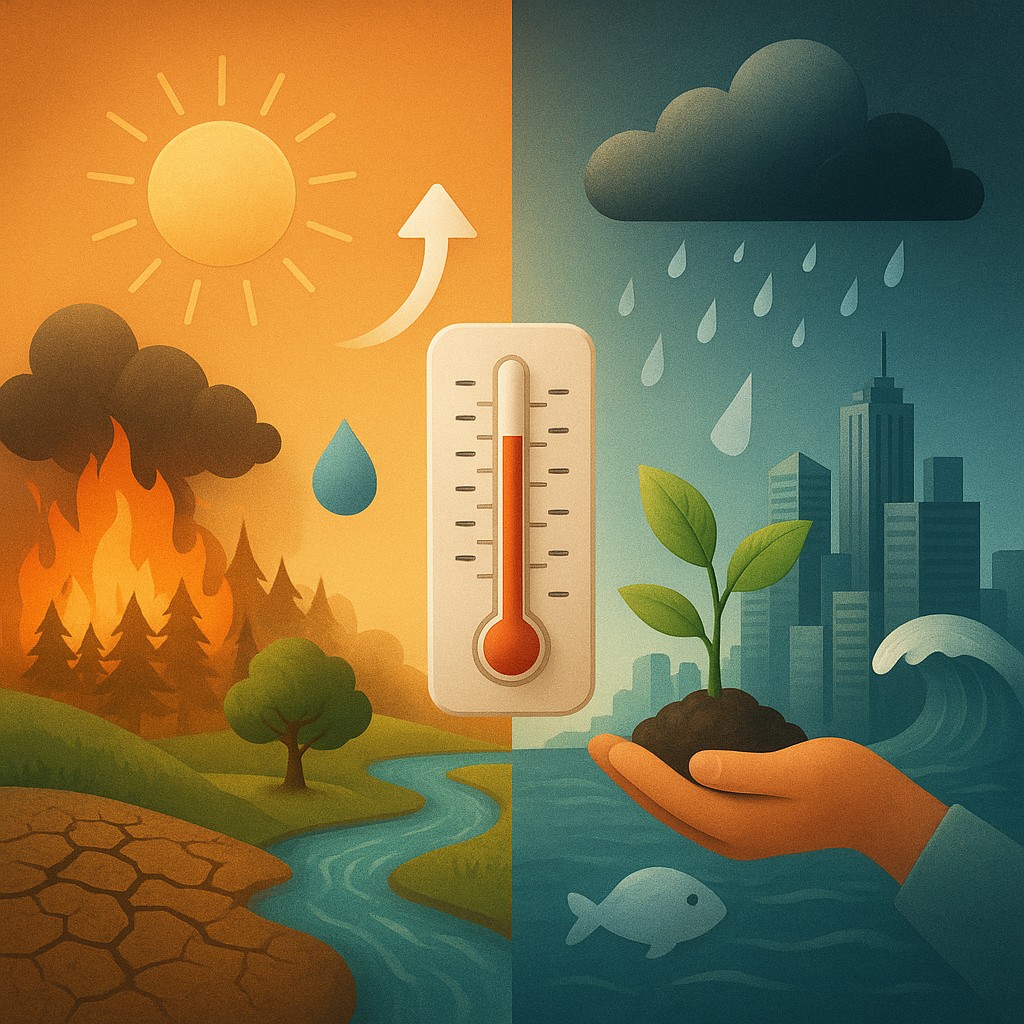
Some topics seem reserved for thick reports, unreadable charts, and debates where someone eventually says, “Sure, but in 1976 it snowed in April at my aunt’s place.” Climate change often gets put in that box. And yet it affects very simple things: how hot summer feels, how much water we have (or do not have) in rivers, the price of certain foods, how often wildfires happen, and even how fast our cities turn into ovens.
So here is the honest question: is it really that alarming, or are scientists overdoing it? The short answer would be, “Yes, it’s genuinely worrying, and scientists actually tend to be cautious.” But since we are not here for a short answer, let’s take the time to understand what we know, how we know it, what is still uncertain (yes, there is some), and why “uncertain” does not mean “no big deal.”
Climate is not weather: the difference that changes everything
Weather is what you check in the morning to decide whether to bring an umbrella. Climate is the average pattern of weather over a long time, usually decades. It includes trends, extremes, seasons, and how all of that is spread out over time. Saying “It’s cold today, so global warming is fake” is like saying “I’m not hungry at noon, so famine isn’t real.” Weather naturally swings from day to day. Climate changes more slowly, and we measure it with statistics.
Today’s climate change is a global rise in the planet’s average temperature, along with a chain of other shifts: warmer oceans, melting glaciers, rising sea level, disrupted rainfall, and more frequent or intense extremes. The word “global” matters. Some regions warm faster, others mainly see changes in rain and snow, and some places can still get bursts of extreme cold, sometimes linked to disruptions in the jet stream. But the big picture is a planet storing more heat.
What makes this tricky is that climate is a complex system. You cannot point to one storm and say, “There, that’s climate change.” Instead, you look at how the odds change. Think of dice: if someone slightly loads a die, you might not notice on one roll, but over 1,000 rolls, the cheating becomes obvious.
What we know with high confidence (and how we know it)
We know several things that are extremely solid, and they rest on independent sources that tell the same story. First, the planet has warmed by about 1.2 °C compared to the pre-industrial era (the exact number varies a bit across datasets, but the ballpark is strong). That may sound small, but it represents a massive amount of extra energy in the climate system. On a planetary scale, 1 °C is not “one less sweater.” It is a real shift in the baseline.
Next, we know the concentration of CO2 in the atmosphere has risen sharply since the Industrial Revolution. We measure it directly in the air (at observatories like Mauna Loa) and indirectly through ice cores, which trap bubbles of ancient air. Those records show today’s levels are very high compared to the past hundreds of thousands of years. And most importantly, we know where this CO2 comes from: the isotopic signature of carbon (different “versions” of the atom) points to a mostly fossil origin. That is not an opinion, it is chemistry.
Finally, we understand the main physical mechanism: the greenhouse effect. Some gases, like CO2, methane, and nitrous oxide, absorb part of the infrared radiation the Earth gives off. More of these gases means more heat kept in. This principle has been known since the 19th century and confirmed by modern measurements, including satellites that see specific wavelengths with less energy “escaping” because those gases absorb it.
In short, three pieces fit together: (1) the planet is warming, (2) we are rapidly increasing greenhouse gases, (3) those gases warm the planet. The scientific debate is not “Is it real?” but “How fast, what does it mean locally, and what paths do we follow based on our choices?”
The human role: why this is not just a natural cycle
Earth has seen climate changes before, sometimes huge ones. There have been ice ages, warmer periods, shifts driven by orbital cycles (Milankovitch cycles), solar activity, volcanoes, and natural feedback loops. So yes, “the climate has always changed” is true. But it is like saying, “There have always been fires, so gasoline has nothing to do with it.” The real question is: what explains the current change, and how fast is it happening?
Natural factors are not enough to explain the warming observed since the mid-20th century. Solar activity has not increased in a way that matches the size of the temperature rise. Volcanoes tend to have a temporary cooling effect by injecting aerosols that reflect sunlight. Natural cycles exist, but they swing around an average, while the current trend is a clear, steady rise that matches the increase in greenhouse gases.
One point people often miss: warming is not spread evenly. Land warms faster than oceans, the Arctic warms far faster than the global average, and nights often warm more than days. These “fingerprints” line up with what we expect from a stronger greenhouse effect. When different observations match what a mechanism predicts, confidence grows.
A simple comparison: natural vs human
| Question |
Natural variability |
Human-caused warming |
| Main cause |
Sun, volcanoes, ocean cycles, orbit |
Greenhouse gases, land-use change, pollution |
| Typical speed |
Often slow (centuries to millennia), sometimes abrupt |
Fast on a historical timescale (decades) |
| Expected fingerprint |
Ups and downs, not always global |
Global trend, oceans storing heat, Arctic highly sensitive |
| Can it explain the recent rise? |
No, not by itself |
Yes, matches observations and models |
This table does not say nature plays no role anymore. It says the main driver of today’s trend is our massive addition of greenhouse gases, and science supports that very strongly.
What “alarming” means in science: risk, not panic
The word “alarming” can sound like someone shouting “Fire!” Climate science usually talks about rising risk, thresholds, probabilities, and potential damage. Picture your doctor saying, “Your blood pressure is climbing. You are not going to collapse tomorrow, but your stroke risk goes up a lot if nothing changes.” That is not exaggeration, it is risk management.
A warming of 1.5 °C to 2 °C is not a cosmetic difference. It affects how often and how strongly heat waves hit, farm drought in some places, extreme rain in others, and pressure on ecosystems. Because oceans absorb a lot of heat, they also face marine heat waves, which stress corals and push species to move. And sea level rise, even if slow, becomes a huge problem when you are talking about deltas, islands, coastal infrastructure, and millions of people.
The key point: many impacts are not linear. Adding a little heat can boost extremes by much more than “a little.” Heat waves, for example, become longer and more likely. This is not only “it will be a bit warmer,” it is “events that used to be rare start happening often.”
The main risks, in plain terms
- More frequent extreme heat: higher health risks, especially in cities and for vulnerable people.
- More unpredictable water: swings between drought and intense rain depending on the region, affecting farming and water supply.
- Oceans under stress: warming, acidification (caused by CO2), and disruption to marine life.
- Sea level rise: long-lasting rise, with risks of flooding, erosion, and salty soils.
- Ecosystems and biodiversity: some species adapt, others do not, especially when change is fast and stacked on top of deforestation or pollution.
This is not “the end of the world” in a Hollywood sense. But it is serious enough to reshape the economy, public health, geopolitics, and everyday life. What is alarming is not instant apocalypse, it is the buildup of damage, inequality, and costs that become hard to manage.
Climate models: crystal balls or solid tools?
Climate models get a bad reputation because “model” can sound like “fragile guess.” In reality, a climate model is a set of equations that describes the physics of the atmosphere, oceans, ice, and energy flows. Models do not “foresee” the future like a fortune teller. They simulate scenarios based on our emissions and other inputs.
They do have limits. Forecasting day-to-day weather two weeks out is hard. But projecting climate over 50 years is more doable, because the focus is statistical trends, not whether it will rain on your street on May 12, 2073. It is the difference between predicting the exact outcome of a roulette spin and predicting that the casino has a built-in advantage.
What makes these models credible is testing. Scientists make them “replay” the past using known data (greenhouse gases, solar activity, volcanoes) and check whether they reproduce observed trends. Overall, they capture large-scale warming well, especially when human factors are included. They are not perfect on every regional detail, but they agree on the essentials: the more we emit, the more warming we get, and the more the risks rise.
“Scientists are exaggerating”: why it can feel that way
Many people feel the issue is being dramatized, often for three reasons. First, media messages squeeze nuance into punchy lines. “Science shows a higher risk of extreme events” does not grab attention like “disaster is coming.” Second, some older predictions were misunderstood. A conditional projection (if we emit a lot, then...) can be framed as a certainty, and then people blame science when reality follows a different path, sometimes because policies changed in the meantime. Third, people confuse uncertainty with ignorance.
In science, uncertainty is normal, and it is measured. Scientists can be very sure about the direction (it is warming) and less sure about local details (how much extra rain in one specific place). That is not weakness, it is honesty. And oddly enough, uncertainty can raise risk: if you do not know exactly how big a fire will get, you do not wait until it reaches your living room to call the fire department.
There is also a simple human bias: climate change is slow on a human life scale, but fast on a planet scale. Our brains are great at reacting to immediate danger (a barking dog), and not as good with a growing statistical risk (a probability that climbs year after year). So we downplay it, put it off, and get worn out by the topic.
Common myths (and simple answers, without talking down)
“There have always been warm periods, so this is natural”
Yes, there have been. But the main cause today is human activity, and the speed of the change is a big problem for societies and ecosystems. The data and the physics point to greenhouse gases.
“CO2 is only a tiny part of the air, it can’t matter”
Small amounts can have big effects, like a pinch of salt in soup. CO2 affects specific bands of infrared radiation, and increasing it changes Earth’s energy balance.
“We can’t predict weather, so we can’t predict climate”
They are not the same kind of prediction. Climate is the statistical distribution of weather conditions. We can be bad at saying whether it will rain on April 3 on your street, and still be good at estimating that heat waves will become more likely in a region as the planet warms.
“Scientists are divided”
On the basics, no. There is broad agreement that warming is real, mainly caused by human activity, and that risks grow with emissions. The debates are about details, scenarios, regional impacts, and the best strategies.
What we can do (and why it’s not “too late”)
Climate change is not an on-off switch. Every tenth of a degree matters. Cutting emissions slows warming, lowers risks, and buys time to adapt. This is less about “saving the planet” (it will survive, thanks) and more about keeping stable conditions for our societies, crops, infrastructure, and health.
Solutions exist, and they are not all about suffering. It is a mix of smart restraint (less waste), efficiency (doing more with less), and decarbonization (low-carbon electricity, transport, buildings, industry). It also means adaptation: cooler cities, better water management, wildfire prevention, and health systems ready for heat waves. Think of climate like a construction project: reduce the cause and strengthen the structure.
The most motivating idea might be this: we still have room to move, but it is shrinking. Action does not require perfection, just a clear direction and real progress. Scientists are not asking us to live in a cave. They are showing the price of doing nothing, and the value of making smart choices.
Ending up clearer, not more anxious
If you take away one thing, make it this: scientists are not “shouting” for fun. They are watching a consistent physical system, measured in a thousand ways, react exactly as expected when we add greenhouse gases. Yes, there are uncertainties, but they are mostly about local precision and the exact size of certain impacts, not about whether the phenomenon is real. And no, this is not meant to make you feel guilty. It is an invitation to think like a grown-up civilization facing a measurable risk.
The good news is that understanding climate change makes you feel less helpless. You move from “it’s too big” to “I see the mechanisms, I see the levers, I can tell myth from fact.” And that is already a kind of superpower. After that comes the part humans sometimes do very well, especially when they stop fooling themselves: cooperate, innovate, and build a future that is a little less scorching, both literally and figuratively.