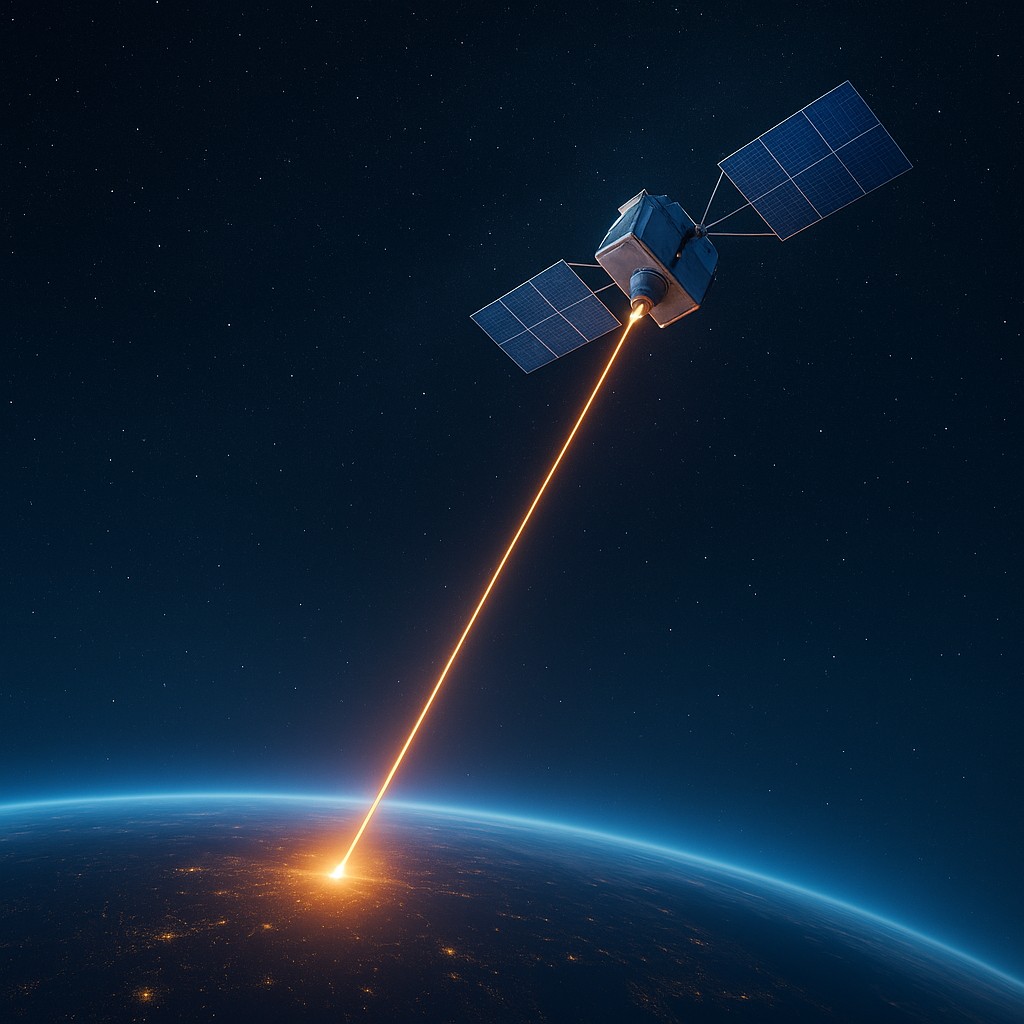
Imagine looking up at a clear night sky, far from the city's neon hum, and spotting a tiny, steady spark cruising across the stars. That light is one of thousands of satellites orbiting our planet. Many are roughly the size of a kitchen appliance, whipping around at 17,000 miles per hour. While they provide everything from GPS coordinates to high-speed internet, they come with a hidden expiration date. In the past, when a satellite died, it became a "ghost ship," a multi-ton piece of metal hurtling through the vacuum. Destined to stay there for decades or even centuries, these wrecks pose a constant threat of high-speed collisions to everything else in the neighborhood.
We are currently facing an orbital traffic jam of epic proportions. The traditional solution, using rocket engines to push a satellite back down into the atmosphere, is both heavy and expensive. Every pound of fuel used for disposal is a pound of fuel that cannot be used for the mission itself. However, a radical new technology is unfolding in Low Earth Orbit (LEO) that turns the laws of physics into a celestial anchor. By deploying incredibly thin, miles-long wires known as plasma brakes or electrodynamic tethers, manufacturers are finding they can "drag" a satellite out of the sky using nothing but Earth's magnetic field and the thin, electrified gas of the upper atmosphere.
The Invisible Friction of the Ionosphere
To understand how a thin wire can stop a speeding satellite, we first have to demystify the "vacuum" of space. While we often think of orbit as being totally empty, Low Earth Orbit is actually filled with the ionosphere. This is a layer of the atmosphere where solar radiation has stripped electrons away from atoms, creating a "soup" of charged ions and free electrons. This thin plasma is the secret ingredient for the plasma brake. When a satellite unspools a conductive wire as it orbits, it isn't moving through nothing. It is moving through a sea of electricity and magnetic field lines that stretch out from Earth's poles.
This is where high school physics makes a practical entrance. When a conductor moves through a magnetic field, it generates an electric current. This is the same principle behind a car's alternator or a massive hydroelectric turbine. As the satellite’s tether cuts across the Earth’s magnetic field lines at several miles per second, voltage builds up across the wire. By using a specialized device to emit electrons at one end, the satellite completes a circuit with the surrounding plasma, allowing a current to flow through the tether. This current creates its own magnetic field, which pushes against Earth's magnetic field. This interaction generates the Lorentz force, which acts in the opposite direction of the satellite's travel. It is, quite literally, an electromagnetic brake.
Turning Planetary Magnetism into a Brake Pad
Mechanical braking on Earth relies on friction, like a rubber pad pressing against a bicycle rim to turn motion into heat. In space, the plasma brake performs a similar energy conversion, but it does so across vast distances without any physical contact. The tether essentially "grabs" the Earth's magnetic field. As the Lorentz force pushes back against the satellite, the craft's speed begins to drop. Since an orbit is a delicate balance between speed and gravity, losing speed means the satellite can no longer stay at its current altitude. It begins a slow, spiral descent toward the thicker layers of the atmosphere, where air resistance eventually take over and burns the craft up.
What makes this particularly elegant is the lack of moving parts or chemical fuels. A traditional thruster requires a tank, valves, pipes, and highly volatile fuel, all of which can fail after years in the harsh radiation of space. A plasma brake, by contrast, is mostly just a spool of very clever wire. It relies on Earth's natural environment to do the heavy lifting. This makes it a "passive" or "semi-passive" system. Once it is deployed, the physics of the universe take over. This ensures the satellite clears its "parking spot" in the sky without the operator having to worry about a fuel leak or a stuck engine valve.
Engineering a Wire Thinner than a Human Hair
You might imagine these tethers as thick, heavy cables, but they are actually feats of micro-engineering. To be effective, the tether needs to be very long (often several miles) but also incredibly lightweight so it doesn't add too much mass to the satellite. Some designs use wires that are flatter and thinner than a strand of hair, made of conductive materials like aluminum or copper. The challenge isn't just making it long; it is making it survive the "shooting gallery" of Low Earth Orbit.
The space around Earth is filled with micrometeoroids and tiny flecks of paint or metal from previous missions, all moving at speeds that make a rifle bullet look like a crawl. A single microscopic impact could snap a single-strand wire like a guitar string. To solve this, engineers use "tether tapes" or multi-line nets. By knitting several thin wires together in a ladder-like structure, the tether becomes redundant. If a tiny piece of space junk hits the tether and severs one or two strands, the electricity simply flows around the break through the remaining wires. This ensures the brake keeps working for the months or years required to bring the satellite down, even if it takes a few hundred hits along the way.
| Feature |
Chemical Propulsion |
Plasma Brake / Electrodynamic Tether |
| Fuel Source |
On-board liquid or gas propellant |
Earth's magnetic field & ionosphere |
| Mass Efficiency |
Low (requires heavy tanks and fuel) |
High (mostly lightweight wire) |
| Complexity |
High (valves, igniters, plumbing) |
Low (deployment motor, conductive wire) |
| Reliability |
Decreases over long missions |
High (operates on basic physics) |
| Deorbit Speed |
Instant but requires active control |
Slow and gradual but works on its own |
| Risk Factor |
Potential for fuel explosion |
Potential for tether entanglement |
Navigating the Challenges of High-Voltage Spacecraft
While the physics are sound and the benefits are clear, deploying a mile-long electrified wire in space is not without its "shocks." One primary concern is the interaction between the tether and the satellite itself. High voltages can cause arcing, where electricity jumps through parts of the spacecraft that were never meant to handle it. Engineers must carefully insulate the connection points and manage the "spacecraft potential," which is the electrical charge the satellite builds up compared to its environment. If the satellite becomes too negatively charged, it could attract ions that damage sensitive sensors or solar panels.
Furthermore, there is the logistical headache of navigating a "long" object in orbit. A satellite with a three-mile wire hanging off it is a much larger target for other functioning satellites. This requires careful coordination and tracking. However, compared to the alternative, a dead satellite drifting uncontrollably for 200 years, a tethered satellite is much more predictable. its path is a steady, measurable decay. Because the tether is so thin, the likelihood of it causing catastrophic damage to another large satellite is statistically lower than the risk of two "zombie" satellites colliding.
The Shift from Junk to Stewardship
The move toward plasma brakes represents a fundamental shift in how we view space exploration. For the first few decades of the Space Age, the focus was entirely on getting up there; getting back down was an afterthought. We treated orbit like a vast, bottomless ocean, assuming that a few discarded rocket stages wouldn't make a difference. Today, with the rise of "mega-constellations" made of thousands of satellites, that mindset is no longer sustainable. If we don't clean up after ourselves, we could trigger the Kessler Syndrome, a chain reaction where a single collision creates a cloud of debris that causes more collisions, eventually making orbit too dangerous for anyone to use.
The plasma brake is a tool of stewardship. It aligns the interests of satellite companies with the health of the orbital environment. Modern regulations, such as the FCC's recent rules requiring many satellites to leave orbit within five years of finishing their missions, are making these technologies a necessity rather than a luxury. By building the cleanup mechanism into the satellite itself, we are ensuring that the sparks of light we see in the night sky eventually return home as shooting stars, leaving the lanes of space clear for the next generation of explorers.
As we continue to push further into the solar system, the lessons we learn from plasma brakes will travel with us. Whether we use the magnetic fields of Jupiter to navigate or harness the solar wind to sail between stars, the ability to interact with the invisible forces of the universe is the key to sustainable travel. Science is often at its most beautiful when it finds a way to do more with less, turning a seemingly empty vacuum into a tool for safety and progress. The next time you see a streak across the sky, remember that it might not just be a falling rock, but a piece of human ingenuity, gracefully bowing out of the cosmic stage using the invisible magnetic threads of our home world.