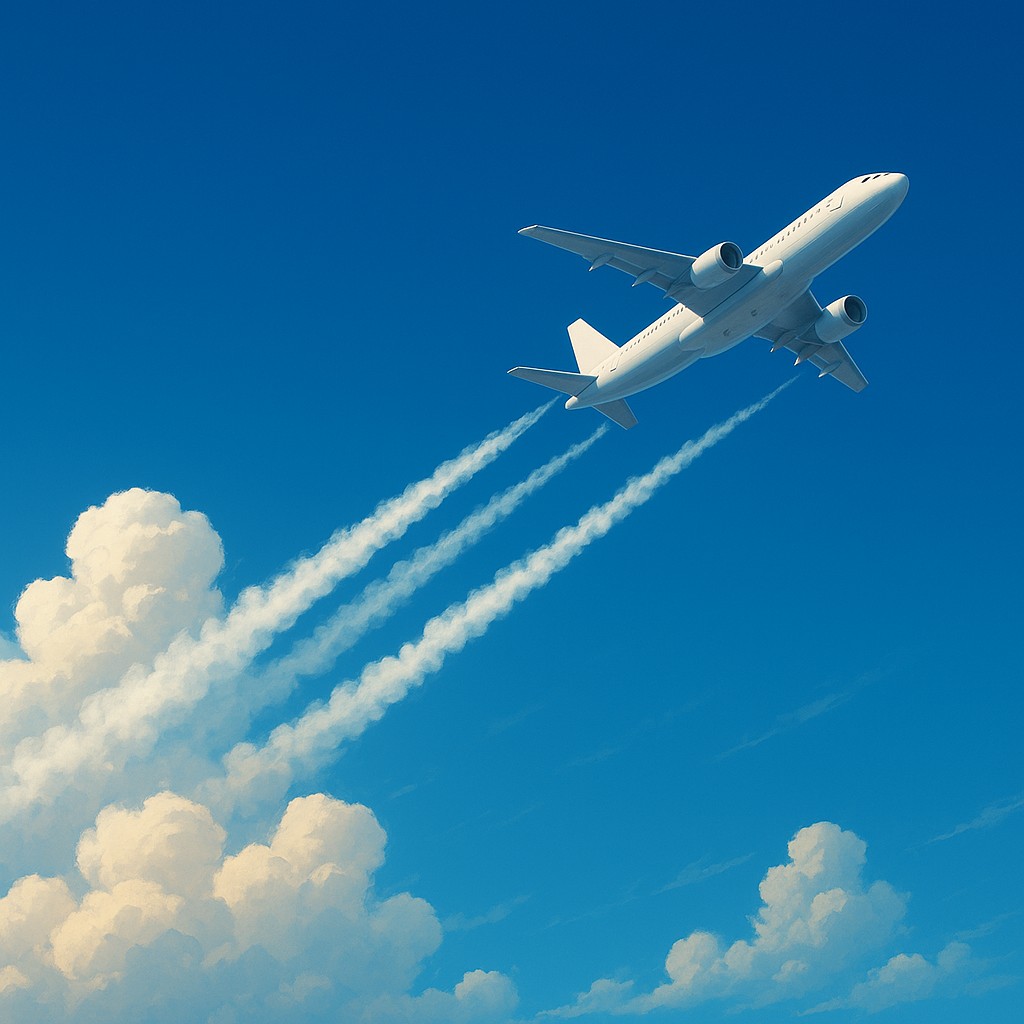
The next time you gaze up at a clear blue sky and spot a lonely white streak following a distant jet, you are witnessing one of the most visible yet misunderstood footprints of human activity on the planet. These slender lines, known as contrails, look harmless enough, resembling wispy strokes of white paint across an azure canvas. For decades, we viewed them merely as evidence of our interconnected world, a sign that people were moving between cities and continents. However, scientists have recently confirmed that these artificial clouds play a much larger role in global warming than the dark exhaust plumes of cars or the invisible carbon dioxide drifting from jet engines.
While we often focus on carbon emissions as the primary villain in the climate story, the aviation industry has a secret passenger that carries a heavy environmental price tag. These condensation trails act like a thin, insulating blanket wrapped around the Earth, trapping heat that would otherwise escape into space during the night. The fascinating part is that unlike carbon dioxide, which lingers in the atmosphere for centuries, a contrail only lasts for a few hours. This creates a unique opportunity for humanity: if we can prevent these clouds from forming in the first place, we could potentially slash the climate impact of flying almost overnight.
The Recipe for an Accidental Cloud
To understand how to stop a contrail, we first have to understand what it actually is. At 35,000 feet, the air is unimaginably cold, often dipping below minus 50 degrees Celsius. When a jet engine burns fuel, it releases hot water vapor and tiny soot particles into this freezing environment. If the surrounding air is humid enough, that water vapor quickly condenses around the soot particles and freezes into billions of microscopic ice crystals. This process is essentially the same as seeing your breath on a cold winter morning, just on a much more massive and high-velocity scale.
Not every flight produces a long-lasting contrail, which is the key to our current mitigation efforts. If the air at cruise altitude is dry, the ice crystals evaporate almost instantly, and the "cloud" vanishes in seconds. However, if the plane flies through a region of the atmosphere that is "ice-supersaturated", meaning the air is holding more moisture than it usually can at that temperature, the contrail stays. It can even grow, spreading out to become a "contrail-cirrus" cloud that looks identical to natural clouds but covers thousands of square miles. These persistent clouds are the real troublemakers, as they are the ones responsible for the majority of aviation's non-CO2 warming effect.
Navigating the Invisible Rivers of Moisture
The most promising solution currently being trialed by major airlines and tech companies involves a surprisingly low-tech maneuver: moving the airplane. Atmospheric moisture is not distributed evenly; it flows in "rivers" or sits in "pockets" at different altitudes. Often, a layer of air that is prone to forming persistent contrails might only be a few thousand feet thick. By climbing or descending just 2,000 feet, a pilot can move the aircraft out of a "wet" patch of air and into a "dry" one, effectively switching off the contrail production like a light bulb.
Modern trials use sophisticated satellite data and weather modeling to predict where these humid zones will be. Instead of flying the most direct route at a static altitude, pilots receive real-time updates suggesting slight deviations. This is a massive shift in how we think about flight efficiency. Historically, "efficiency" meant the shortest path and the lowest fuel burn. Now, we are beginning to redefine efficiency to include "climate impact", acknowledging that a flight that uses slightly more fuel but creates zero contrails might actually be better for the planet than a flight that saves fuel but creates a massive heat-trapping cloud.
Balancing Fuel Burn and Frozen Clouds
This strategy introduces a "climate trade-off" that keeps mathematicians and environmental scientists busy. When a plane moves to a less optimal altitude to avoid a contrail, the engines often have to work harder because the air density or wind patterns are different. This results in a slight increase in fuel consumption, which means more carbon dioxide is pumped into the atmosphere. Because CO2 stays in the air for hundreds of years while contrails last only for hours, we have to be very careful. We don't want to save the planet from a temporary cloud by adding a permanent burden of carbon.
Analysis reveals that we only need to divert a small fraction of flights to see massive benefits. Current research suggests that as few as 2% to 10% of all flights are responsible for about 80% of the total contrail warming. This is because most flights happen in dry air where contrails don't persist. By targeting only the highest-impact flights, we can achieve a disproportionate reduction in warming while only increasing the total fuel burn of the global fleet by a tiny fraction, perhaps less than 1%.
| Feature |
Carbon Dioxide (CO2) |
Contrails (Non-CO2 Impact) |
| Duration in Atmosphere |
Decades to centuries |
Minutes to several hours |
| Primary Effect |
Traps long-wave radiation |
Traps heat and reflects some sunlight |
| Time of Impact |
Constant warming effect |
Mostly warming at night; varied by day |
| Mitigation Strategy |
Sustainable fuels & new engines |
Flight path and altitude adjustments |
| Predictability |
Direct correlation to fuel used |
Highly dependent on local weather |
Solving the Nighttime Warming Puzzle
The timing of a flight also changes the math of contrail mitigation significantly. During the day, contrails have a double-edged effect. While they trap heat escaping from the Earth (a warming effect), their white surfaces also reflect some incoming sunlight back into space (a cooling effect). These two forces partially cancel each other out, though the warming usually wins. At night, however, there is no sunlight to reflect. Nighttime contrails only trap heat, making them pure contributors to global warming.
This makes "red-eye" flights and late-evening departures the primary targets for altitude adjustments. If we can prioritize avoidance strategies for flights crosscutting the Atlantic or Pacific during the dark hours, the environmental payoff is much higher. Pilots and dispatchers are beginning to look at these flights with a new lens, recognizing that a small change in a flight plan over the ocean at 2:00 AM could be just as valuable as planting thousands of trees. It transforms the cockpit from a place of simple transportation into a frontline for active atmospheric management.
The Future of the High-Altitude Horizon
The beauty of contrail mitigation is that it doesn't require us to wait for a revolutionary new technology like hydrogen planes or massive battery breakthroughs. It is a software and data challenge rather than a hardware one. We already have the planes; we already have the satellites; we just need better coordination and more precise sensors to "see" the humidity levels in front of the aircraft. Several airlines have already completed thousands of test flights using these "avoidance" techniques, proving that the concept is not just a laboratory theory but a practical, scalable reality.
As we look toward a greener future for travel, it is inspiring to realize that the solutions are often hidden in the choices we make every day. By merging the wisdom of meteorology with the precision of aviation navigation, we are learning to move through the sky with a lighter touch. This shift represents a coming-of-age for the industry, moving from a focus on pure mechanical performance to a holistic stewardship of the atmosphere. When you see a jet in the future and notice no white line trailing behind it, you might just be looking at the quiet success of a pilot who chose a slightly different path to keep our world a little cooler.