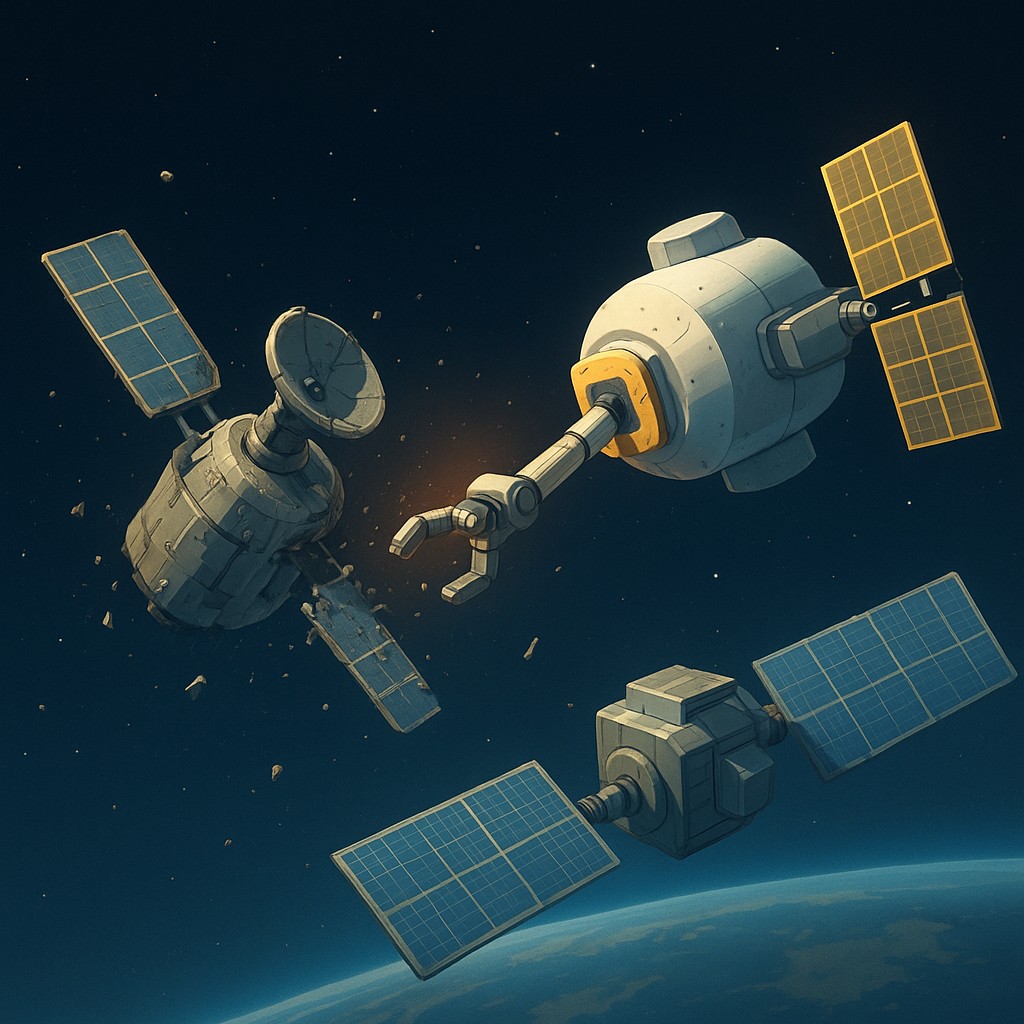
Imagine trying to change a flat tire while the car is speeding down the highway at seventy miles per hour. Now, imagine the car has no lug nuts, no jack points, and the entire chassis is covered in a layer of butter. This sounds like a fever dream, but it accurately describes the current state of orbital mechanics for anyone trying to clean up space. When a satellite dies, it doesn't just sit still; it becomes a multi-ton ballistic projectile tumbling through a vacuum. Because these machines were never designed to be handled after launch, grabbing them is less like a docking maneuver and more like trying to wrestle a spinning, jagged refrigerator while wearing oven mitts.
To solve this, the space industry is shifting from a mindset of disposable hardware to one of cooperative infrastructure. Engineers are beginning to equip new satellites with what can be described as a "universal tow hitch." By installing standardized magnetic docking plates on the outside of a spacecraft before it ever leaves Earth, operators are essentially putting a handle on their luggage. These plates turn a chaotic, high-stakes physics problem into a predictable, routine procedure. Instead of custom-building a robotic claw for every different shape of satellite, future salvage ships will use a simple magnetic or mechanical connection to latch on and drag the debris toward a safe, fiery disposal in the atmosphere.
The Chaos of Non-Cooperative Capture
In the early days of the Space Age, the philosophy was simple: launch it, use it, and forget it. Once a satellite ran out of fuel or its electronics fried, it became a "non-cooperative target." These objects are unpredictable because they are no longer actively pointing their antennas or stabilizing their position. Over time, solar pressure and the Earth’s magnetic field can cause these dead hulks to enter a "zombie tumble," spinning on multiple axes at once. For a repair or removal ship to get close, it has to match that chaotic rotation perfectly, or else the two multi-million dollar machines might smash into each other and create even more debris.
The mechanical interface is the second half of the nightmare. Most satellites are covered in delicate gold foil insulation, protruding scientific instruments, and spindly solar arrays. There is nowhere for a traditional robot arm to grab without crushing something vital or sending the satellite spinning out of control. Without a dedicated "hard point," a salvage mission is forced to use incredibly complex methods like nets, harpoons, or even giant tentacles. These methods are technically impressive but economically disastrous, as they require a custom solution for every single piece of junk. By adding a docking plate during manufacturing, we transform a hostile, jagged object into a cooperative client ready for its scheduled pickup.
Anatomy of the Universal Tow Hitch
A magnetic docking plate is a marvel of simplicity in an industry known for over-engineering. At its core, it is a flat, circular interface usually made of materials that magnets stick to (ferromagnetic) or equipped with specific visual patterns. This plate is bolted directly to the structural frame of the satellite, ensuring that if you pull on the plate, you are pulling the whole craft. Some designs, like those being pioneered by companies like Astroscale or agencies like ESA and NASA, use a mix of permanent magnets and high-contrast markings. These markings act like a QR code for the approaching servicer ship, allowing its cameras to calculate the target's exact distance, speed, and rotation in real time.
The beauty of the plate lies in its passive nature. It requires no electricity, no computer processing, and no maintenance. It can sit in the harsh radiation of space for twenty years, and the moment a magnetic "chaser" ship arrives, the plate is still perfectly functional. Some versions are even "agnostic," meaning they don't care if the retrieval ship uses a magnet, a mechanical gripper, or a vacuum seal. By standardizing this interface across the entire industry, we are effectively creating "rules of the road." If every satellite has the same docking plate, a single "tow-truck" spacecraft could potentially clear out dozens of different dead satellites in one mission, drastically lowering the cost of orbital housekeeping.
Comparing Salvage Strategies
When we look at the evolution of orbital maintenance, we see a shift from "Wild West" improvisation to organized logistics. To understand why docking plates are such a leap forward, it helps to compare them to other methods currently being tested by space agencies around the world.
| Method |
Capture Mechanism |
Main Benefit |
Primary Drawback |
| Nets & Harpoons |
Firing tethers at the target |
Can capture objects from a distance |
High risk of creating more debris |
| Robotic Arms |
Jointed grippers like a human arm |
Very versatile for complex repairs |
Extremely expensive and hardware-heavy |
| Magnetic Plates |
Pre-installed magnetic discs |
Simple, repeatable, and low-cost |
Only works if installed before launch |
| Adhesive Pads |
"Sticky" pads inspired by gecko feet |
Can stick to flat surfaces |
Degrades over time in the space environment |
As the table shows, the magnetic plate is the only solution that solves the problem before it starts. While nets and harpoons are necessary for the thousands of pieces of junk already floating up there, the docking plate represents a future where we no longer create "unreachable" trash. It is a move from reactive cleaning to proactive design, much like how modern shipping containers standardized global trade by making sure every crane on Earth could lift every box.
Solving the Physics of the Latch
The moment of contact in space is the most dangerous part of any mission. Because there is no friction or air resistance, even a tiny bump can send both the servicer and the target careening away from each other. This is where the magnetic interface shines. By using "soft-capture" magnets, the servicer ship can begin to exert a gentle pull on the target before they even touch. This magnetic force acts like an invisible spring, dampening the movement between the two crafts. It allows the servicer to "sink" into the docking plate and align itself perfectly without the need for high-speed mechanical locking pins that might snap under the stress of a tumble.
Once the soft capture is successful and the two ships are moving as one, a "hard-dock" mechanism can engage. This usually involves a more permanent mechanical lock that creates a rigid connection. This rigidity is crucial because, to move a dead satellite, you have to fire your thrusters. If the connection is floppy or loose, the dead satellite will wobble like a trailer on a broken hitch, making it impossible to steer accurately. The docking plate provides a solid, central mounting point that ensures the center of mass is predictable. This makes the "de-orbit burn" - the process of pushing the satellite down into the atmosphere to burn up - a matter of simple math rather than a terrifying guessing game.
The Economic Logic of Orbital Sustainability
You might wonder why a commercial satellite operator would pay extra money to add weight and cost to their spacecraft just to make it easier to throw away. For a long time, there was no incentive to be a good orbital citizen. However, the space economy is changing. Insurance companies and international regulators are beginning to realize that if Earth’s orbit becomes too crowded with junk, no one can make money there. A single collision can create a cloud of thousands of fragments, each moving at 17,000 miles per hour, capable of shredding active, multi-billion dollar satellite networks.
By installing docking plates, companies are essentially buying an insurance policy. If one of their satellites fails early, they have a "serviceable" asset rather than a total loss. It also opens the door for a new market: orbital servicing. In the near future, we may see "life-extension" missions where a small robotic craft latches onto a docking plate and provides the steering and power for a satellite that has run out of fuel but still has working electronics. The docking plate isn't just a way to say goodbye to a dead satellite; it is a way to say hello to a refueled one. This shift toward modular, accessible parts is what will ultimately make a trillion-dollar space economy possible.
A New Era of Celestial Responsibility
The adoption of standardized docking interfaces marks a turning point in our relationship with the heavens. We are moving away from the era of "disposable explorers" and toward being "sustainable residents." It is a quiet revolution, occurring in clean rooms and design software long before a rocket ever touches the launch pad. By agreeing on a few inches of metal and a handful of magnets, the global space community is building a foundation of cooperation that transcends borders. It is a reminder that while the void of space is vast, our presence within it can be tidy, intentional, and enduring. As we look up at the night sky, it is comforting to know we are finally learning how to clean up after ourselves, ensuring that the final frontier remains open for future generations.