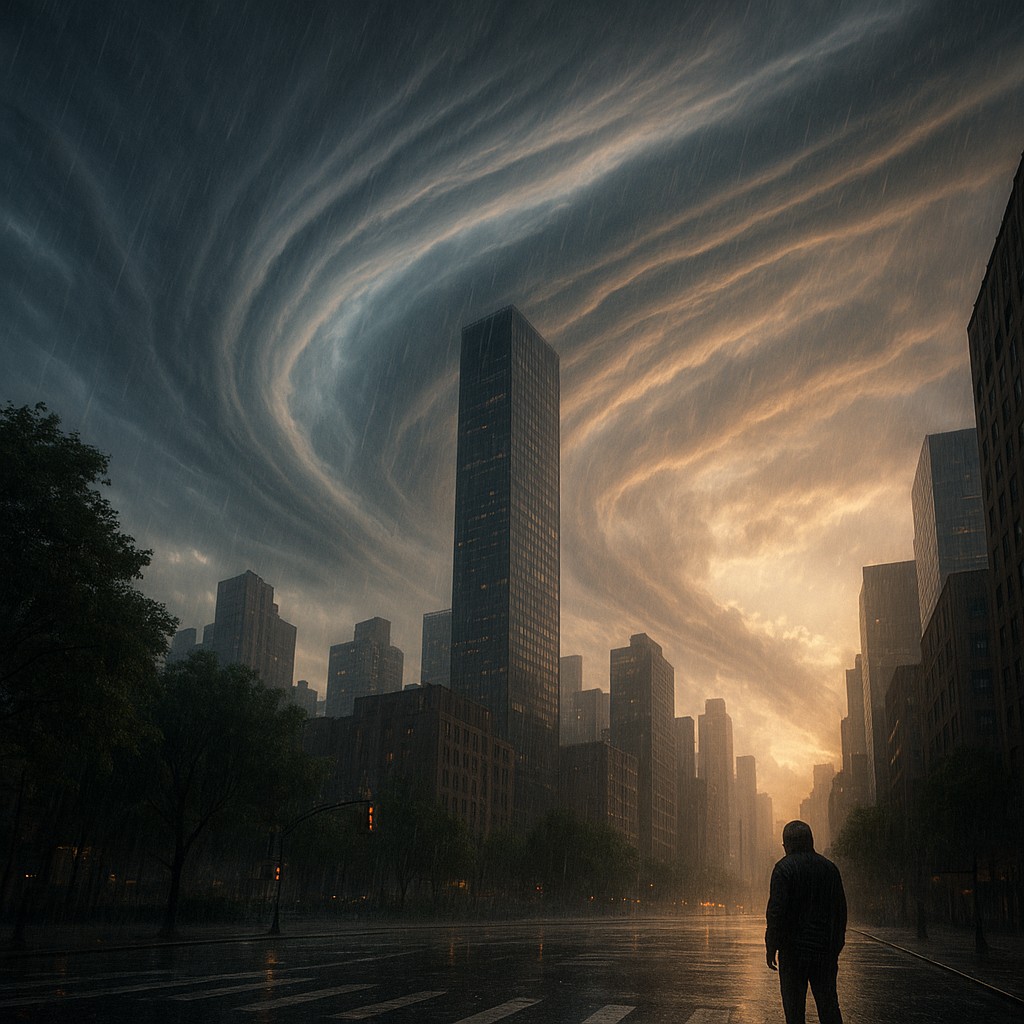
Imagine standing on a city sidewalk on a sweltering July afternoon. You feel a sudden, heavy dampness in the air - a thickness that makes the breeze feel less like a cooling relief and more like a warm, wet blanket. While we often focus on the "heat island" effect, where concrete and asphalt trap the sun's heat, there is a much more fluid and elusive force at play right above our heads.
Vast corridors of moisture, often called "flying rivers" or atmospheric rivers, constantly move water vapor across the globe. When these massive aerial currents hit the jagged, artificial landscapes of our cities, they create a complex local climate. This interaction affects everything from the intensity of a thunderstorm to how hard your air conditioner has to work.
These invisible giants are not just random clouds or general humidity. They are structured, long, narrow bands of concentrated moisture that carry more water than the Amazon River. When we talk about "urban" atmospheric rivers, we are looking at how these global giants are funneled, squeezed, and changed by the glass towers and sprawling pavement of our big cities. Understanding this science is for everyone - not just weather experts. It explains why one neighborhood can feel like a tropical rainforest while another, just five miles away, feels like a parched desert. It is time to look up and map the sky’s currents that dictate the rhythm of our daily lives.
The Massive Scale of the Sky's Hidden Plumbing
To understand what is happening over our cities, we first have to appreciate the sheer scale of atmospheric rivers (ARs) worldwide. These are not merely patches of damp air; they are the main conveyor belts of the planet's water cycle. At any given moment, about four or five of these rivers are active across the globe, usually stretching thousands of miles long but only a few hundred miles wide. They start in the tropics, where the sun’s intense heat evaporates massive amounts of seawater, and are then swept toward the poles by high-speed winds. They are the reason California gets its winter water and why Northern Europe stays green compared to other regions at the same latitude.
When an atmospheric river moves over land, it acts like a slow-motion tidal wave in the sky. If it hits a mountain range, the air is forced upward, cools down, and dumps its water as heavy rain or snow. However, cities act as a different kind of "mountain." A dense skyline of skyscrapers creates air turbulence, forcing these moisture-rich currents to swirl and stall. This interaction can trigger intense, local downpours that overwhelm city drains in minutes. Unlike a normal rainstorm that might pass over an entire state, the clash between an aerial river and city architecture can cause a "firehose effect." This is when one specific part of a city gets a month's worth of rain while the suburbs stay almost completely dry.
The Secret Chemistry of Sweat and Skyscrapers
While global rivers provide the moisture, the city itself provides the "spice" that changes how that moisture behaves. This brings us to the "urban moisture island" (UMI). You may have heard of the heat island effect, but the moisture version is just as important. In many cities - especially those with lots of parks or those located in humid tropical zones - the city can actually become wetter than the surrounding countryside. This happens because the "canopy" of the city (the air between the ground and the rooftops) traps moisture released by trees, decorative fountains, and even car exhaust.
However, the logic often flips in drier environments or heavily paved "concrete jungles." In these places, a lack of plants means there is no "breathing" or evaporation from leaves to cool the air. These cities can act as "dry islands," slicing through an incoming atmospheric river and creating a pocket of intensely dry, hot air. But whether a city is a moisture island or a dry island, having an atmospheric river overhead makes the local feeling much more intense. If the humidity is already high because of local parks, an aerial river acts like a lid. It traps that moisture and creates "humid heat," which is much more dangerous to human health than dry heat because it prevents our sweat from evaporating to cool us down.
Mapping the Differences Between Urban and Rural Moisture
It helps to visualize how these corridors of humidity change depending on the landscape they cross. The way moisture interacts with a forest is completely different from how it hits a grid of glass and steel. In nature, the ground soaks up water and plants regulate humidity through a slow, steady cycle. In a city, everything is sped up and redirected.
| Feature |
Rural/Forest Environment |
Urban Environment |
| Moisture Absorption |
High; soil acts as a giant sponge. |
Low; pavement causes immediate runoff. |
| Wind Interaction |
Smooth; moisture flows in broad sheets. |
Turbulent; buildings "shred" moisture flows. |
| Heat Influence |
Cooling through plant evaporation. |
Warming from asphalt heat; "lifts" moisture. |
| Rain Intensity |
Spread evenly over large areas. |
Concentrated; "firehose" effect from air swirls. |
| Humidity Drop |
Slow and predictable. |
Rapid shifts based on street layout. |
As the table shows, the city doesn't just receive weather; it actively reshapes it. Scientists have found that the heat rising from a city can actually "punch" a hole into a passing atmospheric river, causing it to split or grow stronger. This is known as "urban-induced convection." The heat from the streets acts like an invisible mountain of warm air, pushing the moisture in the aerial river higher into the sky. There, it hits colder temperatures faster, leading to those sudden, violent thunderstorms that seem to come out of nowhere on a muggy afternoon.
The Role of Urban Greenery in the Aerial Flow
There is a common myth that more trees in a city will always make it feel cooler. While trees provide vital shade, they also act as natural humidifiers. In the context of an atmospheric river, urban greenery plays two roles. During a dry spell, trees are lifesavers, releasing moisture and cooling the air. However, when an aerial river passes over, that extra moisture from the trees can combine with the high humidity to create a "sauna effect." This doesn't mean we should stop planting trees, but it does mean city planners must be very smart about "ventilation."
To manage these rivers of humidity, cities need "wind canyons." If buildings are packed too tightly without considering the winds that carry these atmospheric rivers, the moisture gets stuck. By designing streets that line up with natural air corridors, cities can "flush out" the extra humidity. This allows the aerial river to pass through without dumping all its energy and water onto a single neighborhood. This is the future of "bioclimatic" city design, where we treat the air not as empty space, but as a series of flowing rivers that need to be managed as carefully as our sewers and subways.
Debunking the Myths of the Invisible River
One common myth is that these "flying rivers" only affect coastal cities like Seattle or Vancouver. While coastal areas feel the first hit of an atmospheric river, these corridors can travel thousands of miles inland. A river of moisture starting in the Gulf of Mexico can travel all the way to Chicago or Montreal, fueled by a "low-level jet" - a fast-moving stream of air that acts as a highway for humidity. When this moisture hits the inland urban grids, the impact is often worse because these cities were not built to handle the tropical levels of moisture that are now becoming common.
Another misunderstanding is that moisture in the air is always "clean" water. In reality, atmospheric rivers act like giant vacuum cleaners. As they travel over oceans and industrial zones, they pick up dust and pollutants. When these rivers meet the "urban plume" (the mix of chemicals and heat rising from a city), they can create a unique form of chemical rain. The moisture allows nitrogen oxides from cars and sulfur dioxide from factories to react with each other. So, the "flying river" isn't just carrying water; it is delivering a complex chemical cocktail directly to our doorsteps.
Navigating the Future of Our Liquid Skies
Understanding atmospheric rivers changes the way we look at a cloudy day. It shifts our perspective from seeing "the weather" as a vague condition overhead to seeing it as a moving resource and a risk. As our planet warms, the atmosphere can hold more water - roughly 7 percent more for every degree Celsius of warming. This means the "aerial rivers" of the future will be wider, faster, and carry much more water. Our cities will be the main stages where the drama of this intensified water cycle plays out.
We are no longer just passive observers of the rain; we are the architects of the terrain that shapes it. By using "sponge city" designs that soak up extra water and "cool corridor" layouts that let the sky’s rivers flow freely, we can turn a potential threat into a manageable part of our environment. The next time you feel that heavy, humid air between the skyscrapers, remember that you are standing at the bottom of a vast, invisible river. Respect its power, marvel at its scale, and stay curious about the fluid world that connects our city streets to the furthest tropical seas. This awareness is the first step toward building cities that don't just survive the elements, but work in harmony with the planet's great, flowing cycles.