Why chromosomes are more fascinating than your favorite playlist
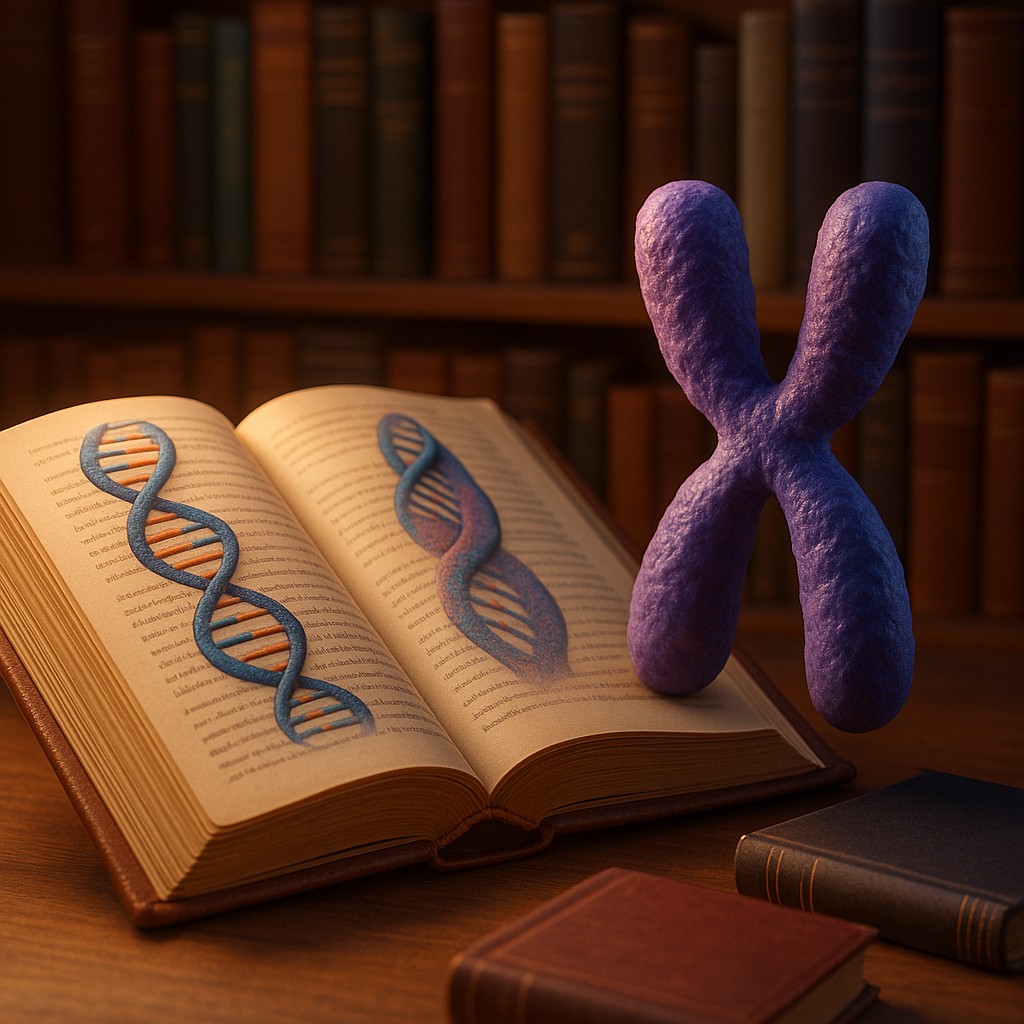
Imagine a cookbook so vast and precise that it contains the instructions to build and maintain every part of a human, from hair to neurons. That cookbook exists, and it is written in a chemical language. Chromosomes are the bound volumes of this inner library. Understand their role, and you understand how traits, diseases, and evolution are passed from one generation to the next.
Chromosomes are not mysterious objects reserved for labs and medical dramas. They are active in every one of your cells, from the beating of your heart to the repair of a cut on your finger. Knowing how they work helps you read genetic risk more clearly, interpret a genetic test, and, above all, appreciate the beauty of a system that blends stability and change.
In this text we will untangle what chromosomes are, how they do their jobs, what can go wrong, and why some common ideas need correcting. The tone will be clear and sometimes playful, but the science will stay rigorous, so you leave smarter and more confident.
Chromosomes: what you see when you zoom in on a cell
At the center of a cell is the nucleus, and inside that nucleus chromosomes appear when the cell prepares to divide. A chromosome is a structure made of long DNA and a set of proteins called histones, which help pack and organize that DNA. If all the DNA in a human cell were stretched out, it would measure several meters, but thanks to histones and other proteins, it fits into a microscopic space.
Each chromosome contains thousands of genes, which are DNA segments that code for proteins or regulatory elements. But chromosomes are more than gene containers. They organize DNA in the nuclear space, control when and how much each gene is expressed, and play an active role in faithfully transmitting genetic information during cell division. They are at once instruction manual, filing system, and conductor.
When a cell is not dividing, chromosomes do not look like distinct rods under a microscope; the DNA is instead in a loose form called chromatin. It is only during mitosis and meiosis that they condense into visible structures. That is why the classic rod-shaped image of chromosomes is accurate, but only at a specific moment in the cell cycle.
Why number and shape matter: chromosomes in humans
A normal human has 46 chromosomes, arranged in 23 pairs. Each pair includes one chromosome inherited from the mother and one from the father. Twenty-two of those pairs are autosomes, numbered 1 to 22 by relative size, while the 23rd pair consists of the sex chromosomes X and Y, which largely determine biological sex and influence other traits.
Having 46 chromosomes does not make an organism more "complex" than one with more DNA. Some plants and amphibians have far more DNA than humans, without being inherently "more advanced". What matters is organization, gene expression, and epigenetic regulation. The number and structure of chromosomes are important because they affect how information is passed on, gene balance, and cellular stability.
Sex chromosomes have special features: the X chromosome carries many genes not related to sex, while the Y is smaller and contains fewer genes. In females (XX), one of the two X chromosomes is largely inactivated to balance X-linked gene expression between the sexes, a process called X inactivation. In males (XY), a single active X is sufficient, and some Y genes are required for male development.
Main responsibilities of chromosomes: who does what
Chromosomes carry out several essential jobs. First, they store genetic information. Each gene is like a recipe coded in DNA; together, these recipes determine the phenotype, that is, an individual's visible and functional traits. Second, chromosomes ensure this information is copied accurately before a cell divides, using mechanisms of replication and repair.
Third, chromosomes orchestrate gene expression. They do not merely carry genes; they also control when, where, and how much genes are turned on. This regulation is crucial during embryonic development, cell differentiation, and stress responses. Chemical modifications of histones and the addition of methyl groups to DNA influence expression without changing the DNA sequence itself, a field called epigenetics.
Finally, a key responsibility is hereditary transmission. During meiosis, chromosomes reshuffle and segregate to create the reproductive cells - sperm and eggs - which carry a unique mix of parental information. This genetic mixing is the source of individual diversity and trait heritability.
Cell division: the big moment for chromosomes
Chromosomes play a central role when a cell divides, and the two main types of division are mitosis and meiosis. In mitosis, a somatic (nonreproductive) cell divides to produce two daughter cells identical to the parent, each containing the same chromosomal information. Mitosis is essential for growth, tissue repair, and cell replacement.
Meiosis, on the other hand, is the specialized division that produces reproductive cells. It halves the chromosome number, going from 46 to 23 in humans, and introduces genetic variation by exchanging segments between homologous chromosomes, a process called crossing-over. These mechanisms ensure every child is unique and inherits a combination of genes from both parents.
The table below summarizes the key differences between mitosis and meiosis, and explains why these distinctions matter for chromosome function.
| Aspect |
Mitosis |
Meiosis |
| Main purpose |
Repair and replacement, growth |
Produce gametes, generate genetic diversity |
| Number of divisions |
1 |
2 |
| Number of daughter cells |
2 |
4 |
| Chromosome number in daughter cells (human) |
46, identical to parent cell |
23, genetically different |
| Genetic exchange between homologous chromosomes |
No |
Yes, crossing-over |
| Biological role |
Maintenance of organism |
Reproduction and variation |
When chromosomes go off track: errors and consequences
Despite strict control mechanisms, errors can happen. Aneuploidy, meaning an abnormal number of chromosomes, is a common example. Trisomy 21, also called Down syndrome, results from an extra chromosome 21 and is one of the best-known chromosomal anomalies. Other examples include monosomy X (Turner syndrome) and XXY (Klinefelter syndrome).
Structural rearrangements can also occur: translocations (exchange of fragments between nonhomologous chromosomes), deletions (loss of a segment), duplications, or inversions. These anomalies can disrupt critical genes or regulatory regions, leading to genetic diseases, cancers, or developmental disorders. For example, certain types of leukemia are linked to specific chromosomal translocations.
Diagnostic technologies have evolved: classical karyotype analysis reveals large chromosomal changes, while finer methods like FISH and DNA microarrays detect smaller anomalies. Precise knowledge of chromosomal abnormalities guides medical follow-up, therapeutic options, and sometimes reproductive decisions.
Epigenetics: the voice that tells you when to read the books
A commonly misunderstood point is that DNA sequence is not the only factor. Epigenetics regulates access to genes, and therefore their expression. Chromosomes carry chemical marks on DNA and histones that can turn genes on or off. These marks are influenced by environment, diet, stress, and age, and some can be inherited across generations.
A famous example is X inactivation in female mammals. To balance X-linked gene expression between males and females, one of the two X chromosomes is condensed and largely silenced, forming a Barr body. This shows that chromosomes are not static objects; their structural and chemical state changes with context.
Epigenetics also explains why two people carrying the same genetic mutation can show very different symptoms. How chromosomes are "marked" and organized influences gene impact, making human biology both more complex and more flexible.
Common misconceptions and helpful clarifications
- Chromosomes are not visible all the time. They condense only at certain moments of the cell cycle, mainly during division. Outside those times, DNA exists as extended chromatin.
- A greater number of chromosomes does not mean a more evolved organism. Plants and some animals can have much more DNA, without a direct link to complexity.
- Genes are not isolated units: their expression depends on chromosomal and epigenetic context. Having a "gene for" something is not enough, the gene must be active at the right time and place.
- Genetic tests do not always read everything. Some tests detect only specific anomalies, and the absence of a detected anomaly does not guarantee the absence of any genetic disease. Interpretation often requires genetic counseling.
Handy memory aids to keep the essentials
Here are simple ways to lock these ideas into memory: picture a cookbook (DNA) shelved in a library (chromosomes) where each drawer contains recipes inherited from both parents. Think of histones as elastic bands and paper clips organizing the book. Finally, imagine mitosis as a faithful photocopy of the book, and meiosis as creating a new unique volume by mixing pages from both parental libraries.
A few quick, useful facts:
- 46 chromosomes in humans, 23 pairs.
- Chromosomes = DNA + proteins (histones).
- Mitosis = identical cells, meiosis = variation for reproduction.
- Epigenetics = chemical modifications that regulate gene expression.
When curiosity turns into action: what to do with this knowledge
Understanding chromosomes helps you make sense of scientific news, genetic tests, and medical discoveries. If you are a parent or future parent, this knowledge clarifies prenatal screening options. If you work in health, education, or communication, it gives you tools to explain complex topics clearly.
Most importantly, knowing how chromosomes work gives perspective on life's fragility and resilience: fragile because errors can cause disease, resilient because repair and regulation mechanisms exist that allow recovery, adaptation, and evolution. And that is encouraging.
One last inspiring note to keep your hands on the book
Chromosomes are both the memory and the workshop of a living being. They tell us where we come from, influence who we are, and help shape who we will become. By learning how they work, you do not just become more knowledgeable about biology; you gain a key to understanding health, disease, and the mystery of human variation. Keep your curiosity alive: asking questions about chromosomes, their organization, and their roles can lead to personal or professional discoveries, or simply renewed admiration for the quiet complexity at work in every one of your cells.