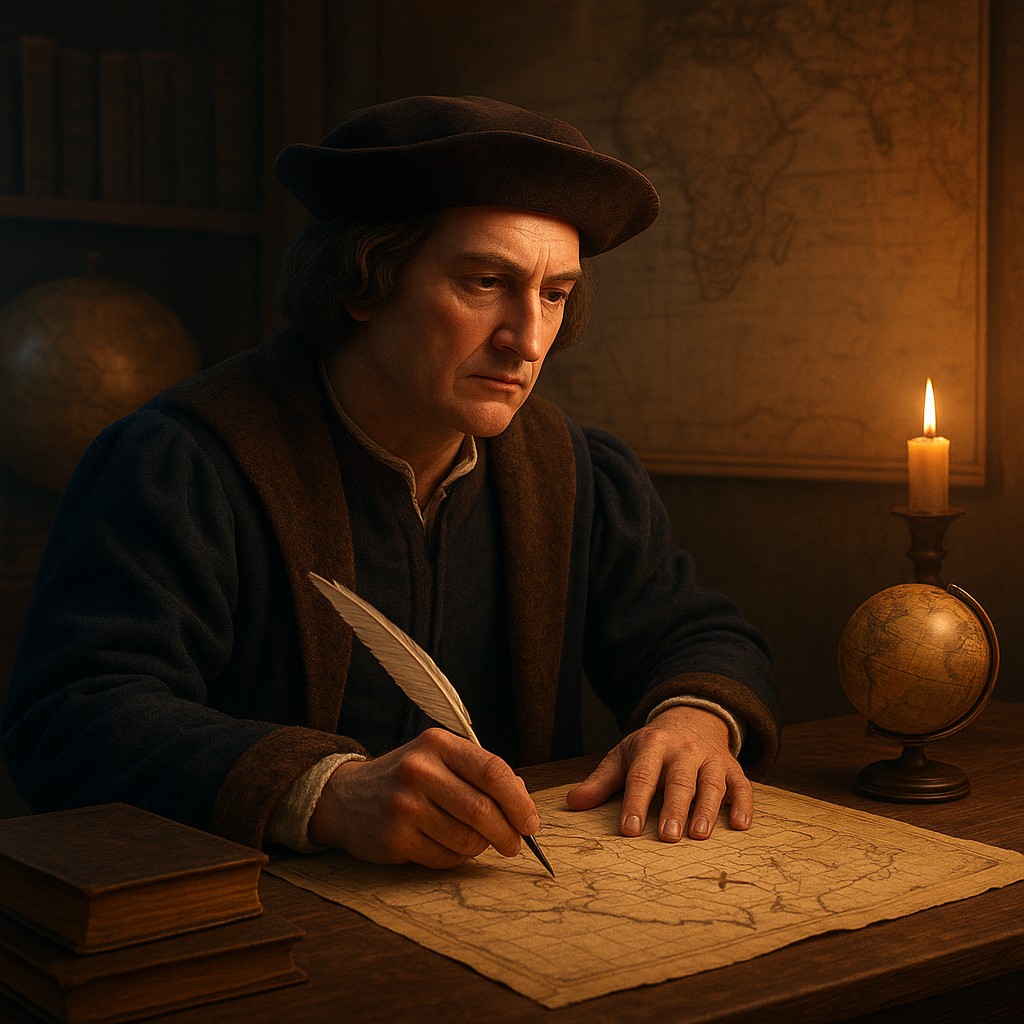
If you have heard that Christopher Columbus "proved the Earth was round," you have met one of history's most persistent myths. The true story is messier, more interesting, and sometimes more shocking than the neat bedtime tale. Columbus was not a lone genius battling medieval flat-earthers. He was a driven, ambitious sailor who mixed real nautical skill with risky guesses, political hustling, and a stubbornness that could wear down even patient monarchs.
His voyages linked continents and reshaped world history, but "linked" is not the same as "discovered." Complex societies already lived across the Americas. Europeans had reached North America before him (the Norse did, centuries earlier). And Columbus's trips set off consequences that were enormous and often catastrophic for Indigenous peoples. The full story holds two truths at once: his voyages were historically pivotal, and they were also the opening act of large-scale colonization, exploitation, and disease.
A Genoese kid with a sea-sized ambition
Christopher Columbus was born in 1451 in the Republic of Genoa (now part of Italy), into a working family tied to weaving and trade. Genoa was a maritime place where ships and markets shaped everyday life, so it is not surprising he turned to the sea. He spent his early years learning sailing, navigation, and trade the hard way — by working on ships where storms, pirates, and financial risk were part of the job.
By the 1470s and 1480s he moved into Portugal's orbit, probably spending time in Lisbon, the hub of European navigation. Portugal led Atlantic exploration then, sending ships down Africa's coast and to islands like Madeira and the Azores. Columbus married into a family with sea ties and soaked up the era's mix of commerce, religion, and exploration. Many Europeans wanted direct access to Asian goods like spices, silk, and precious metals, and they wanted to bypass land routes controlled by rivals and taxed at every stop. In that world, a sailor with a big idea could be either a visionary or an expensive mistake.
Columbus became convinced he could reach Asia by sailing west across the Atlantic. He was not trying to prove the Earth's shape; educated Europeans already accepted a spherical Earth. The real debate was about distance. How far was Asia if you sailed west? Columbus argued it was not too far, and that is where his plan moved from bold to dangerously optimistic.
The risky math behind "sailing west to Asia"
Columbus's plan depended on numbers: the size of the Earth and the width of the ocean. Ancient and medieval scholars had already produced estimates of Earth's circumference, and some were fairly close to the modern value. Columbus, however, favored a smaller Earth and a larger Asia, which made the Atlantic look narrower. That made his voyage seem doable with the ships and supplies of the time. Many experts, including advisers to monarchs, worried he had badly underestimated the distance and that a westward trip would run out of food and water long before reaching Asia.
This is a key correction to the popular story. The skeptics were not clinging to a cartoonish "flat earth." They were checking the math and thinking about the practical limits of 15th-century sailing. If Columbus had been forced to cross the full Pacific without knowing the Americas existed, the voyage would probably have been impossible with then-current ships and provisions.
So why did Columbus keep pushing? Partly because he believed it, partly because he needed it to be true, and partly because he treated doubt as an obstacle to be overcome. He pitched his plan for years, seeking a sponsor to fund ships, crews, and supplies. Portugal said no. Spain, newly united under Ferdinand and Isabella and just finished with the conquest of Granada in 1492, wanted an edge against Portugal.
Columbus negotiated hard. He wanted titles, a share of profits, and authority over any lands he found. That is an important point: this was not a purely scientific voyage. It was a business venture, a religious mission, and a political gamble tied together.
Spain says yes, and three ships roll into history
In 1492 Columbus finally won Spanish backing. He sailed with three ships commonly called the Niña, the Pinta, and the Santa María. (Strictly speaking, "Niña" and "Pinta" were nicknames, but the trio is the familiar image.) He left from Palos in August, stopped in the Canary Islands for repairs and resupply, and then pushed west into the open Atlantic with no friendly ports and no backup beyond turning around.
The crossing was tense. Sailors fretted about winds and food and the simple fear of getting lost. Navigation then used tools like the compass, the hourglass, dead reckoning (estimating position by speed and direction), and observations of the sky. Columbus kept logs, and evidence suggests he sometimes gave his crew different distance figures than he recorded for himself, perhaps to keep morale from collapsing. That is either clever leadership or nerve-racking management, depending on where you stood on the ship.
On October 12, 1492, they sighted land. Columbus named it San Salvador, in the Bahamas, though scholars still debate which island it was. He believed he had reached islands near Asia and called the local people "Indians," a label that stuck in European usage for centuries despite the geographic mistake. He explored parts of the Caribbean, including Cuba and Hispaniola, looking for gold, spices, and signs of wealthy Asian kingdoms. He found no palaces, but he did meet societies with their own trade networks, politics, and culture.
The Santa María ran aground near Hispaniola on Christmas 1492. Columbus used its timbers to build a small fort, La Navidad, and left some men behind. That moment shows how quickly exploration slid into occupation.
Four voyages, one stubborn belief, and a growing colonial machine
Columbus made four Atlantic voyages between 1492 and 1504. Each trip added to European knowledge of Caribbean geography and coasts, but Columbus read everything through the lens of Asia. Even as evidence grew that these lands did not match descriptions of China, Japan, or India, he stuck to his belief that he was near Asia or its islands. In a sense he was exploring with a conclusion already chosen, forcing reality to fit.
Here is a clear overview of the voyages and what they changed:
| Voyage |
Years |
Main regions visited |
Big outcomes |
| First |
1492-1493 |
Bahamas, Cuba, Hispaniola |
First sustained contact for Spain in the Caribbean, La Navidad established |
| Second |
1493-1496 |
Lesser Antilles, Puerto Rico, Hispaniola |
Large colonizing expedition, settlements expanded, conflict with Indigenous communities grew |
| Third |
1498-1500 |
Trinidad, northern South America, Hispaniola |
Reached South American mainland, political trouble in Hispaniola intensified |
| Fourth |
1502-1504 |
Central America (Honduras to Panama) |
Searched for a passage to Asia, shipwrecks and hardship, no route found |
The second voyage matters most because it was not a small scouting trip. It brought many more ships and people, including settlers, and turned "we visited" into "we are staying." That shift sharpened the consequences. Columbus and Spanish authorities demanded tribute, hunted for gold, and used violence to enforce control. Enslavement and forced labor became common, and European diseases spread. The population collapse in parts of the Caribbean over the next decades was devastating, driven by disease, violence, and exploitation.
Columbus became governor and viceroy in Spanish territories, but he was not a skilled administrator. Reports accused him of mismanagement and harsh rule, even toward Spanish settlers who protested his leadership. In 1500 officials arrested him and sent him back to Spain in chains. He was later released and allowed another voyage, but his political power never recovered.
He died in 1506 famous but without the secure, wealthy empire he had imagined, still believing he had reached Asia's outskirts. Meanwhile, other Europeans were putting the pieces together: these lands belonged to continents that were new to Europe.
The human story behind the headlines: skill, faith, greed, and fear
It is easy to turn Columbus into a simple symbol, either hero or villain. The fuller story is more useful and more uncomfortable. He was a real person with mixed motives and blind spots. He had real maritime skill. Surviving Atlantic crossings then demanded discipline, experience, and a willingness to bet your life on winds you could not control. He also had deep religious conviction and saw his voyages as part of a Christian mission.
At the same time, Columbus wanted status and wealth with a contractual intensity. He negotiated titles like "Admiral of the Ocean Sea" and a share of whatever profits came. That mattered because it shaped his actions on the ground: pushing for tribute, obsessing over gold, and treating people as resources. His letters and policies reflect a common European view of the time, where conquest and conversion were linked and Indigenous sovereignty was ignored.
If you want a memorable picture of Columbus, imagine a talented navigator with a salesman's persistence and a gambler's math. He could read wind and sea, but he also misread the world he sailed into, geographically and morally. That mix helped set off a historical chain reaction.
Clearing up the myths that cling to Columbus like barnacles
Columbus stories often bring a bundle of misconceptions. Dropping them does not make the story less interesting. It makes it truer.
The "Columbus proved the Earth was round" myth
Educated Europeans long accepted a spherical Earth. The real debate was the Earth's size and the distance to Asia going west. Columbus did not win a scientific argument about roundness; he won funding for a risky route based on contested estimates.
The "Columbus discovered America" myth
The Americas were not empty or waiting to be discovered. Millions lived there with civilizations, agriculture, trade, and politics. If you mean "first humans," people arrived tens of thousands of years earlier. If you mean "first Europeans," the Norse reached North America around the year 1000. Columbus's importance lies in starting sustained contact and colonization between Europe and the Americas, not in being the first person to show up.
The "He knew exactly what he was doing" myth
Columbus was confident, but confidence is not the same as being right. He believed he was near Asia for most of his life and forced his observations to fit that belief. Exploration often includes misunderstanding, and Columbus is a clear example.
The "It was just exploration" myth
From the second voyage on, the trips involved settlement, forced labor, and violent enforcement of Spanish claims. The "Age of Exploration" was also an age of conquest and empire-building, and Columbus's expeditions were part of that.
The collision of worlds and the start of the Columbian Exchange
Columbus's voyages helped trigger what historians call the Columbian Exchange, the large transfer of plants, animals, people, and pathogens between the Eastern and Western Hemispheres. That exchange reshaped diets, economies, and environments. It sounds abstract until you see how it changed what's on your plate.
Foods from the Americas like potatoes, tomatoes, maize (corn), and cacao spread widely and transformed cuisines and farming. Europe and Africa introduced wheat, sugarcane, horses, and cattle to the Americas. Along with these goods came diseases such as smallpox, measles, and influenza, to which Indigenous peoples had little immunity. The result was staggering mortality in many regions. That demographic collapse then made colonization easier, a grim feedback loop.
This period also ties to the rise of the transatlantic slave trade. As Indigenous labor systems were exploited and populations fell, European colonies increasingly turned to enslaved Africans, creating a racialized system of forced labor that shaped centuries of history. Columbus did not invent these systems alone, but his voyages helped open the door to them and offered early models of conquest and extraction.
What Columbus's story teaches us about history itself
Columbus's life is not just about a man and some ships. It shows how history works. Big outcomes can flow from small decisions, bad assumptions, and practical limits like food storage. A single successful crossing, aided by luck and skill, can rearrange political maps and human lives.
It is also a lesson in perspective. For Columbus and his sponsors, the voyages were about routes, wealth, and prestige. For Indigenous communities, they were the start of invasion, upheaval, and loss. Both views are part of the same event, and understanding the full story means refusing to tell it only from the deck of the ship.
Finally, Columbus shows how myths form because they are convenient. A tidy tale about "proving the world is round" lets people praise courage without facing colonization or slavery. The real payoff comes from facing complexity. History is not a trophy case of heroes. It is a record of choices and consequences.
A clearer way to remember Columbus, without flattening the truth
If you want a simple model that still respects complexity, try this:
- Columbus was a skilled navigator and relentless self-promoter.
- He proposed sailing west to reach Asia, based on underestimated distances.
- He reached Caribbean islands and later parts of the American mainland, but misidentified them as Asia-related.
- His voyages started sustained European colonization in the Caribbean.
- The consequences included a global exchange of crops and animals, and also disease, violence, and systems of exploitation.
That list is not meant to settle an argument at dinner. It is meant to anchor the story in reality so you can add more detail later.
Walking away smarter than the myths
Columbus's story endures because it sits at a hinge: medieval and modern, local and global, ocean and empire. Reading it carefully upgrades you from a postcard to a full documentary. You start seeing the negotiations, the bad assumptions, the human cost, and the way power and profit steer "adventure."
If you take one thing away, let it be this: understanding Columbus is not about choosing praise or condemnation like scorecards. It is about seeing how a set of voyages could be both a feat of navigation and the start of deep injustice. When you can hold both sides without flinching, you are not just learning about Columbus. You are learning how to read history — curious, critical, and brave enough to prefer truth over a fairy tale.