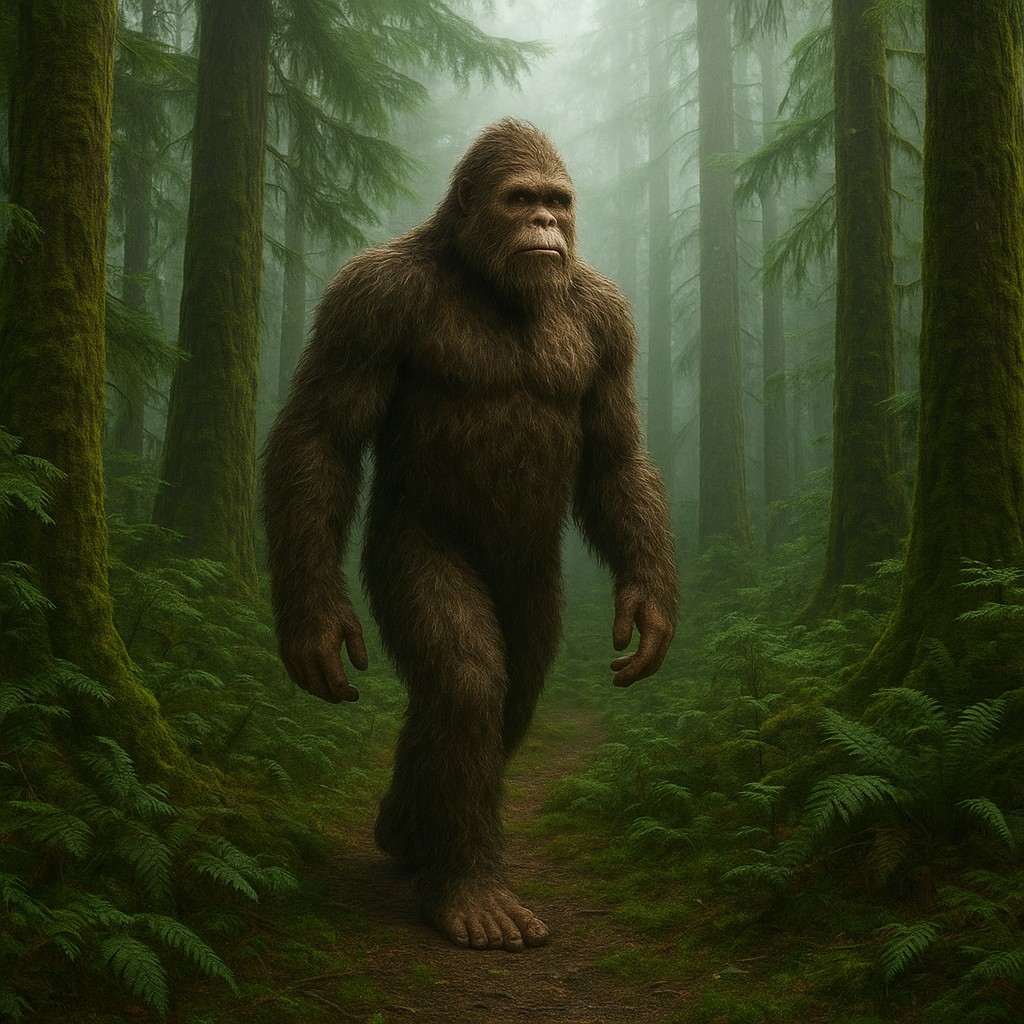
In the dense, emerald corridors of the Pacific Northwest, where mist clings to Douglas firs like a damp wool blanket, a giant is said to roam. He goes by many names - Sasquatch, the Woodman, or, most famously, Bigfoot - and he occupies a unique space in our collective imagination. He is the ultimate hide-and-seek champion, a creature that bridges the gap between prehistoric relic and modern myth. While some dismiss him as nothing more than a guy in a cheap gorilla suit or a misidentified black bear, the sheer volume of stories, footprints, and blurry photographs suggests that something is deeply rooted in our culture that refuses to let the legend die.
The fascination with this towering, two-legged primate is more than just a hobby for people in camouflage hats, it is a window into how humans process mystery. We live in an age where every inch of the globe can be mapped by satellites, yet we still crave the idea that something wild and undiscovered remains in the shadows. To understand the legend of Bigfoot, one must look past the grainy film reels and dive into a rich tapestry of Indigenous oral histories, 19th-century frontier accounts, and the peculiar cocktail of 1950s pop culture that turned a regional folk character into a global superstar.
Ancient Origins and the Wisdom of the First Nations
Long before the era of viral videos, the Indigenous peoples of North America shared stories of massive, hairy beings that lived deep within the wilderness. For many tribes, these were not monsters in the Hollywood sense, but rather "protectors" or "wild men" who coexisted with humans at the edge of the known world. In the Halkomelem language of southwestern British Columbia, the word Sásq’ets literally translates to "wild man," which eventually morphed into the English word Sasquatch. These entities were often seen as spiritual beings or a separate race of people possessing great strength and the ability to vanish into the forest as if by magic.
In the legends of the Sts'ailes people, Sasquatch is a noble figure, a shapeshifter that can move between physical and spiritual realms. Other tribes, such as the Hoopa of California, told stories of the Oh-Mah-Ah, creatures who left enormous tracks and lived high in the mountains. Unlike modern hunters who seek to capture the beast on film, these early cultures viewed the creature with a mixture of respect and caution. The tales served as both a moral guide for living in harmony with nature and a practical warning about the dangers of the deep woods. By the time European settlers arrived, the groundwork for the Bigfoot legend was already laid in the soil of the continent.
The Mid-Century Boom and the Birth of a Media Icon
The modern version of Bigfoot truly blasted into the public consciousness in the late 1950s. While there had been newspaper reports of "Ape-Men" and "Wild Men of the Woods" throughout the 1800s, it took a specific event in 1958 to give the creature its catchy nickname. A construction crew working on a new road in Bluff Creek, California, arrived at their site one morning to find massive, 16-inch human-like footprints circling their bulldozers. The foreman, Ray Wallace, reported the tracks to the local newspaper, the Humboldt Times, which coined the term "Bigfoot." The story was picked up by national wire services, and a sensation was born overnight.
Interestingly, decades after his death, Ray Wallace’s family claimed that the patriarch had carved wooden feet and used them to prank his workers. While this cast a shadow of doubt over the origin of the name, it did nothing to slow the momentum of the mystery. By the 1960s, the Pacific Northwest had become a magnet for amateur adventurers and serious naturalists alike. They were not just looking for a prankster; they were looking for a biological reality. This era transformed a series of disjointed folk tales into a focused pursuit, complete with its own investigative techniques and burgeoning pseudo-science.
Analyzing the Infamous Film of 1967
If there is a single "Holy Grail" in the world of Bigfoot research, it is undoubtedly the Patterson-Gimlin film. Shot in October 1967 at the same Bluff Creek location where the legend began, the 59-second clip shows a large, hairy figure walking with a distinctive gait through a sunlit clearing. For decades, this footage has been the subject of intense debate among primatologists, Hollywood special effects artists, and skeptics. The figure, often affectionately called "Patty," stops to look back at the camera before calmly disappearing into the brush.
The film is remarkably difficult to debunk definitively. Critics argue that it is simply a man in a costume, but supporters point to the creature's fluctuating muscle under the fur and its unique, non-human walk. High-definition scans of the original film allegedly show anatomical details that would have been nearly impossible for a costume designer to replicate in the late 1960s. Whether it is a masterful hoax or the most incredible wildlife footage ever captured, the film remains the centerpiece of the Bigfoot debate. It gave the world a visual reference point, turning a vague idea of a monster into a specific, recognizable being.
Comparing High-Profile Evidence Categories
To understand how researchers evaluate the "proof" of Bigfoot, it helps to look at the different types of evidence that regularly surface. While no "smoking gun" like a skeleton or a live specimen exists, the cumulative body of work is surprisingly diverse.
| Evidence Type |
Pros |
Cons |
| Footprint Casts |
Provide physical data on weight, toe movement, and dermal ridges (skin patterns). |
Can be faked with wood carvings or shaped by natural erosion of smaller tracks. |
| Patterson-Gimlin Film |
Shows clear movement, body proportions, and muscle dynamics. |
Blurry quality by modern standards; possibility of a high-end costume. |
| Audio Recordings |
"Samurai chatter" or high-pitched screams that do not match known local animals. |
Difficult to localize; could be distorted sounds from wind, owls, or coyotes. |
| Hair & DNA Samples |
Allows for scientific laboratory analysis and genetic sequencing. |
Most samples test as bear, cow, dog, or human; environmental degradation is common. |
| Eyewitness Testimony |
Thousands of reports from credible professionals like pilots and park rangers. |
Human memory is famously fallible, especially during high-stress encounters. |
The Biological Debate and Ecological Feasibility
From a scientific perspective, the existence of a seven-to-nine-foot-tall ape in North America faces significant hurdles. Zoology dictates that any species requires a "minimum viable population" to survive. This means there would need to be thousands of Bigfoots scattered across the continent to ensure genetic diversity and reproduction. If thousands of these creatures exist, skeptics ask, why haven't we found a single bone, a carcass, or a fossil? Furthermore, a creature of that size would require a massive amount of calories, necessitating a vast roaming range and frequent interactions with human infrastructure.
However, proponents of the "Relict Hominoid" theory argue that the North American wilderness is far larger and more rugged than most people realize. Millions of acres of forest in places like the Great Bear Rainforest or the Olympic Peninsula are nearly impassable for humans. They suggest that Bigfoot could be a descendant of Gigantopithecus blacki, a massive, extinct ape from Asia that might have crossed the Bering Land Bridge during the last Ice Age. According to this theory, Sasquatch is not a magical spirit, but a highly intelligent, nocturnal, and elusive primate that has evolved to avoid detection by humans, much like the mountain gorilla remained hidden from Western science until 1902.
Deconstructing Hoaxes and Misidentifications
In any field where the stakes are high and the evidence is scarce, hoaxes are inevitable. The Bigfoot community has been burned many times by people seeking fame or personal gain. In 2008, two researchers claimed they had a Bigfoot body in a freezer, only for it to be revealed as a rubber suit stuffed with frozen animal parts. These incidents often dominate the headlines, making it easy for the public to dismiss the entire subject as a joke. Yet, for many dedicated investigators, these hoaxes are just noise that needs to be filtered out to find the genuine anomalies beneath.
Misidentification is perhaps an even greater challenge than intentional fraud. The human brain is hardwired for "pareidolia," a phenomenon where we see familiar patterns, such as faces or human figures, in random data. In a dark, shadowy forest, a rotting cedar stump can easily look like a hunched-over giant. A black bear standing on its hind legs to get a better view of its surroundings looks remarkably like a hairy man in a suit. By understanding these psychological pitfalls, serious researchers try to apply a higher standard of "proof" to sightings, often discounting any report that does not include multiple points of corroboration.
Why the Legend Persists in a Digital World
In an era where everyone carries a high-definition camera in their pocket, one might expect the Bigfoot mystery to have been solved by now. If anything, the mystery has only deepened. Some suggest that the creature’s absence from clear digital photography is proof of its non-existence, while others believe that the forest is simply too vast and the creature too clever. But the real reason Bigfoot stays relevant is not just about biology; it is about our psychological need for the "Other." He represents the untamed wilderness that we have largely conquered and paved over.
Bigfoot lives in the "liminal space" between what we know and what we fear. He is a reminder that despite our technology and our skyscrapers, we are still small in the face of the natural world. Whether he is a flesh-and-blood animal or a modern myth, the legend of Bigfoot serves as a campfire story for a scientific age. It keeps the woods feeling mysterious and reminds us to look a little closer at the shadows when the sun begins to set. As long as there are unexplored corners of the map and things that go bump in the night, the legend of the great ape will continue to walk among us.
The search for Sasquatch is a testament to the human spirit of curiosity and our refusal to believe that all the world’s secrets have been revealed. Whether you are a staunch skeptic or a dedicated believer, there is a certain magic in the idea that a giant could be watching from the treeline, just out of sight. That sense of wonder is a rare and precious thing in our modern lives, and it encourages us to go outside, hike the trails, and keep our eyes open. So, the next time you find yourself deep in the woods, listen closely to the silence - you might just hear the crack of a branch and wonder if the legend is truly just a legend after all.