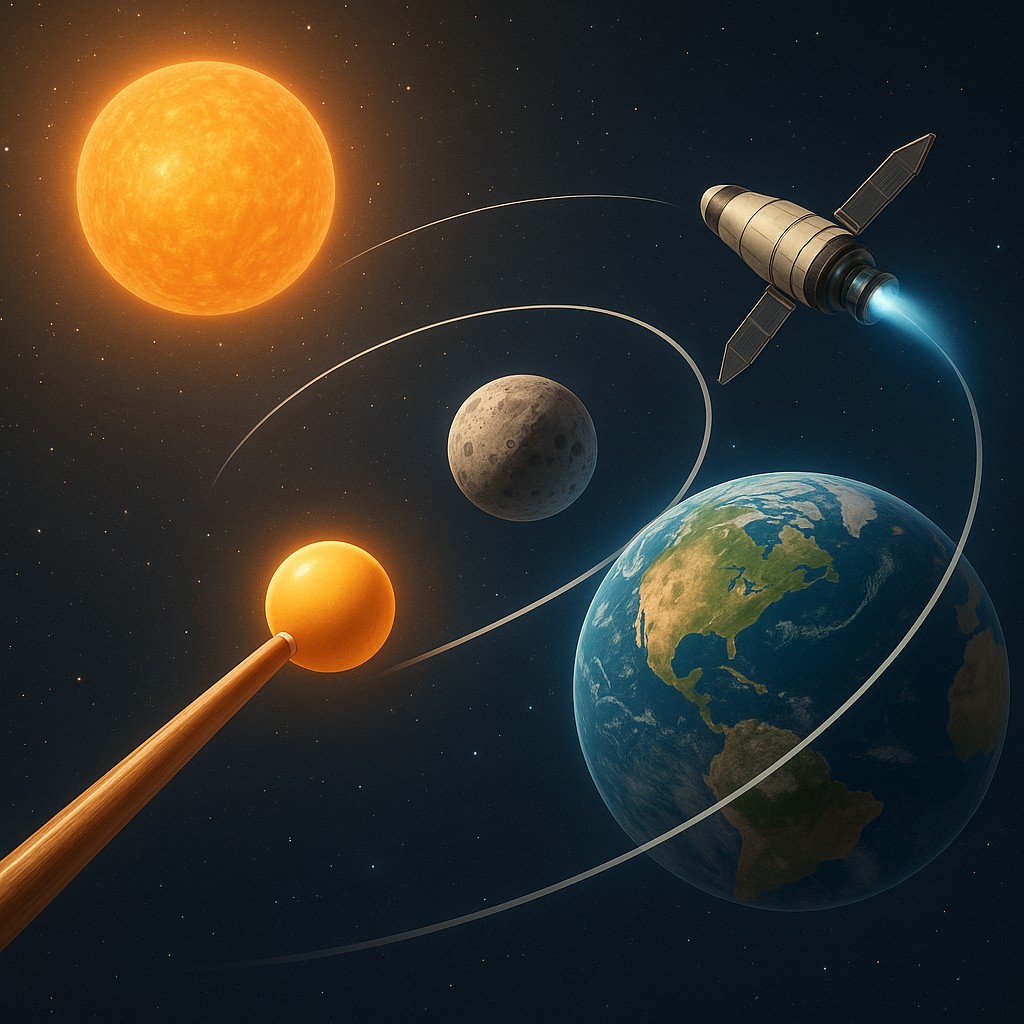
Imagine trying to parallel park a car, but instead of using the engine, you rely solely on the gentle slope of the driveway and the precise timing of a passing gust of wind. In the vacuum of space, weight is the ultimate enemy. Every gram of fuel added to a rocket requires more fuel to lift that additional weight, creating a vicious cycle of mass that makes sending anything beyond our atmosphere an engineering nightmare. To escape this trap, space agencies like NASA have stopped trying to brute-force their way through the solar system and have started playing a much smarter game of celestial billiards.
The Artemis missions represent the pinnacle of this shift in thinking, moving away from simple, high-thrust travel toward a sophisticated choreography of orbital mechanics. By treating the Moon not just as a destination but as a dynamic engine, engineers are effectively turning gravity into a free accelerator. This approach treats space travel as a puzzle of timing rather than a contest of raw horsepower. When we look at how these spacecraft navigate, we are witnessing a transition from the era of heavy-duty transport to the age of elegant, momentum-driven navigation.
The Celestial Game of Energy Exchange
At its most fundamental level, a gravity assist is a trade. It may look like a spacecraft is catching a free ride, but physics demands a balanced ledger. When a spacecraft performs a flyby around a planet or the Moon, it enters the object's gravitational sphere of influence and is pulled toward it. As the craft approaches, it accelerates; as it pulls away, the gravity of the body attempts to slow it down. If the spacecraft were stationary, it would simply be pulled in and then tugged back, resulting in no net gain.
The secret revealed by orbital mechanics is that the Moon itself is hurtling through space at thousands of miles per hour. As the spacecraft swings around the back of the Moon in the direction of its motion, it effectively steals a tiny, infinitesimal fraction of the Moon's orbital momentum. The spacecraft gains speed relative to the Sun, while the Moon loses an impossibly small amount of energy. Because the Moon is so incredibly massive, this loss is completely undetectable, but for a lightweight ship like the Orion capsule, that energy boost is equivalent to thousands of kilograms of wasted rocket propellant.
Precision Timing as a Fuel Substitute
Navigation today is closer to fine art than automated driving. The Artemis trajectory relies on what is known as a free-return trajectory, which requires the spacecraft to be placed in an exceptionally precise corridor in space. If the launch window is missed by even a few minutes, the geometric alignment between Earth and the Moon shifts enough to invalidate the plan. You cannot simply hit the gas pedal to catch up because you lack the fuel to compensate for a missed orbital rendezvous.
This creates a rigid structure for space exploration. Mission planners must analyze thousands of potential trajectories, each accounting for the gravitational pull of the Earth, the Moon, and even the Sun. The chosen path acts like an invisible track in the vacuum. Once the spacecraft is on that track, it is essentially falling through space along a preordained curve. We are essentially building a highway out of gravity, where the entrance ramp is a precisely timed burn that sets the spacecraft on a collision course with the Moon's shadow, turning the craft's arrival into a high-speed exit toward its next destination.
The Arithmetic of Interplanetary Travel
To understand why this is necessary, consider the difference between chemical propulsion and gravitational maneuvers. Chemical rockets provide high thrust but have very low specific impulse, meaning they run out of energy quickly. Gravity assists provide a slow, steady boost that costs nothing in terms of hardware wear or mass. The following comparison highlights the trade-offs that mission architects face when designing deep-space trajectories.
| Metric |
Chemical Propulsion |
Gravity Assist (Orbital Mechanics) |
| Energy Source |
Stored onboard chemical propellant |
Kinetic energy of celestial bodies |
| Mass Penalty |
High (fuel needs to carry fuel) |
Zero (uses existing orbital energy) |
| Flexibility |
High (can burn at any time) |
Low (requires precise launch windows) |
| Complexity |
Moderate (engine firing sequences) |
High (requires complex trajectory math) |
| Primary Utility |
Launch and precise docking |
Long-range travel and acceleration |
The inherent trade-off is clear. If you want to go anywhere on demand, you need a massive amount of fuel, which effectively makes you too heavy to move quickly. If you want to reach the outer reaches of the solar system or establish a long-term presence on the Moon, you must adopt the gravity-reliant model. We are trading total freedom of movement for the efficiency required to sustain a presence in deep space.
Misconceptions of the Space Sling
One of the most persistent myths in popular science is that a gravity assist is like a slingshot pulling an object around a wall. People often imagine the spacecraft "bouncing" off the surface, but there is no contact involved. In reality, the spacecraft never gets anywhere near the physical surface of the Moon or a planet if it can help it. If a craft were to get too close, it would risk atmospheric drag or accidental collisions, both of which are catastrophic at the speeds involved in interplanetary travel.
Another common misunderstanding is that the spacecraft exits the assist at a random speed. The beauty of the mechanism is that its exit velocity is highly predictable based on the angle of approach. By adjusting the periapsis, or the closest point of approach during the flyby, mission controllers can determine exactly how much energy is transferred. If they want a sharper turn, they bring the craft closer; if they want a smaller boost, they steer further out. It is a dial, not a binary switch, allowing for granular control of the craft's trajectory toward its next goal.
Designing the Future of Orbital Logistics
As we look toward sustaining a permanent lunar outpost, these techniques will evolve from curiosity-driven exploration to routine logistical operations. We are already seeing the development of automated flight software that can calculate these trajectories in real time, allowing spacecraft to adjust their flight paths with minimal human intervention. This moves the bottleneck away from ground-based control rooms and onto the ship itself, which is vital once communication delays reach the scale of minutes.
The mastery of this craft is essentially the mastery of patience. In deep space, speed is not found in the roar of an engine, but in the silence of an empty corridor of space where gravity does the heavy lifting. By aligning our path with the natural rhythm of the planets, we are learning to stop fighting the universe and start working with it. Every mission that uses a gravity assist stands as a testament to the fact that intelligence can often achieve what sheer kinetic force cannot.
When you look up at the night sky, you are no longer looking at static dots against a velvet backdrop. You are looking at a complex, moving map of potential paths, where every planet and moon is a gate waiting to be unlocked. The next time you see news of an Artemis mission, remember that the ship is not just flying from point A to point B. It is participating in a grand, gravitational dance that has been playing out for billions of years, and we have finally learned the steps. Explore with the confidence that the universe provides the energy, as long as you have the vision to time your journey correctly.