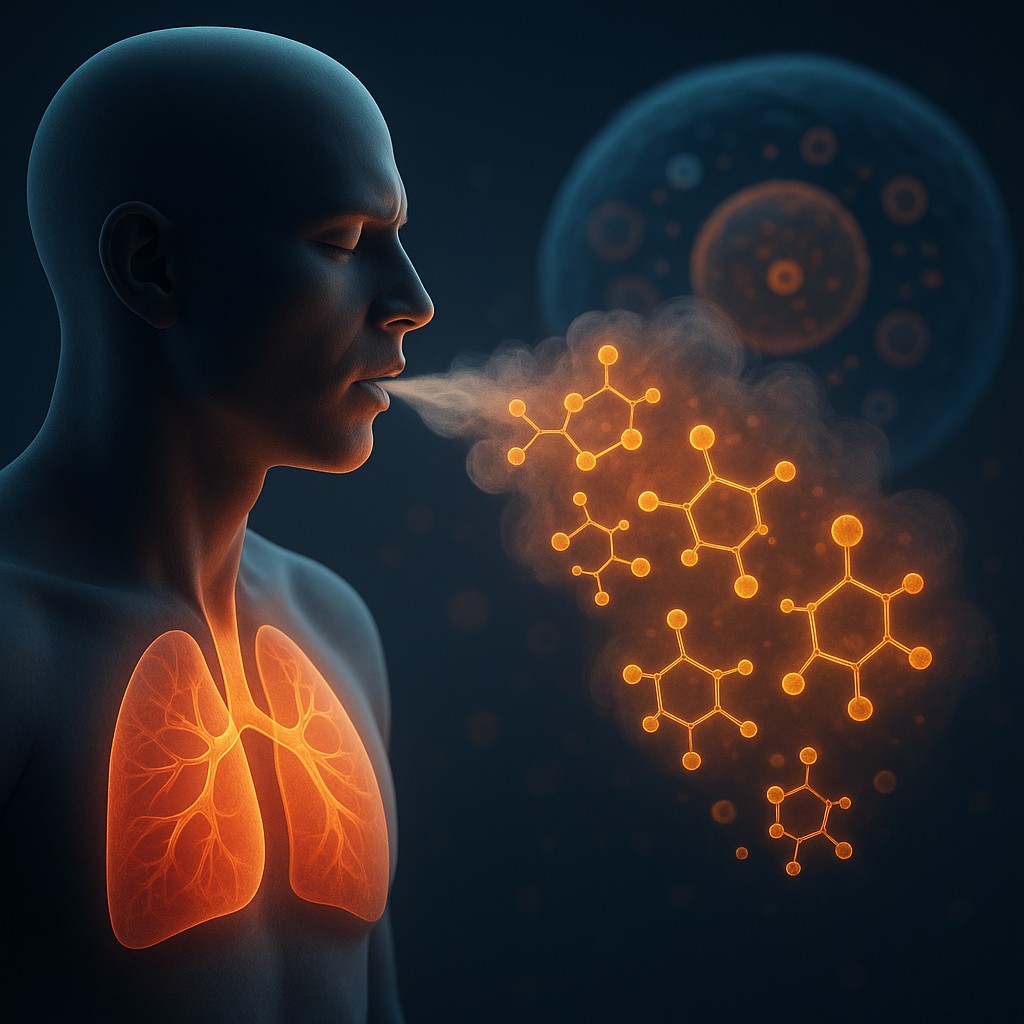
Imagine your body is a massive, complex chemical factory that never stops running. Inside, millions of workers, your cells, are busy processing fuel, building structures, and disposing of waste. When these workers are healthy, the factory chimneys emit a specific, predictable scent. However, if a few workers go rogue and start building something they shouldn't, like a tumor, they change the entire factory's recipe. They begin using different raw materials and churning out strange, exotic waste products that do not belong in a healthy system.
These tiny chemical byproducts are known as Volatile Organic Compounds, or VOCs. Because these molecules are incredibly small and "volatile," meaning they evaporate easily at room temperature, they leak out of the rogue cells and hitch a ride in your bloodstream. When that blood reaches your lungs to trade carbon dioxide for oxygen, these tell-tale gases hop across the membrane and into your breath. Right now, as you read this, your breath contains a chemical autobiography of everything happening deep inside your tissues. Researchers are finally learning how to read the chapters that describe the very earliest stages of cancer.
The Invisible Fingerprints of Cellular Malfunction
To understand how a breath test could replace a surgical biopsy, we have to look at the unique "smell" of a cancer cell. Every cell in your body has its own metabolism, which is essentially a series of chemical reactions that keep it alive. Cancer cells, however, are notoriously greedy and inefficient. They consume glucose at an incredible rate and prioritize rapid growth over everything else. This altered metabolism creates a "chemical signature" that is distinct from healthy tissue. While a tumor might be far too small to see on an X-ray or feel by hand, it is already pumping out these metabolic gases from day one.
The challenge is that these gases are present in your breath in vanishingly small amounts. We are talking about concentrations measured in parts per billion or even parts per trillion. To put that into perspective, it is like trying to find a single specific grain of sand in a giant swimming pool filled with billions of other grains. For decades, technology simply wasn't sensitive enough to catch these whispers. But thanks to advances in nanotechnology and chemical sensing, we are moving from an era of "looking" for cancer with cameras to "smelling" it with sensors.
High-Tech Noses Inspired by Nature
The "lab-on-a-chip" devices currently in development use a variety of clever tricks to catch these fleeting molecules. One of the most promising methods involves mats made of gold nanoparticles. These tiny particles are coated with specific organic layers that act like molecular "velcro." When a specific VOC associated with a disease hits the sensor, it sticks to the gold, causing a measurable change in electrical resistance. By arranging several of these sensors in a row, scientists create an "electronic nose" that can recognize a pattern of chemicals rather than just one.
Another heavyweight tool in this field is the mass spectrometer. This device works by smashing molecules into fragments and weighing them with extreme precision. If you breathe into a mass spectrometer, it can identify every single molecule in your breath based on its mass and charge. While these machines used to be the size of a refrigerator and cost more than a house, they are becoming smaller and more automated. The goal is to create a tabletop device that a family doctor could keep in the office, allowing for a "liquid biopsy" of the air every time a patient comes in for a checkup.
Navigating the Background Noise of Daily Life
If detecting cancer were as simple as finding one specific molecule, we would have had these tests years ago. The real world, however, is very "loud" in a chemical sense. Your breath isn't just a product of your internal cells; it is influenced by what you ate for breakfast, whether you brushed your teeth, the perfume you are wearing, and even the exhaust fumes from the bus you passed on your way to the clinic. This "background noise" can easily drown out the faint signal of a developing tumor.
Because of this, researchers have to be incredibly careful about how they collect samples. Some trials require patients to breathe into a specialized bag that filters out the "dead space" air from the throat and mouth. This allows doctors to focus only on "alveolar air," the air from deep in the lungs that has come directly from the blood. Sophisticated machine learning algorithms then sift through the data. These AI systems are trained to ignore the chemical signature of a cup of coffee or a piece of garlic bread and focus exclusively on the patterns that suggest cellular distress.
| Feature |
DNA/Needle Biopsy |
Traditional Imaging (CT/MRI) |
Breath-Based Biopsy |
| Invasiveness |
High (Requires tissue removal) |
Low (Non-invasive) |
Minimal (Just breathing) |
| Radiation Risk |
None |
Moderate (for CT scans) |
Zero |
| Detection Timing |
After tumor is formed |
Often after tumor is visible |
Potentially at the cellular start |
| Patient Comfort |
Low (Pain and recovery) |
Moderate (Claustrophobia) |
High |
| Primary Limitation |
Risk of infection or bleeding |
Hard to find tiny masses |
Environmental chemical noise |
From Detection to Daily Monitoring
The potential for breath testing goes far beyond a first diagnosis. One of the most stressful parts of being a cancer survivor is the "scanxiety" that comes with regular follow-up appointments. Currently, patients often have to undergo repeated CT scans to ensure their cancer hasn't returned, which exposes them to cumulative doses of radiation. A breath test could potentially serve as a frequent, safe monitor. If the "smell" of the cancer starts to reappear, doctors could intervene months before a tumor would show up on a traditional scan.
Furthermore, this technology could help doctors choose the right treatment. Not all cancers of the same type react to the same drugs. By analyzing the VOCs a specific tumor produces, doctors might be able to identify its genetic subtype without ever having to cut into the patient. This would allow for "precision medicine" tailored to the specific chemical fallout of a person's unique condition. It moves the entire field of oncology away from a "one size fits all" approach and toward truly listening to what the body is saying.
Closing the Global Health Gap
One of the most exciting aspects of breath-based diagnostics is its potential to bring healthcare to everyone. In many parts of the world, expensive MRI machines and pathology labs are simply not available. In these regions, cancer is often diagnosed only when it is very advanced, making it much harder to treat. A portable, relatively inexpensive breath-testing device could change that. Because the basic supplies for a breath test, like a disposable mouthpiece, are cheap, it could be used for mass screening in rural villages or community clinics.
Imagine a world where a mobile health van could visit a remote area and screen hundreds of people in a single day just by having them exhale into a tube. By identifying high-risk individuals early, healthcare systems can save millions of dollars in treatment costs and, more importantly, save countless lives. The goal isn't just to make a more advanced sensor; it is to make one robust enough to work in a dusty environment or a humid climate, providing life-saving data to people who currently have no access to early screening.
The Future of the "Annual Exhale"
As we get better at distinguishing between the "smoke" of a disease and the "steam" of a healthy body, the annual physical exam might look very different. Instead of the cold, sharp prick of a needle, your doctor might simply hand you a tube and ask you to take a deep breath. This shift represents a move toward proactive medicine. We are learning that the body is constantly communicating its status; we just had to build the right microphones to hear the message.
The journey from a laboratory curiosity to a standard medical tool is long and filled with clinical trials and regulatory hurdles. However, the science is clear: our metabolism doesn't lie. By capturing the volatile whispers of our cells, we are opening a door to a future where cancer is caught so early that it becomes a manageable hurdle rather than a terrifying crisis. It's a reminder that sometimes the most profound medical breakthroughs aren't found in a complex surgery, but in the simple, rhythmic act of breathing.