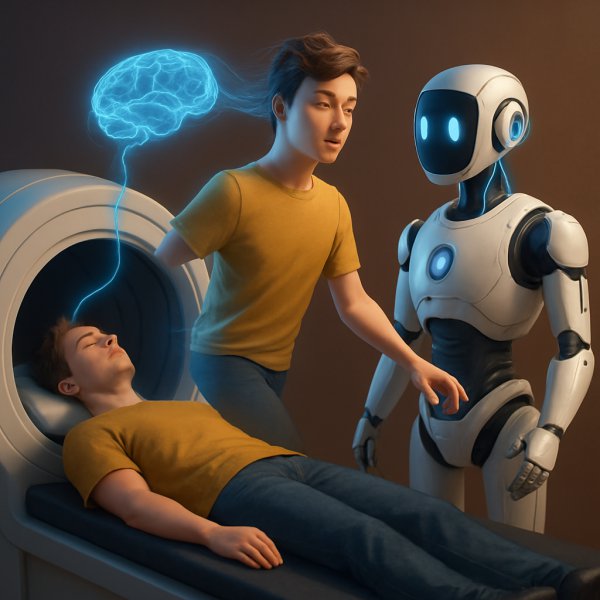
<h2>Imagine stepping out of your body and into a machine - could we really upload our minds?</h2>
The idea of copying your mind into a computer has long been the stuff of science fiction, from gleaming spaceship vaults to the anonymous cloud. Picture this: you lie down for a scan, a machine reads every crease of neural wiring, the pattern is translated into software, and a digital you wakes up in a virtual world or a robot body - preserved, uninterrupted, immortal. It is an image that thrills, terrifies, and puzzles us because it touches on identity, technology, and what it means to be conscious.
That picture is seductive because it compresses several hard questions into one simple promise: transfer equals continuity. But before buying a ticket to the upload, we need to unpack what is being moved - pattern, process, function, or something ineffable - and whether current science and engineering can capture it. The rest of this article walks that path from concrete experiments to philosophical knots, then back to practical takeaways you can use to think clearly about policy, research, and your own curiosity.
<h2>What people mean by "upload" - mapping terms to possibilities</h2>
When people say "upload a mind," they usually mean one of three distinct scenarios. First is structural emulation - reconstructing the brain's anatomy at a level of detail that lets a computer simulate its dynamics, sometimes called whole-brain emulation. Second is functional emulation - reproducing the brain's input-output behavior, perhaps without copying microstructure, so the system behaves like you. Third is gradual replacement - swapping neural circuits for electronic ones one bit at a time so that subjective continuity is preserved. Each scenario has different technical demands and different philosophical implications about whether the copy is "you."
These possibilities can seem similar to lay intuition but they are very different in practice. Structural emulation requires mapping neurons, synapses, and possibly molecular states to high resolution. Functional emulation might rely on learning algorithms that mimic behavior without matching substrate. Gradual replacement raises questions about continuity: if your neurons are replaced slowly, does the stream of experience continue, or is a replica produced? The word "upload" therefore masks fundamental disagreements about what must be preserved for personal identity and consciousness.
<h3>Quick comparison table - three upload pathways and what they need</h3>
<table>
<tr>
<th>Pathway</th>
<th>What must be measured</th>
<th>Key technical hurdle</th>
<th>Philosophical question</th>
</tr>
<tr>
<td>Structural emulation</td>
<td>Connectome, synaptic weights, neurotransmitter states, possibly glia and molecular states</td>
<td>Ultra-high resolution scanning of living brain and massive simulation power</td>
<td>Is a copy with identical structure the same person?</td>
</tr>
<tr>
<td>Functional emulation</td>
<td>Behavioral mapping, input-output functions, learned models</td>
<td>Capturing all task-relevant behaviors and hidden internal states</td>
<td>Does similar behavior imply same consciousness?</td>
</tr>
<tr>
<td>Gradual replacement</td>
<td>Interface devices that preserve functional role of each neuron</td>
<td>Biocompatible implants and precise timing control</td>
<td>Does continuity guarantee identity?</td>
</tr>
</table>
<h2>What the scientific road would actually require - pieces of the puzzle</h2>
To make a structural upload you would need three broad capabilities: extremely detailed measurement, accurate models of neural dynamics, and stupendous computational resources. Measurement means not just seeing where neurons are, but knowing synaptic strengths, the distribution of ion channel types, the chemical milieu, and perhaps dynamic states such as neuromodulator concentrations. Many neuroscientists argue that a connectome alone - the map of who connects to whom - is not enough, because timing, neuromodulation, and molecular context shape computation in ways that a static graph cannot capture.
Modeling brings its own problems. Real neurons are not binary switches - they are electrochemical devices with continuous dynamics, stochasticity, and history-dependence. Simulating them at molecular fidelity might require solving differential equations for millions of compartments and accounting for intracellular cascades. Finally, computation: even simplified models of a single human-scale brain may require exaflops of sustained performance and vast memory bandwidth. These are not impossible in principle, but they push the limits of what engineers can sustain at scale and with acceptable energy.
To make a functional upload, you need methods that learn the brain's behavior across contexts so the machine responds indistinguishably from the original. That reduces the mapping burden but raises questions about underdetermination - multiple internal states could produce the same outputs. Gradual replacement seems promising because it preserves behavioral continuity and avoids the need to scan everything at once, but it requires implants that can faithfully reproduce neuron-level functions without disrupting network dynamics and plasticity.
<h2>What we have achieved so far - real experiments and projects</h2>
Science has made impressive but still limited steps toward the components of upload. Connectomics has mapped the 302-neuron nervous system of the roundworm C. elegans - a milestone that seemed like it might open the door to whole-organism simulations. In practice, even with that map, capturing behavior required additional physiological detail. Laboratories have mapped larger but partial connectomes for fruit fly brains and fragments of mammalian tissue using serial electron microscopy and computational reconstruction. Techniques like CLARITY, expansion microscopy, and optogenetics let scientists peer into structure and function with increasing clarity.
Large projects aim to model circuits at increasing scale. The Blue Brain Project and the Human Brain Project pursued high-detail simulations and infrastructure, while private efforts and startups explore neural interfaces - for instance, several companies are developing brain-computer interfaces for medical use. Neuroscience labs routinely simulate small networks and use machine learning to predict neural responses, and organoids - miniature, simplified neural tissues grown in labs - give new experimental platforms. These advances show the modular pieces are maturing, but a human-level upload remains orders of magnitude more complex than current achievements.
<blockquote>"The hard problem of consciousness is the problem of experience - why and how physical processes in the brain give rise to subjective experience." - David Chalmers</blockquote>
<h2>Hard engineering and computational hurdles that most people gloss over</h2>
A major technical barrier is not just scale but fidelity. Consider synapses: to predict how a network will respond tomorrow, you may need to know not only which synapses exist but their molecular states and the distribution of ion channels, which can change with time and learning. Then there is the role of glial cells, the vascular system, and the body - all of which contribute to brain function through metabolism and feedback. Ignoring these elements risks losing crucial dynamics that support cognition.
On the computational side, the data volume of a single human brain at nanometer resolution is staggering - estimates suggest exabytes of raw data for full ultrastructural maps. Even if scanning technology improved, the processing and storage demands, the energy cost, and the need for error correction and verification push the problem into a multi-disciplinary engineering nightmare. Furthermore, validating a simulation is difficult: how would you know a simulated mind has the same subjective states, or even the same problem-solving capacities in unexpected situations? There is simply no settled, objective test for identity or consciousness that is independent of behavioral equivalence.
<h2>Philosophical puzzles that are crossword-level hard - identity, duplication, and continuity</h2>
Suppose a perfect copy of your brain is made and runs on a computer. Is that copy you? If it behaves like you, remembers your life, and feels pain, many people would want to call it you. Others insist that the original's subjective continuity - the unbroken stream of experience - cannot be duplicated by a copy. Thought experiments such as the Ship of Theseus or teleportation puzzles sharpen this tension: is replacement that preserves function sufficient for identity, or does true identity require continuity?
Gradual replacement seems comforting to those who value continuity - if you replace one neuron at a time with a functionally identical device while remaining conscious, you may feel you persisted. But if an exact copy is made at the start, and the original continues to exist as well, there are two people claiming to be you. That creates moral and legal tangles - ownership of identity, rights of copies, and the value of life when duplication becomes possible. Philosophers like Derek Parfit have argued that psychological continuity, not metaphysical sameness, may be what matters - a view that reshapes ethical reasoning for possible future copies.
Reflective question - imagine your family is told two people are now equally you; which one would you want to inherit your estate, vote, or be legally responsible? How would you decide?
<h2>Ethics, law, and the social ripple effects of making minds portable</h2>
If uploading becomes feasible, it would pose urgent ethical questions. Who can be uploaded, and under what consent protocols? Could uploads be made without consent for forensic or military purposes? Would digital minds have legal personhood, property rights, or voting rights? Would companies monetize uploads, creating a market where wealthy people can afford multiple backups and poor people cannot? Societal inequality could be magnified if continuity of memory and cognitive ability becomes a commodity.
Beyond rights, there are also downstream cultural effects. Attitudes toward risk, death, and responsibility might shift. People might take more risks if backups exist, or they might become risk-averse to protect unique originals. We would have to design governance frameworks and global norms that balance innovation with human dignity. Ethicists like Susan Schneider and philosophers like Nick Bostrom have called for preemptive, multi-stakeholder governance to address these concerns before technology outpaces regulation.
<h2>Practical benefits even if full upload remains impossible</h2>
The pursuit of upload yields concrete benefits regardless of whether perfect transfer is achieved. High-resolution mapping techniques improve diagnosis and treatment of neurological diseases, enabling better prosthetics and targeted therapies. Computational neuroscience advances machine learning and inspires new hardware that is more energy-efficient and robust. Brain-computer interfaces are already helping paralyzed patients communicate, and research into memory encoding could one day assist people with dementia.
Moreover, engaging honestly with the upload idea sharpens our ethical and legal systems for future technologies - from AI to gene editing. Thinking about personal identity, consent, and continuity forces society to clarify values now, making it easier to manage other disruptive technologies as they arrive. Even skeptics of upload often acknowledge that the research it spurs produces immediate, human-scale benefits.
<h2>How you can explore this topic further - a practical reading and action plan</h2>
If this topic fascinates you and you want to learn more, start with multidisciplinary sources: read introductory neuroscience texts to understand neurons and synapses, then explore computational neuroscience and philosophy of mind. Recommended entry points include Eric Kandel's work on memory mechanisms for biology, classic philosophical accounts such as Derek Parfit on personal identity, and David Chalmers on consciousness. Follow contemporary research via review papers on connectomics, and watch developments in brain-computer interfaces from medical trials.
Actionable steps you can take include learning basic neuroanatomy using online courses, experimenting with neural network models in Python to grasp computational analogies, attending public talks or philosophy meetups to debate identity puzzles, and supporting ethical AI and neuroethics initiatives. If you want to contribute professionally, aim for interdisciplinary training - neuroscience, computer science, and ethics together - because the problems require cross-domain fluency.
<h2>A cautious verdict and a thought experiment to carry with you</h2>
Could we upload our minds to a computer? In the short to medium term, probably not in the sense most people imagine. The measurement, modeling, validation, and ethical frameworks required are far from solved. In the long term, some form of functional emulation or brain-inspired cognitive augmentation may be achievable, and gradual replacement strategies could create convincing continuity for some. Whether that equals "you" is both a scientific and philosophical question - one that depends on your definition of personhood.
Final thought experiment - imagine two futures side-by-side. In future A, we perfect implants that let people extend memory, treat disease, and gradually replace neurons with electronic equivalents while subjective continuity remains intact. In future B, we perfect scanning and create abundant copies of minds, spawning many legally recognized duplicates and new forms of society. Which future would you prefer, and what rules would you set to govern it? Reflect on that preference, because how you answer reveals your deeper values about identity, risk, and the meaning of life.
Small challenge - take five minutes and write a paragraph describing what continuity would mean for you personally. Would the survival of your memories be enough, or does being the same person require an unbroken experience? Keep that paragraph; it will help you think clearly as the science progresses.