How a famous mouse experiment turned into a myth about inevitable collapse
Imagine a sealed paradise where food, water, and shelter are abundant, yet the inhabitants still fall apart. That image is partly why John B. Calhoun’s 1960s "mouse utopia" experiments have been so compelling and so frightening. The experiments are vivid, easy to picture, and they yield a tidy story: give animals everything they need and social life will still break down when density becomes high. For those who worry about overcrowded cities, the narrative seems to confirm a grim inevitability - that social systems unravel under pressure and collapse into pathology.
But science rarely hands out moral lessons on a silver platter. The experiments are real, their observations striking, and the phrase behavioral sink useful. Yet the popular interpretation - that animal or human populations will exponentially expand to any density and then collapse because social pathology is unavoidable - stretches the evidence. The reality is richer, more conditional, and more hopeful. We can learn important things about stress, social structure, and limits, while avoiding simplistic doom stories that ignore context, mechanisms, and human adaptability.
This Learning Nib will take you through what Calhoun actually did and observed, what he inferred, and what later science says about density, behavior, and collapse. You will get vivid stories, a comparative table to clarify myths versus evidence, two short case studies, an actionable plan for how to evaluate sensational experiments, reflection questions, and compact takeaways you can remember and use.
What Calhoun built and what he observed in Universe 25
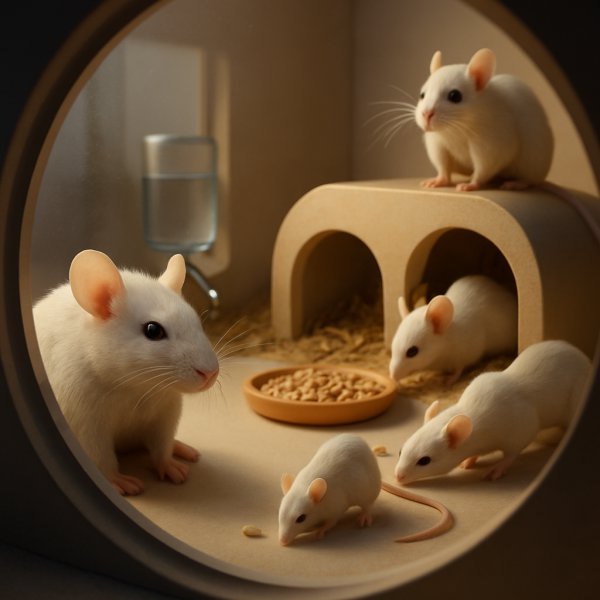
Calhoun created enclosed environments in which he provided abundant food, water, and nesting material for mice, while removing predators and disease vectors. The idea was to study population dynamics in an environment where physical resources were not limiting. Populations rose quickly, displaying an initial boom, then reached a plateau of high density, and eventually experienced a dramatic decline toward extinction-level numbers in that enclosure even though food and water remained available.
Along the way Calhoun described striking social changes. He coined the term behavioral sink to describe the clustering of pathological behaviors: extreme aggression, failure of parental care, hypersexuality or withdrawal from mating, abnormal grooming and social avoidance. Some females became passive or indifferent to pups. Social bonds dissolved and young mice failed to learn normal social roles. From these observations Calhoun argued that the social environment itself, crowded and disrupted, produced a form of social pathology that could cause population collapse.
The visceral appeal of the experiment is clear. Here is a concrete, visualized world where abundance of physical needs does not prevent social collapse. But seeing is not the same as understanding causal mechanisms or generalizing across species and scales. We need to unpack design, alternative explanations, and the constraints of translating lab findings to wild animals and to humans.
The leap from description to explanation - what Calhoun concluded
Calhoun’s interpretation emphasized density-related social stress as the proximate cause of the observed behaviors and ultimate population decline. He suggested that crowding produced social role breakdown, a failure to transmit social norms, and pathological behaviors that undermined reproduction and survival. For him, the lesson was that social structure is fragile under extreme crowding and that without social order, populations can collapse even when material needs are met.
That conclusion highlights an important principle: social environment matters. But the stronger claim - that populations will expand to arbitrary densities and then perish because social pathology inevitably follows - is not fully supported by his design. Calhoun assumed that if physical resources are unlimited, density will only be constrained by behavioral pathology. The experiments showed one pathway under specific conditions, but did not demonstrate inevitability, nor did they examine other mechanisms that can regulate populations.
Key methodological limits that shape interpretation
Laboratory ecology is powerful, but it imposes constraints. Calhoun’s enclosures prevented normal dispersal, migration, and partner choice that wild populations use to manage crowding. Enclosed spaces exaggerate contact rates and social friction. Genetic bottlenecks and inbreeding can magnify behavioral anomalies. The mice are not living in a heterogeneous environment with variable microhabitats, predators, or parasites that can change how individuals respond.
Moreover, small numbers of experimental replicates, and variation in enclosure design, can amplify idiosyncratic outcomes. Behaviorally induced reproductive failure in one sealed system may reflect particular stressors - for example, an imbalance of social roles - rather than a universal law of density. In short, Calhoun’s world was intentionally simplified to test a hypothesis, and simplification is both a strength and a limit. It isolates mechanisms but can generate artifacts that would not arise in open, dynamic systems.
Scientific critiques and alternative explanations that matter
Researchers who revisited Calhoun’s findings pointed to several alternative explanations. One is the bottleneck-genetic effect: when a population rises rapidly from a few founders, deleterious alleles can increase and produce behavioral issues unrelated to density per se. Another is social structure mismatch: mice in enclosures cannot disperse, so socially subordinate individuals cannot leave to form new groups; that increases friction and stress beyond what would happen when migration is an option.
Ecologists emphasize density dependence - the idea that birth and death rates change with population density. In many species, reproduction declines smoothly as density increases, stabilizing populations before catastrophic collapse occurs. Predation, disease, and resource depletion also often intervene. Allee effects - when very low densities cause problems for mating or cooperative behaviors - add more nuance. Taken together, these frameworks suggest multiple regulatory mechanisms, not a single path to social pathology.
Empirical attempts to replicate Calhoun-style collapses have produced mixed results. Some labs saw similar behavioral changes under extreme confinement; others found populations stabilized at different densities or adjusted behaviors in less pathological ways. The variance shows both that behavior can respond to density and that the outcome depends critically on context and experimental design.
How the mouse story translates - and does not translate - to humans
It is tempting to draw a straight line from stressed mice to stressed humans, especially when the media runs with the "inevitable societal collapse" angle. But humans are qualitatively different in key ways. Humans have culture, norms, institutions, technology, and intentional planning that modify how density affects well-being. We build cities, design institutions, invent contraception, and create social safety nets. Those cultural and technological buffers change the arithmetic.
Also, human populations rarely are completely closed. Migration, both internal and international, relieves pressure. Behavioral norms, legal systems, and social learning can adapt to new density regimes. That does not mean density has zero effects on mental health or social cohesion. Studies show urban living can correlate with increased stress markers and certain mental health risks for some people, and overcrowding can exacerbate conflict under certain conditions. But the human story is contingent and multi-causal rather than deterministic.
Think of the difference between a laboratory beehive and a bustling city. Both are socially organized, but humans can reorganize institutions, redistribute resources, and change reproductive strategies in ways that mice cannot. So the useful insight from Calhoun is a warning: social environments shape behavior and health. The misleading takeaway is fatalism - that collapse is inevitable once density passes some threshold.
Two short real-world stories that illuminate the nuances
Case study 1 - Universe 25, the headline experiment: In Calhoun’s most famous enclosure the population surged and then entered a phase where social roles fractured, females became ineffective mothers, aggression spiked, and courtship faltered. The final phase saw a population crash despite continuing material abundance. Versus the dramatic narrative, a sober reading shows this was a particular outcome of a particular closed system. Other enclosures and species often respond differently when allowed to disperse or when social structure is preserved.
Case study 2 - Harlow’s rhesus monkey work and social deprivation: Mid-20th century experiments on rhesus macaques examined the effects of maternal separation and social isolation. Isolated or maternally-deprived monkeys developed severe social pathologies, unable to parent normally later in life. These experiments emphasize how early social experiences shape later behavior, and they parallel Calhoun in showing social environment matters. But they also underscore another lesson - the timing and type of social stress are crucial, and interventions can mitigate harm. In humans, early supportive social institutions and parenting programs show real benefits for psychological development.
What to take away if you want to use the mouse story productively
Calhoun’s experiments are a vivid probe into how social environment and density can shape behavior. They show one plausible route to dysfunction when movement is constrained, social roles are disrupted, and early social learning breaks down. They do not demonstrate inevitability, nor do they prove a single mechanism for all species or situations.
Use the experiments as a prompt to ask better questions: When does crowding increase stress, and when do institutions buffer it? How do migration, economic exchange, and social norms alter the effects of density? What specific mechanisms - hormonal changes, social learning failures, genetic drift - are operating in any observed case? This calibrated approach produces more useful science and wiser policy.
Quick comparison table - claim versus the wider evidence
| Claim from popular retellings |
What Calhoun actually observed |
What broader evidence shows |
| Populations will expand to any density until social pathology causes collapse |
In sealed enclosures, mice showed social breakdown and population decline despite abundant food |
Many populations show density-dependent regulation, dispersal, predator/disease effects, or behavioral adjustments; collapse is not inevitable |
| Social pathology is the primary driver of population collapse |
Social role breakdown, maternal neglect, aggression were prominent in the enclosure |
Social pathology can be a factor, but genetic, ecological, and experimental artifacts also explain outcomes |
| Human cities are bound to follow the same script |
Popular accounts extrapolate the mouse narrative to humans |
Humans have culture, institutions, migration, technology and adaptive responses that change the dynamics; density can raise risks but is not deterministic |
Action plan - how to evaluate sensational animal experiments and apply them wisely
If you want to use Calhoun-style studies to inform thinking or policy, follow these steps as a practical guide:
- Start with method-first thinking: ask how the experiment was set up, what was controlled, and what was prevented - especially dispersal and migration.
- Look for replication: has the finding been reproduced across labs, species, and settings? Note variation in outcomes.
- Separate observation from interpretation: identify the raw behaviors reported and then examine alternative mechanisms that could explain them.
- Consider scale and mechanism: ask whether the mechanism requires enclosure, genetic bottlenecks, or simple social stress that would apply at larger scales.
- Integrate other evidence: compare with field ecology, human social science, and longitudinal studies that include institutional and technological factors.
- Translate to policy cautiously: design interventions that address proximate causes, such as improving social support, housing design, and early childhood programs, rather than assuming doom.
- Ethically reflect: consider welfare implications when using animal studies to guide human policy, and prioritize humane, evidence-based interventions.
Reflection prompts to pause and think
- In your own city or community, what social institutions buffer the effects of crowding, and where are the weak spots that could erode under pressure?
- When does a laboratory model add clarity, and when might it mislead us about complex, open systems like ecosystems or societies?
- If you were advising a policymaker worried about urban crowding, which kinds of evidence would you prioritize before recommending large-scale interventions?
Key points to remember
- Calhoun’s mouse utopia experiments showed striking social breakdowns under extreme, artificial crowding, but not inevitability across species or contexts.
- Lab enclosures prevented natural responses like dispersal, which magnified social friction and created artifacts.
- Multiple mechanisms - genetic, ecological, and behavioral - can cause population regulation; social pathology is one of several possibilities.
- Humans differ from lab mice because culture, institutions, technology, and migration provide adaptive responses.
- Use the experiments as a cautionary lens, not as a prophecy; focus on mechanisms and evidence when shaping policy.
A final nudge of optimism
Calhoun’s mice give us a memorable image and a serious reminder that social environment matters for behavior and population health. But the larger lesson is empowering. Humans design systems, build institutions, and learn from bad outcomes. We can study when and why social stress leads to pathology, and then craft better housing, better social services, and policies that allow movement, autonomy, and social learning. That kind of applied curiosity is exactly what turns scary laboratory stories into useful knowledge. Keep the curiosity, refine the questions, and act in ways that protect both welfare and freedom.