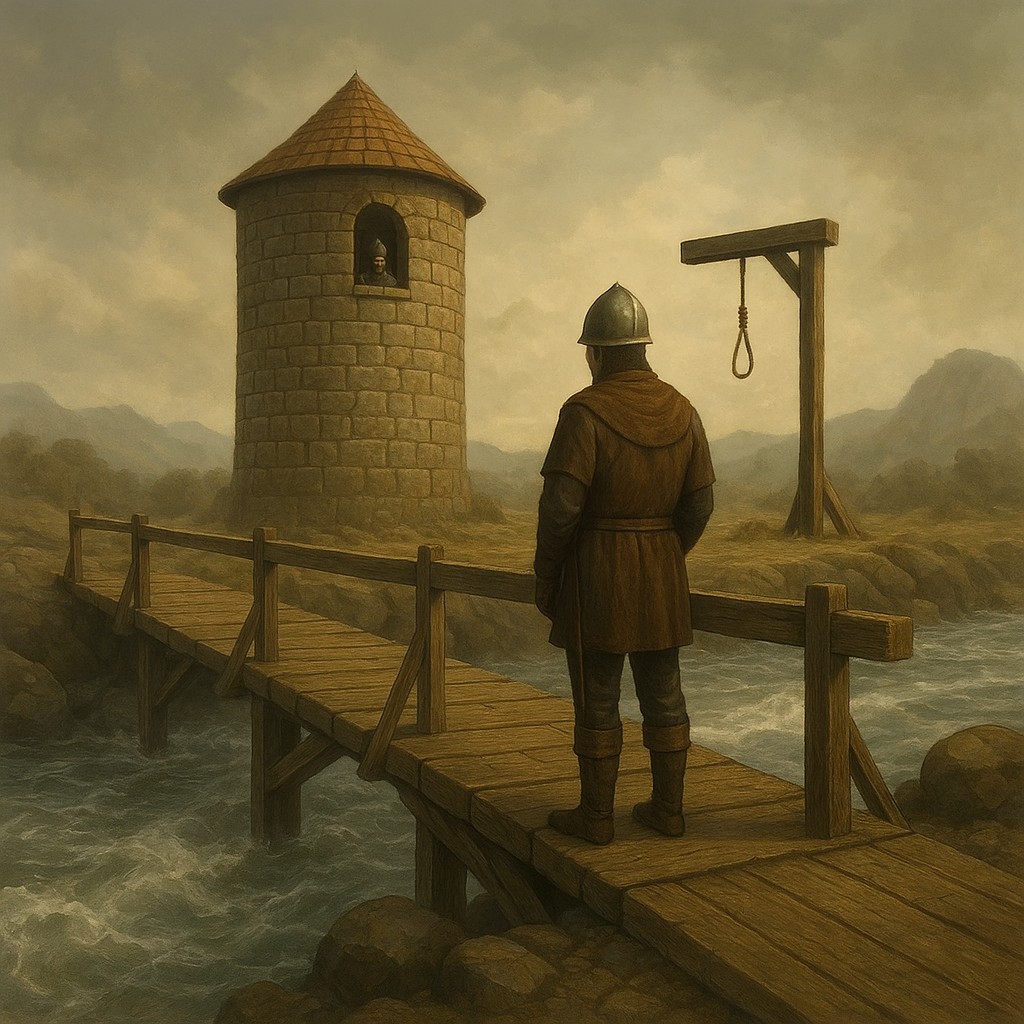
Imagine standing on a weathered wooden bridge over a violent, rushing river. On the far side stands a stone tower guarded by a man with a very specific, very strange set of orders. This guard has only two ways to deal with travelers. If you tell him something true, he must throw you into the icy waters below. If you tell him something false, he must hang you from the gallows.
At first, this seems like a simple, if terrifying, game. If you say "Two plus two is four," he tosses you into the river. If you say "The moon is made of green cheese," he marches you to the rope. It is a grim choice, but the logic is clear and the rules are stable.
However, the situation turns surreal when you decide to use the system's own logic against it. You look the guard in the eye and say, "You are going to hang me."
This single sentence acts like a wrench thrown into the gears of a complex machine. If the guard hangs you, your statement becomes true, which means his orders require him to throw you in the river instead. But if he throws you in the river, your statement becomes false, which means he was supposed to hang you. The guard is now trapped in a state of logical paralysis. He cannot follow his orders because every action he takes immediately cancels out the legal basis for that very action.
The Structural Flaw in Absolute Rules
This puzzle, known as Buridan's Bridge, centers on the problem of self-reference. It is more than just a clever riddle to annoy guards; it represents a fundamental challenge in how we build systems of law, mathematics, and computer science. The paradox happens because the truth of your statement is tied directly to the action the statement predicts.
Most sentences we speak refer to the world around us, like "It is raining" or "The cat is on the mat." These are easy to check. But when a statement refers to itself or its own consequences, it creates a feedback loop that can shatter the boundaries of a logical system.
Jean Buridan, the 14th-century philosopher credited with this version of the puzzle, was exploring the limits of language. He was part of a group of medieval thinkers obsessed with "insolubles" - problems that seem to have no reachable truth. Buridan’s Bridge is a variation of the classic Liar’s Paradox, often stated as "This sentence is a lie." If it is true, it is false; if it is false, it is true. The bridge version is even more compelling because it moves the paradox out of the mind and into the physical world. It suggests that even if a set of rules is perfectly written and consistent on paper, it might be impossible to carry out in reality.
Why the Guard Cannot Move a Muscle
To understand why the guard is stuck, we have to look at the mechanics of "bivalence." This is a technical term for the idea that every statement must be either true or false, with no third option. In the world of Buridan's Bridge, the guard's laws are built on this binary assumption. He has an "If-Then" script: IF truth, THEN river; IF lie, THEN gallows.
It sounds simple, but your statement - "You will hang me" - creates a scenario where the truth is "unfounded." The statement is waiting for the guard to act before it can decide what it is, but the guard cannot act until he knows what it is.
Logicians call this a "circular dependency." In modern software engineering, we call it a "deadlock." Imagine two programs: Program A is waiting for Program B to finish, but Program B is waiting for Program A to finish. Neither can move, and the computer freezes. The guard is the processor, and your statement is the corrupted code that has stopped his brain entirely. This highlights a reality for any lawmaker: you can create a logical constitution or a flawless coding language, but if you allow that system to talk about itself without limits, you risk a total system crash.
| Logical Element |
The "True" Path |
The "False" Path |
Resulting Paradox |
| Statement |
"You will hang me" |
"You will hang me" |
Contradiction |
| Guard's Action |
Throws you in the river |
Hangs you on the gallows |
Conflict of interest |
| Rule Applied |
Truth = River |
Falsehood = Gallows |
Rules collapse |
| Truth Value |
Statement becomes false |
Statement becomes true |
Infinite loop |
Mapping the Loop to Modern Technology
While the bridge and gallows feel like relics of a medieval nightmare, the logic of Buridan's Bridge is very much alive in the digital age. This paradox is the ancestor of the "Halting Problem" in computer science. In 1936, Alan Turing proved that there is no general formula that can look at any random program and tell you for sure whether that program will eventually stop or keep running forever. He proved this by designing a mathematical version of Buridan's Bridge - essentially a program that says, "I will only stop if the program analyzing me says I will run forever."
Because of this, software developers have to be incredibly careful with "recursion" (functions that call themselves). If a function does not have a "base case" - a clear exit strategy that does not rely on its own output - it can create an infinite loop that crashes the system. We see this in everyday life with "circular definitions." If a dictionary defines "Strength" as "The quality of being strong," and "Strong" as "The possession of strength," it hasn't actually defined either word. It has built a tiny, two-word bridge where the reader is trapped, walking back and forth between definitions forever.
The Strategy of Hierarchy Solutions
How do we fix the bridge? How does the guard go home to his family without breaking the laws of logic? For centuries, philosophers and mathematicians have tried to build "logic-gates" to prevent these loops. One famous solution, proposed by Alfred Tarski, suggests separating "object language" from "meta-language." In this view, a language should never be allowed to comment on its own truth. You would need a higher level of language (the meta-language) to talk about the truth of the lower level (the object language).
Under these rules, the guard would simply tell you that your statement is "invalid" because it tries to comment on the rules of the game while playing the game. It is like a football player blowing a whistle to declare himself the winner; the rules of the game exist on a different level than the actions of the players. By creating a hierarchy, we prevent the "snake eating its own tail" scenario. However, this is easier said than done. In the real world, our laws and conversations are messy. We constantly mix our levels of language, which is why legal loopholes and logical paradoxes still pop up in our courts and social contracts.
Reforming the Rules of Engagement
The lesson of Buridan's Bridge isn't that logic is useless, but that rules must be "grounded." A grounded statement is one that points to a fact in the physical world that doesn't depend on the statement itself. If you say "The bridge is made of wood," we can check the wood. The statement is grounded. When you say "You will hang me," the statement is ungrounded. It is floating in the air, waiting for a future event to give it meaning, while that event is waiting for the statement's meaning to be decided.
To avoid this in real-world systems, we use "defaults" or "precedence." In many legal systems, if a law is found to be contradictory, a default rule steps in - for example, the person is set free or the most recent law takes priority. The guard could have a "fail-safe" instruction: "If a traveler creates a paradox that cannot be solved, give them a cookie and let them pass." This moves the solution outside the loop. It acknowledges that the formal system has reached its limit and provides a practical exit. Without these exits, our systems - whether legal, digital, or social - would be fragile and prone to breaking.
Embracing the Complexity of Self-Reference
It is tempting to see these paradoxes as mere annoyances, but they offer deep insight into the human mind. Our ability to think about our own thinking (metacognition) is what makes us unique, but it is also the source of our mental loops. We often get stuck in our own internal Buridan bridges, telling ourselves, "I will only feel successful once I stop worrying about success." This is a self-referential trap. If you follow the instruction, you have reached the goal, but by reaching the goal, you are thinking about it - which means you haven't followed the instruction.
By studying the guard and the bridge, we learn the importance of precision and boundaries. We learn that for any system to work, it must be aware of its own limits. Whether you are writing code, drafting a contract, or trying to win an argument, remember that self-reference is a powerful tool. It has the power to define the world, but it also has the power to stop it in its tracks.
The next time you are stuck between two impossible choices, remember the guard on the bridge. Sometimes, the problem isn't that you aren't thinking hard enough; it's that the rules of the game are designed to make a solution impossible. In those moments, the smartest move isn't to walk further onto the bridge, but to step back and ask how the bridge was built. Understanding the logic of the loop is the first step toward breaking it. Once the loop is broken, the path forward becomes clear.