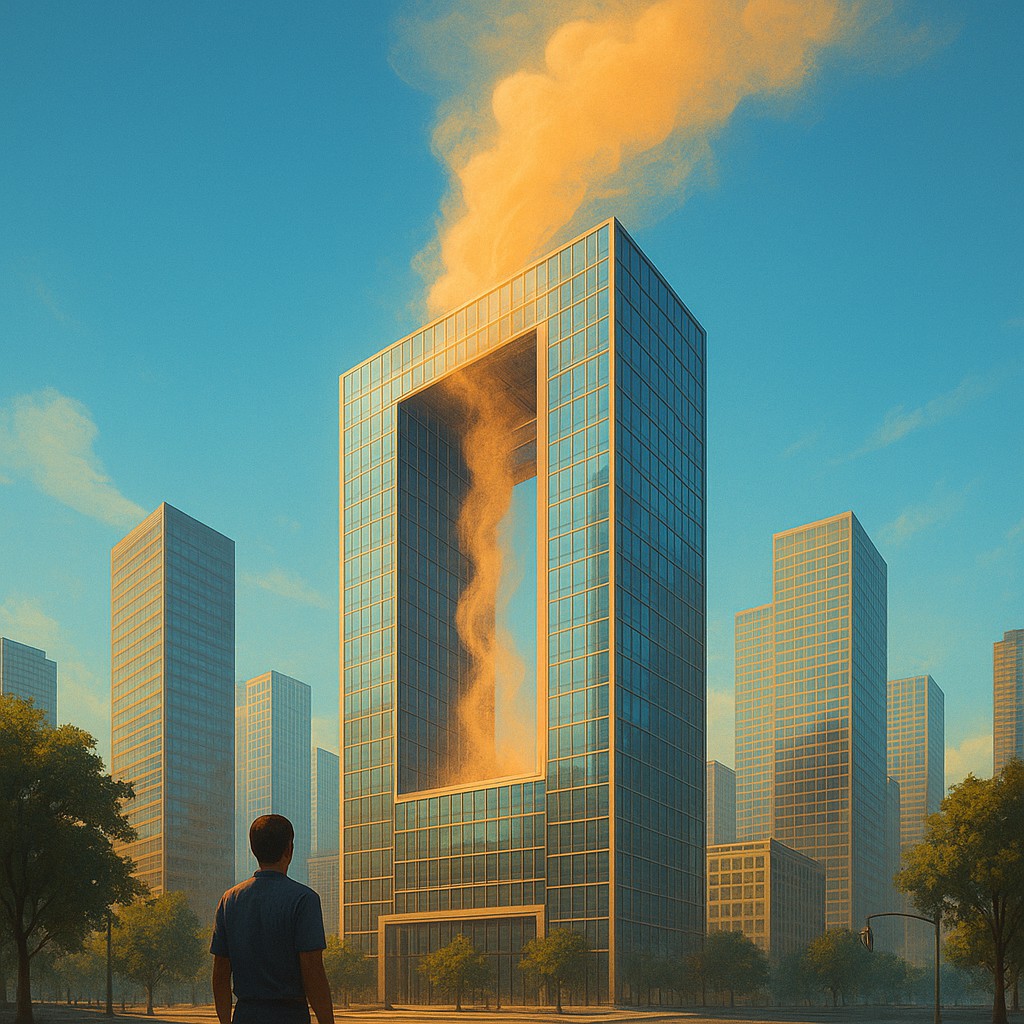
Imagine standing in the middle of a bustling city on a sweltering July afternoon. You look up at glass towers shimmering like pillars of heat, and you can practically hear the collective hum of thousands of air conditioners working overtime to keep the rooms inside bearable. This is a massive, energy-hungry infrastructure designed to fight nature rather than work with it. We have become so used to the roar of fans and the chill of chemical refrigerants that we often forget humans stayed cool for thousands of years without ever plugging a device into a wall. Our ancestors understood something fundamental about how air moves, a secret we are only now rediscovering in our search for sustainable living.
The secret lies in a simple, undeniable fact: hot air is lighter than cold air. While that might sound like a trivial detail from a middle school science book, it is actually the engine behind one of the most elegant engineering tricks in history. By treating a building not as a sealed box, but as a living, breathing organism, we can harness the natural movement of gases to create a self-sustaining cooling machine. This is the story of the "stack effect," a phenomenon that uses architecture itself to breathe fresh air into our lives while letting the heat of the day simply drift away into the sky.
The Invisible Engine of Thermal Buoyancy
To understand how a massive stone or concrete building can act like a giant pair of lungs, we first have to look at the molecules dancing around us. Air is not a solid, stagnant thing; it is a fluid, and like all fluids, its density changes with its temperature. When air gets warm, the molecules inside start zipping around faster, pushing off each other and taking up more space. This makes the warm air less dense, or "lighter," than the cooler air surrounding it. In a natural environment, this warm air wants to go exactly one place: up. This is why hot air balloons rise and why smoke from a campfire drifts toward the stars instead of pooling around your feet.
In the world of physics, this is known as thermal buoyancy. In a standard house or office building, this heat often gets trapped against the ceiling, creating those stifling pockets of stagnant air we all dread. However, if you intentionally design a vertical passage, like a chimney or a tall central atrium, you give that warm air an escape route. As that warm air rises through the shaft and exits through a vent at the top, it creates a slight drop in pressure at the bottom of the building. This "partial vacuum" is the magic ingredient. Nature hates empty space, so the building begins to suck in fresh, cooler air from windows or vents located near the ground to fill the gap. It is a continuous, self-powering cycle that requires nothing more than the sun's heat to keep the air moving.
Ancient Wisdom in a High-Tech World
While we might think of ourselves as the masters of technology, ancient Persian and Middle Eastern architects were the true pioneers of this atmospheric magic. Centuries ago, they developed structures known as "Badgirs," or wind catchers. These were tall, ornate towers sitting atop homes and palaces, designed to catch even the slightest breeze and funnel it downward. But more importantly, they worked in reverse when the wind died down. During the hottest parts of the day, the tower acted as a massive chimney, pulling hot air out of the thick-walled masonry homes and allowing cool air from underground water channels or shaded courtyards to take its place. These structures were so effective they could keep ice frozen even in the middle of a desert summer.
Today, we are seeing a resurgence of these principles in what is called "Bioclimatic Architecture." Architects are moving away from the "sealed glass box" model of the 20th century, which depends entirely on mechanical ventilation. In its place, we see buildings with hollow, breathing cores. These modern stacks use computer-controlled shutters at the top to regulate how much air escapes, ensuring the building stays cool without becoming a wind tunnel. By combining these ancient concepts with modern materials, we can create skyscrapers that use a fraction of the energy of their predecessors. It is a beautiful irony that the most advanced buildings of the 21st century work very much like the mud-brick towers built in the desert a thousand years ago.
Mastering the Balance of Airflow and Comfort
The cooling tower effect is a powerful tool, but it is not as simple as poking a hole in the roof and calling it a day. Like any sophisticated engine, it requires precise tuning to keep the system from becoming a nuisance. If the vents at the bottom are too large, the draft can become uncomfortably strong, blowing papers off desks and whistling through doorways like a haunted house. Conversely, if the vertical shaft is too narrow, the air creates too much friction against the walls, slowing down the "pull" and leaving the rooms feeling stuffy. Engineers must calculate the exact volume of air needed based on how many people use the building and the local climate to ensure the breeze feels like a gentle caress rather than a gale.
Seasonality is another critical factor. While we want to vent heat during the summer, that same stack effect can be a problem in the winter. During cold months, the chimney effect can work too well, pulling all the expensive, heater-warmed air straight out the roof and sucking in freezing drafts from under the doors. This is why modern versions of this technology use "smart" vents that can adjust their openings or close entirely based on the outside temperature. See the table below for a quick breakdown of how the stack effect interacts with different conditions and how architects manage those variables.
| Variable |
Summer Impact |
Winter Impact |
Design Strategy |
| Shaft Height |
Taller shafts create a stronger "pull" for better cooling. |
Can lead to excessive heat loss if not managed. |
Use adjustable shutters to limit the flow. |
| Outdoor Temp |
Large temperature gaps drive rapid air exchange. |
Cold air is very heavy, creating high-pressure drafts. |
Seal lower inlets during the coldest hours. |
| Vent Placement |
Low inlets ensure the "living zone" gets the freshest air. |
High outlets can sap all the warmth from the ceiling. |
Place vents behind radiators to pre-warm intake air. |
| Indoor Humidity |
Moving air helps evaporate sweat, making it feel cooler. |
Can dry out the air too much if flow is constant. |
Use indoor plants to help regulate moisture. |
The Physics of Living Structures
When we step back and look at a building designed with a cooling tower, it changes our perception of what "shelter" really is. Instead of a static object that just sits there, the building becomes a machine that processes its environment. This is often called "Passive Cooling" because it does not require mechanical power to work. The building uses its own shape to do the job. The direction the tower faces, the materials of the walls, and even the color of the roof all play a part in how efficiently the air moves. For example, dark-colored materials at the top of a cooling stack can absorb sunshine, heating the air in the shaft even further and "supercharging" the upward draft on a sunny day.
This approach also addresses a major health concern in modern architecture: Sick Building Syndrome. In many air-tight offices, the same air is recirculated over and over through filters and ducts, leading to a buildup of carbon dioxide and indoor pollutants. A building that uses the cooling tower effect, however, is constantly flushing itself out. It ensures a high rate of ACH, or "Air Changes per Hour," which is one of the most effective ways to keep indoor environments healthy. By allowing the building to "exhale" its stale air and "inhale" fresh air from outside, we create a space that feels more like an outdoor garden and less like a plastic container.
Reimagining the Future of Our Cities
It is easy to get bogged down in the technical details of pressure and airflow, but the real takeaway of the cooling tower effect is philosophical. It reminds us that we do not always need to throw more "stuff" at a problem. We do not always need a bigger motor or a more complex computer chip to stay comfortable and sustainable. Sometimes, the most sophisticated solution is simply the most thoughtful one. By understanding the natural laws of our world, we can design our way out of the energy crisis, one breeze at a time. This transition requires us to be more than just consumers of technology; it asks us to be observers of the world around us.
As you walk through your own neighborhood or office, start looking at the shapes of the buildings. Are they fighting against the elements, or are they inviting them in? Imagine a city where the skyline is not just a collection of neon signs and steel, but a forest of wind towers and thermal chimneys, all working in silent harmony with the sun and the wind. This is not a futuristic dream; it is a return to a proven path. By embracing the simple physics of rising heat, we can create a world that is not just more efficient, but more human, reminding us that we are part of a larger, living system that is always ready to help us catch our breath.