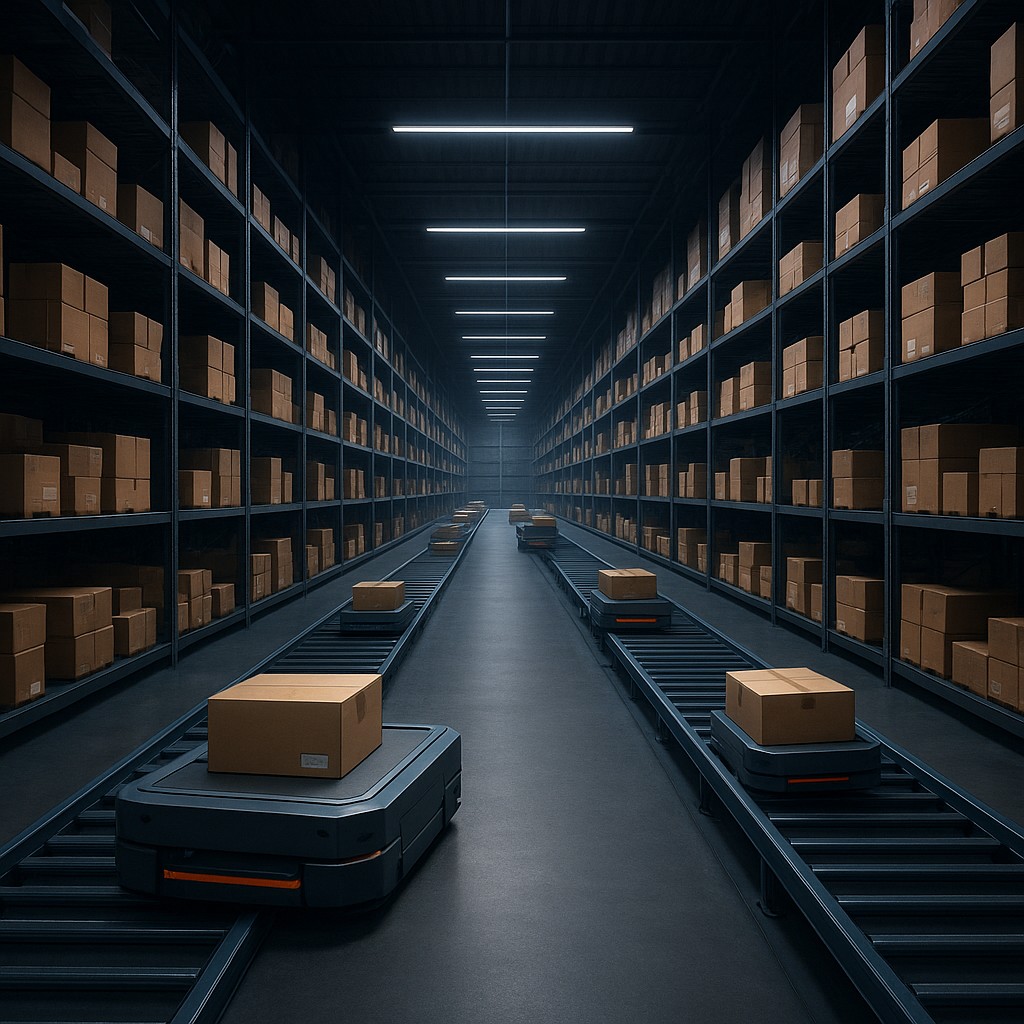
Imagine a vast cathedral of commerce stretching several stories high and covering an area the size of four football fields. Unlike any building you have ever entered, there are no light switches by the door. Inside, the air is still and chilly, kept at a temperature that would make a person shiver. The silence is broken only by the rhythmic whirring of electric motors and the soft click-clack of plastic hitting metal. In this space, thousands of products - from high-end electronics to organic dog treats - move with precision through a three-dimensional grid, guided by invisible digital maps. This is the "dark warehouse," a peak of modern logistics where traditional needs like human comfort, visibility, and even floor space are being redesigned to serve a new master: the autonomous robot.
The move toward dark warehouses marks a fundamental shift in industrial architecture. For nearly a century, warehouses were built as "human-centered" shells. They needed high ceilings for ventilation, wide aisles for forklifts, bright LED lights for safety, and expensive climate control to keep workers productive. When you remove humans from the daily routine of picking items off shelves, those design constraints vanish. Suddenly, a building does not need to be a workplace; it becomes a giant, uninhabited machine dedicated entirely to the flow of goods. This evolution isn't just about saving on the electric bill, though that is a huge perk; it is a radical rethinking of the physics of moving products from a screen tap to your front door.
Engineering for an Inhabitant with No Eyes
To understand a dark warehouse, you have to stop thinking like a human and start thinking like a sensor-driven algorithm. Humans are versatile but physically demanding. We need roughly 1,000 lumens of light to read a shipping label accurately, and we need wide paths to walk without bumping into things. Robots, by contrast, are perfectly happy navigating via infrared sensors, LIDAR (laser-based scanning), or by reading QR codes printed on the floor that are invisible to us in the dark. Because these machines do not literally "see" the way we do, cutting the lights is the first and easiest way to slash overhead. In a facility covering half a million square feet, the cost of lighting alone can reach tens of thousands of dollars a month - an expense that simply evaporates in a dark setup.
Beyond the darkness, the very air in these buildings changes. Humans are sensitive to humidity and temperature, requiring expensive HVAC (heating and cooling) systems to keep a warehouse at a comfortable 70 degrees Fahrenheit. Many robotic systems, however, run more efficiently in cooler environments where their batteries don't overheat as quickly. By letting the warehouse temperature fluctuate or by keeping it cold on purpose, companies can significantly reduce their carbon footprint and energy costs. This "machine-first" design means the building is no longer a traditional workplace, but a specialized climate-controlled enclosure for high-performance hardware.
The absence of people also allows for an incredibly efficient use of space known as "cube storage." In a traditional warehouse, about 60 percent of the floor space is actually "dead space" used for aisles so people and forklifts can move around. In a dark warehouse, robots often live on top of a massive aluminum grid, reaching down into deep stacks of bins to pull products. There are no aisles, no walkways, and no wasted gaps. This allows companies to pack up to four times as much inventory into the same footprint. It is the architectural equivalent of moving from a sprawling suburban neighborhood to a dense, high-rise city where every cubic inch is put to use.
The Logic of the Vertical Grid
In a world run by human pickers, the most popular items are usually kept in "golden zones" - shelves at waist height that require the least amount of bending or reaching. In an automated dark warehouse, the golden zone is replaced by algorithmic shuffling. Using a "burst" or "grid" layout, robots move bins around based on predicted demand. If the local weather forecast calls for a heatwave, the system will spend the night moving fans and air conditioners from the bottom of a 20-bin stack to the very top. The robots are essentially playing a giant, high-stakes game of Tetris 24 hours a day, ensuring the most needed items are always the easiest to reach.
This vertical density creates unique engineering challenges, particularly regarding weight and structural strength. When you stack inventory 30 feet high without any gaps, the pressure on the bottom bins and the floor itself is immense. This is why dark warehouses are often built from the ground up with reinforced concrete foundations that can handle several times the load of a standard warehouse. The robots themselves are also masterpieces of weight distribution; they must be light enough to zip across the top of the grid at high speeds, but strong enough to winch up a 60-pound bin of heavy laundry detergent from the depths of the "hive."
| Feature |
Traditional Warehouse |
Dark Warehouse |
| Primary Lighting |
High-output LED (1,000+ Lumens) |
Minimal or Zero (Infrared/Digital) |
| Aisle Requirement |
10-12 feet for forklifts |
Zero (Continuous grid) |
| Climate Control |
Regulated for human comfort |
Minimal (Optimized for electronics) |
| Storage Density |
Low/Medium (Horizontal layout) |
Ultra-High (Vertical cube layout) |
| Navigation System |
Visual signs and floor tape |
QR codes, LIDAR, and Digital Twins |
| Operating Hours |
Based on labor shifts |
Continuous 24/7 |
The Fragility of a Perfect System
While the dark warehouse sounds like a flawless engine of efficiency, it introduces a new kind of vulnerability. In a manual warehouse, if one worker gets sick, the rest of the team picks up the slack. In a dark warehouse, the system is a highly interconnected web. If the central "brain" of the facility has a software glitch, or if a single robot breaks down and blocks a high-traffic intersection on the grid, the entire operation can grind to a halt. Because the bins are packed so tightly, there is often no way for a human to simply walk over and fix the problem. The very density that makes the warehouse efficient also makes it inaccessible to the people who built it.
This has led to the creation of "recovery robots," specialized machines whose only job is to rescue their fallen comrades. When a picker-bot fails, a recovery bot is sent to latch onto the broken unit and tow it to a maintenance bay at the edge of the grid. If the problem is more severe, such as a structural collapse or a fire, the challenges multiply. Fighting a fire in a dark, high-density cube is remarkably difficult because water from ceiling sprinklers cannot easily penetrate the tightly packed bins. Modern dark warehouses are now being designed with oxygen reduction systems, which lower the oxygen levels in the building just enough so that fire cannot burn, though this makes it even more uninhabitable for humans without breathing gear.
There is also the economic reality of these "mega hubs." While they are incredibly efficient at scale, they are also wildly expensive to build. The upfront cost to equip a facility with thousands of robots and miles of precision aluminum tracking is astronomical. Recent market shifts have shown that while giants like Amazon are leaning heavily into this future, others have had to pull back. If the volume of orders isn't high enough to justify the initial multi-million dollar investment, a low-tech warehouse with a few lightbulbs and humans with carts can actually be more cost-effective. The dark warehouse is a high-stakes bet on a future of constant, high-volume online shopping.
Navigating the Ghost in the Machine
One of the most fascinating aspects of these facilities is the use of a "Digital Twin." Because the warehouse is pitch black and packed tight, managers cannot simply look out over a balcony to see how things are going. Instead, they interact with a real-time 3D simulation of the warehouse on their computer screens. This digital twin tracks the location, battery life, and "health" (via sensors) of every single robot in the building. If a robot begins to vibrate slightly more than usual, signaling a failing part, the system flags it in the simulation. The manager sees a red flashing icon in a virtual world, even though the physical reality is a silent machine moving in the dark five miles away.
This data-driven approach allows for "predictive maintenance," the secret to keeping a dark warehouse running. By analyzing the data coming off the bot fleet, algorithms can predict when a part is going to fail before it actually breaks. This allows the system to schedule "doctor appointments" for the robots during slow periods. A robot will realize it is getting "sick" and drive itself to a maintenance station where a human technician, working under bright lights in a separate area, can swap out a motor or a sensor before returning the bot to the dark.
The use of floor codes and digital mapping also means the warehouse can be reconfigured instantly. In a traditional setup, moving a row of shelves requires a construction crew and a weekend of downtime. In an automated dark warehouse, you just update the digital map. You can tell the robots that a certain area is now off-limits or change traffic patterns with a few keystrokes. This flexibility is vital in a world where consumer trends change in weeks rather than years. The building is no longer a static storage space; it is a fluid, evolving structure that responds to the data flowing into it from the internet.
The Ethical and Philosophical Shift
The rise of the dark warehouse inevitably sparks a conversation about the future of work. We often hear that robots are "taking jobs," but the reality in logistics is more complex. Warehouse work is notoriously grueling, involving walking 10 to 15 miles a day on concrete floors and lifting heavy boxes in repetitive motions that often lead to long-term injury. By moving the "picking" process into a dark, automated grid, the human role shifts from physical labor to system oversight. The jobs don't necessarily disappear, but they turn into roles like robot technician, flow controller, or software troubleshooter.
However, this shift also creates a geographic and social gap. A dark warehouse doesn't need to be near a large pool of local workers; it just needs a massive power hookup and a fast fiber-optic connection. This allows logistics hubs to move to more remote, cheaper land, potentially leaving "warehouse towns" that relied on these facilities without employment. Furthermore, there is a certain philosophical weight to building vast structures explicitly designed to exclude us. It marks the first time in history where our most essential infrastructure is being built for a non-human occupant, creating "ghost cities" of productivity that exist alongside our own, yet are completely optimized for a different type of existence.
Ultimately, the dark warehouse is a testament to our desire for effortless shopping. Every time we enjoy the "magic" of a package arriving hours after we ordered it, we are benefiting from these invisible, lightless engines of efficiency. They are the physical form of the internet itself: a high-speed, data-driven network where the physical location of an item matters less than the algorithm's ability to find it. As we move forward, this "lights out" philosophy will likely spread to other industries, from indoor farming to manufacturing, creating a world where the most productive places on Earth are the ones where nobody is home.
Standing outside one of these massive structures at night, you might see nothing but a dull, windowless box and hear nothing but a faint hum. It is a strange thought to realize that inside that silent box, a frantic, highly coordinated dance is happening in total darkness. Thousands of machines are communicating, calculating, and moving with a speed and precision that would be impossible under the glow of a lightbulb. It is a reminder that the future of technology isn't just about making our lives brighter; sometimes, the greatest leaps in progress happen when we step back and let the machines do their best work in the dark. This shift represents a coming of age for automation, where we stop trying to make robots act like humans and instead create environments where they can truly excel as robots.