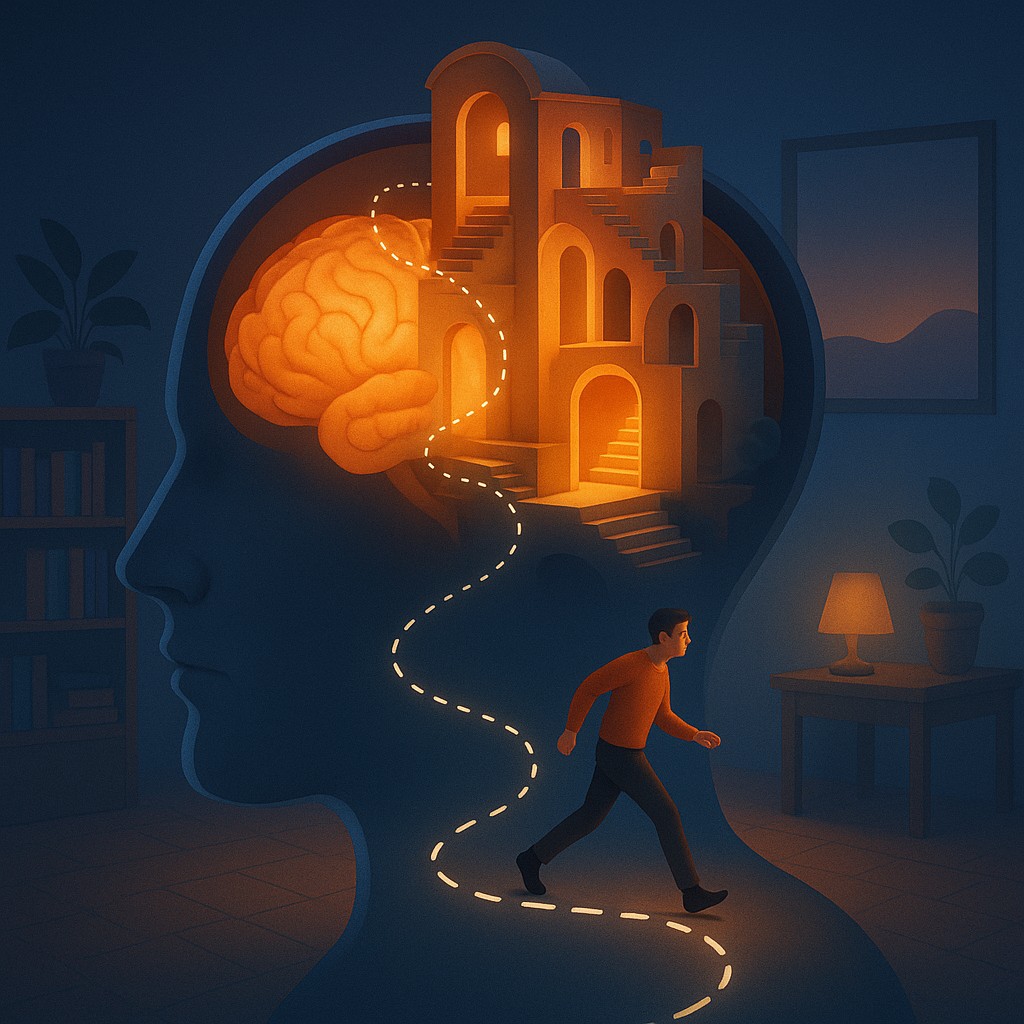
Imagine you are at a party and someone introduces themselves as a world record holder. You might expect a champion sprinter or a master of some difficult physical feat. Instead, they proceed to recite the first 70,000 digits of Pi without breaking a sweat. It looks like a supernatural gift, the kind of "photographic memory" we see in movies. Yet, if you asked how they did it, they wouldn't credit a special brain. Instead, they would tell you about a mental stroll they took through their childhood home. This is the power of the Method of Loci, an ancient Greek memory technique. It proves our brains are much better at being GPS units than they are at being filing cabinets for lists.
The real problem with modern learning is that we try to memorize facts by staring at them on a flat page. This is exactly what the human brain is worst at doing. For millions of years, our ancestors survived not by memorizing grocery lists, but by remembering where the lions lived, which berry patch was poisonous, and the path back to the cave during a storm. Our brains evolved to prioritize navigation and landmarks. The Method of Loci, or the "Memory Palace," hacks this evolutionary software. It turns boring data into bright, physical objects scattered throughout a familiar place. By the time you finish reading this, you will know how to turn your own home into a living library of everything you have ever wanted to remember.
The Architectural Blueprint of the Mind
To understand why this works, we have to look at the hippocampus. This is the part of the brain that forms new memories and helps us find our way around. In the 1970s, researchers discovered "place cells" in this region. These cells light up like a scoreboard when we move through a physical space. Essentially, your brain creates a high-definition map of every room you have lived in and every street you use. The Method of Loci simply lets your data "piggyback" on these existing maps. When you attach information to a physical spot, like your kitchen sink or front door, you are no longer trying to remember a word. You are remembering a location, which is something your brain does automatically.
The term "Loci" is the plural of the Latin word "Locus," which means place. The strategy has two steps: building the palace and placing the "images." You start by picking a place you know so well that you could walk through it in the dark. Your childhood home, your office, or your favorite park are perfect choices. Since these locations are already burned into your long-term memory, they provide a stable skeleton for new information. Without this anchor, a list of facts is like a handful of glitter tossed into the wind. With a palace, every fact has its own shelf.
Success depends on the "Route" principle. You do not just throw items into a room randomly; you follow a set path. Perhaps you start at the driveway, move to the porch, enter the hallway, and turn left into the kitchen. By moving in the same order every time, you make sure you never miss a piece of information. The sequence of the path becomes the sequence of the data. Whether you are memorizing the Kings of England or the steps of a chemical reaction, the order is built into the geography of your mind.
Transforming Data into Vivid Hallucinations
The secret to making a Memory Palace stick is what you put inside it. The brain is bored by the ordinary. If you try to remember a "loaf of bread" by imagining it sitting on your sofa, you will likely forget it in ten minutes. To make a memory permanent, use the "VON" principle: Visualization, Observation, and Novelty. Your mental images need to be bizarre, hilarious, or even a bit gross. Instead of a plain loaf of bread, imagine a six-foot-tall baguette wearing a tuxedo and dancing on your sofa. The more sensory details you add, the more the brain flags it as important information worth keeping.
Psychologists call this "elaborative encoding." By taking a dry fact and dressing it in a ridiculous costume, you engage multiple parts of your brain. You aren't just using the language center; you are using the visual cortex, the emotional centers, and the spatial maps. This creates several "back-up" paths to the same memory. If you forget the word, you might remember the smell of the baguette. If you forget the smell, you might remember the sound of the music. The Method of Loci builds a web of associations that makes it nearly impossible for information to slip away.
When starting out, focus on the "sticky" details of your location. These are called "memory pegs." A peg is a specific piece of furniture or a feature that never moves. In a living room, your pegs might be the fireplace, the TV, the armchair, and the bookshelf. As you walk through the room in your mind, you stop at each peg to leave a vivid image. If you are trying to remember the five levels of Maslow’s Hierarchy of Needs, you might see a shivering person trying to light a fire in your fireplace (Physiological needs) and a security guard standing by your TV (Safety needs).
A Comparison of Traditional and Spatial Learning
It is helpful to see how the Method of Loci compares to the way we usually study. Most of us grew up using "rote rehearsal," which is just repeating a phrase until it sticks. While this can work for short tasks, it is fragile and requires constant work. The table below shows why the spatial approach is a major upgrade.
| Feature |
Rote Rehearsal (Repetition) |
Method of Loci (Spatial) |
| Primary Brain Region |
Prefrontal Cortex (Working Memory) |
Hippocampus (Spatial Memory) |
| Retention Duration |
Short-term (Hours to Days) |
Long-term (Weeks to Years) |
| Effort Level |
High (Dull and boring) |
Medium (Creative and fun) |
| Recall Speed |
Slow (Searching for clues) |
Fast (Walking a path) |
| Contextual Links |
Very few; data exists in a vacuum |
Strong; data is tied to landmarks |
| Reliability |
Likely to "blank out" under stress |
Very stable; maps resist stress |
As the table shows, the shift is from "holding" information to "experiencing" it. With repetition, you are trying to balance a stack of plates on your head. If you get distracted or stressed, the plates crash down. With the Method of Loci, you are placing those plates on a sturdy table in a room you have visited a thousand times. Even if you are stressed, the table stays put. You can leave the room, go for a walk, and when you return, the plates will be exactly where you left them.
Common Pitfalls and Upkeep
Despite its power, the Method of Loci is not a magic wand. One common mistake is choosing a place that is too cluttered or unfamiliar. If you try to use a hotel where you stayed for only one night, your brain will waste energy trying to remember the room layout. Reliability comes from using "high-traffic" areas of your life. Your current home is usually best because the floor plan is already etched into your subconscious.
Another hurdle is the "ghosting" effect. This happens when images from an old list linger in a room when you try to use it for something new. If you used your kitchen for a grocery list on Monday, you might still see a ghostly baguette dancing on the stove when you try to memorize a business report on Tuesday. To fix this, memory experts either use different palaces for different subjects or perform a "mental cleaning." This means taking a moment to imagine the rooms are empty and quiet before adding new images.
Finally, do not skip the initial "walk-through." While spatial memory is strong, the link between the fact and the location needs time to set, like wet cement. After you place your images, you should walk the path at least three times: once immediately, once an hour later, and once the next morning. This uses the "spacing effect," where information is kept longer if it is reviewed at increasing intervals. Once the cement dries, the information becomes part of the "furniture" of your mind.
Expanding the Palace into a Mental City
Once you master one room, the possibilities grow. You are not limited to your house. You can use your commute to work, a favorite hiking trail, or even the map of a video game. Some people build "Virtual Palaces" from movies or books. The beauty of this technique is that space is unlimited. You can link rooms together with "portals," so that walking through your back door leads to your grandmother's garden, which then leads to your school gym. You are building a custom-designed internet for your own brain.
This approach lets you store complex systems of knowledge. For example, a medical student might use an entire neighborhood to store the skeletal system. Each house represents a limb, and each room represents a joint. By the time they are done, they aren't "memorizing" anatomy; they are simply "visiting" it. This turns studying from a chore into a creative act of world-building. You become the architect of your own mind, designing a space where everything you know has a home.
Ultimately, the Method of Loci is more than just a trick for exams. It is a way of reclaiming how humans naturally learn. We were never meant to be dry data processors. We are explorers and storytellers. By turning facts into physical journeys, we honor the way we were built. So, start small. Pick five spots in your room today and place five things you want to learn there. Make them loud, make them strange, and make them yours. You might find that your mind is a much larger and more beautiful place than you ever imagined.