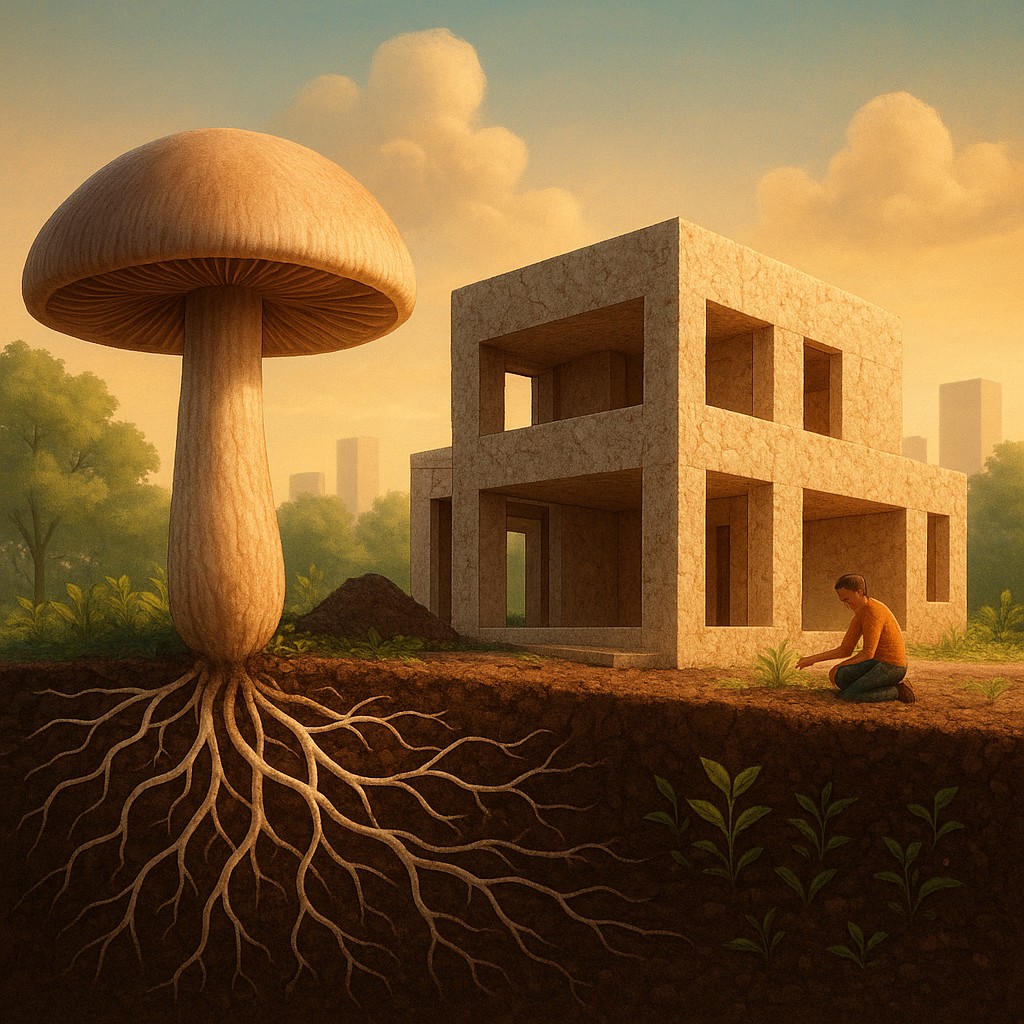
Imagine for a moment that you are a silent witness to the birth of a modern city. Usually, this is a scene of industrial violence: the grinding of steel, the roar of cement mixers, and the blistering heat of kilns firing clay into stone at temperatures over 2,000 degrees Fahrenheit. For thousands of years, our recipe for a stable building has been a simple variation of "dig up the earth, crush it, and cook it until it stops moving." This process built our civilizations, but it also left us with a massive carbon debt and piles of non-recyclable debris that will outlive the very empires that created them.
But what if, instead of baking our buildings, we could grow them? What if the walls of your next home weren't manufactured in a smog-belching factory, but were harvested from a quiet, dark room where a hidden network of biological intelligence was hard at work? This isn't a scene from a science fiction novel; it is the rising reality of mycelium-based architecture. By partnering with the root systems of fungi, architects are finding ways to turn agricultural waste into building materials that are carbon-negative, fire-resistant, and entirely compostable. We are moving from an age of extraction to an age of cultivation, and the humble mushroom is leading the way.
The Subterranean Engineer at Work
To understand how a mushroom can become a brick, we first have to clarify what a mushroom actually is. The capped stalk you see popping up in your garden is just the "fruit" of the organism, much like an apple on a tree. The real body of the fungus is the mycelium, a vast, microscopic web of thread-like structures called hyphae that live underground or inside decaying wood. These hyphae are nature's ultimate recyclers. They release enzymes that break down complex organic matter into nutrients, effectively acting as a biological glue that binds soil or wood together.
When we use this process for construction, we are essentially acting as matchmakers between two worlds: industrial waste and biological growth. A manufacturer takes agricultural "trash" like corn husks, hemp scraps, or sawdust and packs it into a mold. They then add a specific strain of fungal spores. In a controlled, humid environment, the mycelium wakes up. It doesn't see the waste as trash, but as a five-course meal. As it eats, it weaves its threads through every crack and crevice of the mold, creating a dense, interconnected web that is incredibly sturdy.
The brilliance of this process is that the fungus does all the heavy lifting. While a traditional brick requires massive amounts of outside energy to fuse clay together, mycelium uses the chemical energy stored in the waste itself to build its own structure. Once the mold is completely filled with this white, felt-like material, the manufacturer "deactivates" the fungus by heating it. This stops the growth and dries out the material. The result is a lightweight, solid block that feels like a cross between high-density foam and a thick cracker.
A Comparative Look at Building Blocks
When we compare mycelium bricks to traditional materials, the differences go beyond looks. We are seeing a fundamental shift in how we measure the "cost" of a material. In the old world, cost was purely financial and ignored the environmental toll of energy-hungry kilns. In the mycelium world, the cost is actually a credit. The material stores carbon that would have otherwise been released into the atmosphere if the agricultural waste had been burned or left to rot.
| Feature |
Conventional Clay Brick |
Mycelium Bio-Brick |
| Manufacturing Temp |
1,800 - 2,400°F (980 - 1,300°C) |
Room Temp (followed by low-heat drying) |
| Growth/Firing Time |
3 - 5 days in a kiln |
5 - 10 days of biological growth |
| Weight |
Heavy (high transport emissions) |
Ultra-lightweight (airy structure) |
| Insulation |
Poor (needs extra layers) |
Excellent (natural heat barrier) |
| Fire Resistance |
High (naturally non-combustible) |
High (chars rather than melts) |
| End of Life |
Becomes landfill rubble |
Fully compostable in your garden |
The table above shows a fascinating trade-off. While the mycelium brick cannot yet match the crushing strength of a traditional brick, it excels where traditional masonry fails. Because mycelium is naturally cellular, it traps air, making it a world-class insulator. Furthermore, because fungi have spent millions of years evolving to survive forest fires, the chitin found in their cell walls is a natural fire retardant. When exposed to a flame, the mycelium chars rather than melting or releasing toxic fumes, providing a safer alternative to the synthetic foams currently used for home insulation.
Navigating the Constraints of Living Materials
Before you try to build a skyscraper out of mushrooms, we need to address the "structural elephant" in the room. Every material has its limits. Steel handles tension well, concrete handles weight well, and mycelium is currently king of the "non-load-bearing" world. At the moment, you cannot use mycelium bricks to support the weight of a thirty-story building. Their internal structure is more like a dense sponge than a solid rock. If you pile too much weight on top of them, they will eventually compress and fail.
This is why, in today's architecture, mycelium is used as a strategic teammate rather than a solo superstar. It is being used for internal partition walls, acoustic panels, and temporary pavilions. For example, at the MoMA PS1 in New York, architects once built the "Hy-Fi" tower out of 10,000 mycelium bricks. It stood for the entire summer, providing shade and structural support. When the exhibition ended, the entire building was taken down and sent to a local community garden to be turned into compost.
There is also the matter of moisture. Because mycelium is an organic material, it is naturally "hygroscopic," meaning it likes to hold onto water. In a damp climate, an untreated mycelium brick could potentially start to rot or even "wake up" if it wasn't dried properly during manufacturing. Researchers are currently working on bio-based coatings, such as waxes or linseed oils, to create a waterproof barrier. Until these coatings are perfected, mycelium is best suited for the interior of a home or for dry, temporary outdoor structures.
The Circular Economy in Your Living Room
The true magic of mycelium lies in its ability to close the loop of the "circular economy." In our current system, we follow a straight line: we take resources, we make products, and then we toss them into a hole in the ground. If you decide to renovate your kitchen today, the old drywall and insulation go straight to a landfill where they will sit for centuries. With mycelium, the story ends differently. When a mycelium wall reaches the end of its life, you don't need a garbage truck; you just need a shovel.
By breaking down the brick and mixing it with soil, you return nutrients to the earth. The very wall that kept you warm all winter becomes the fertilizer for the garden that feeds you in the spring. This is a radical shift in how we think about our buildings. It suggests that our cities could be living, breathing parts of the ecosystem, rather than concrete scars on the landscape. It redefines the architect not as a master of dead matter, but as a gardener of structural systems.
We are also seeing this technology make manufacturing more accessible. Because you don't need a million-dollar kiln to make a mycelium brick, local communities can set up small "bio-factories" using whatever waste is nearby. In Kenya, mushroom farms are starting to provide panels for affordable housing using coconut husks. In the American Midwest, corn leftovers are the primary ingredient. This reduces the carbon footprint caused by shipping heavy materials around the world and helps local economies build their own futures with the materials they have on hand.
Dreaming of a Cultivated Future
The journey of the mycelium brick shows the power of looking at the natural world with fresh eyes. For centuries, we viewed fungi as either a snack or a nuisance in the bathroom corner. We are only now realizing that they are some of the most sophisticated engineers on the planet, capable of weaving complex structures out of things we throw away. While we may not live in mushroom cities tomorrow, the seeds of that future are already being planted in labs and architectural firms around the world.
As we look forward, the challenge is not just technical, but psychological. We have been trained to value "permanence" above all else, often at the expense of the environment. Mycelium invites us to consider a different value: "harmony." By choosing materials that grow with us and return to the earth when we are finished with them, we acknowledge that we are part of a larger cycle. It is a humble realization, but a powerful one.
The next time you walk past a patch of mushrooms in the woods, take a moment to look down and appreciate the silent, invisible network beneath your feet. It is a network that has been refining its construction techniques for a billion years, waiting for us to catch up. The future of architecture isn't just about high-tech gadgets and shiny glass; it is about learning to listen to our oldest ancestors. We are finally learning that the best way to build a world that lasts is to build one that knows how to die and be reborn.